Czech Republic Logistics Automation Market Size & Growth Rate (2026-2032)
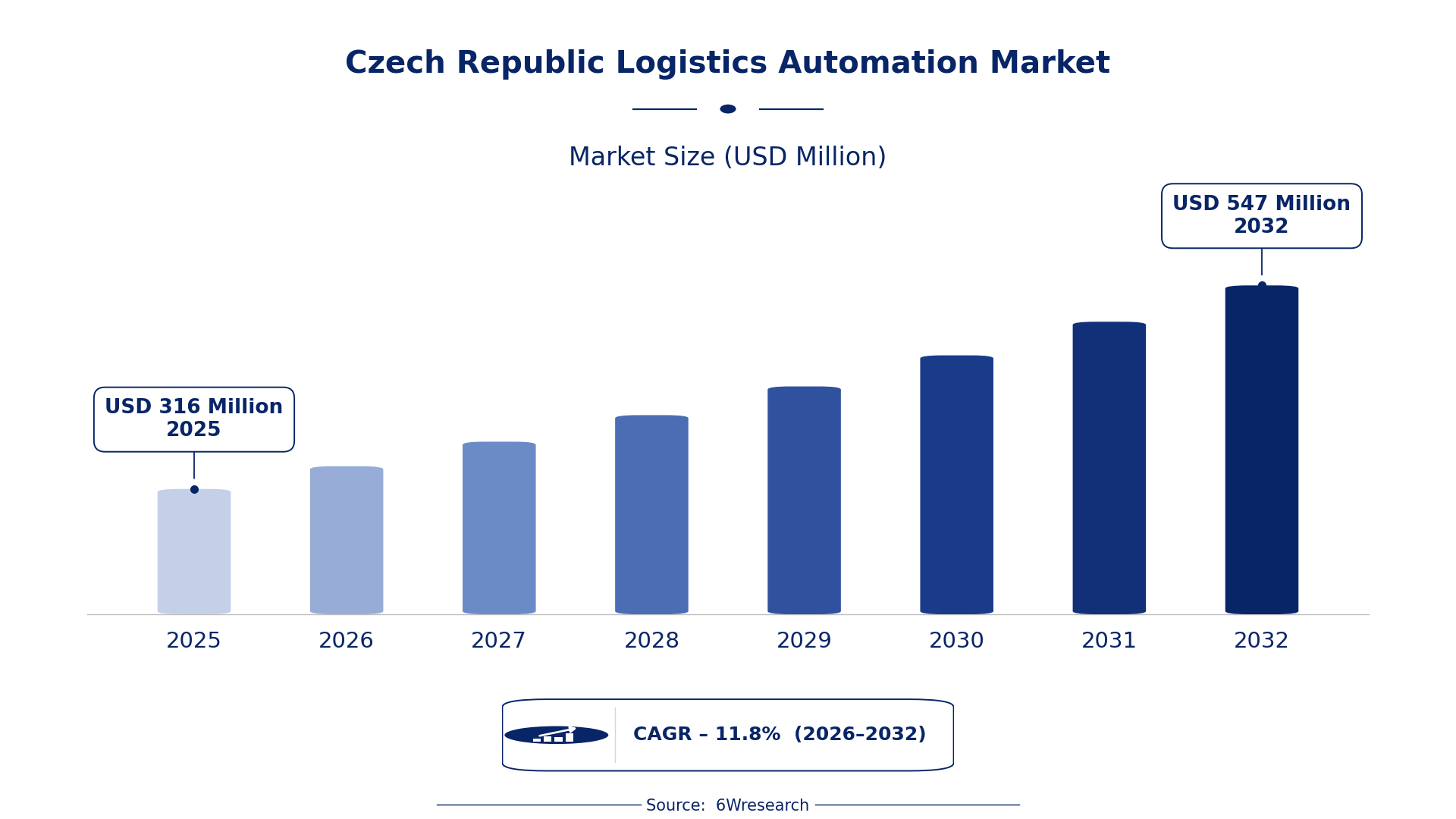
The Czech Republic Logistics Automation Market was estimated at USD 316 Million in 2025 and is projected to reach USD 547 Million by 2032, growing at a CAGR of 11.8% from 2026 to 2032.
Czech Republic Logistics Automation Market Synopsis
The logistics automation sector in the Czech Republic is witnessing a surge in demand, driven by the urgency for operational efficiency and cost savings. As businesses increasingly adopt automation technologies, the trajectory indicates a promising future for this market, with expectations for sustained growth.
With the rise of e-commerce and consumer expectations for rapid delivery, companies are compelled to optimize their supply chain processes. This shift not only enhances productivity but also presents a ripe environment for technology providers aiming to capitalize on emerging opportunities.
Czech Republic Logistics Automation Market Year-wise Growth Rate and Key Drivers
This graph illustrates the annual growth rates of the Czech Republic Logistics Automation Market from 2021 to 2032, highlighting a steady upward trajectory and projected expansion over the forecast period.
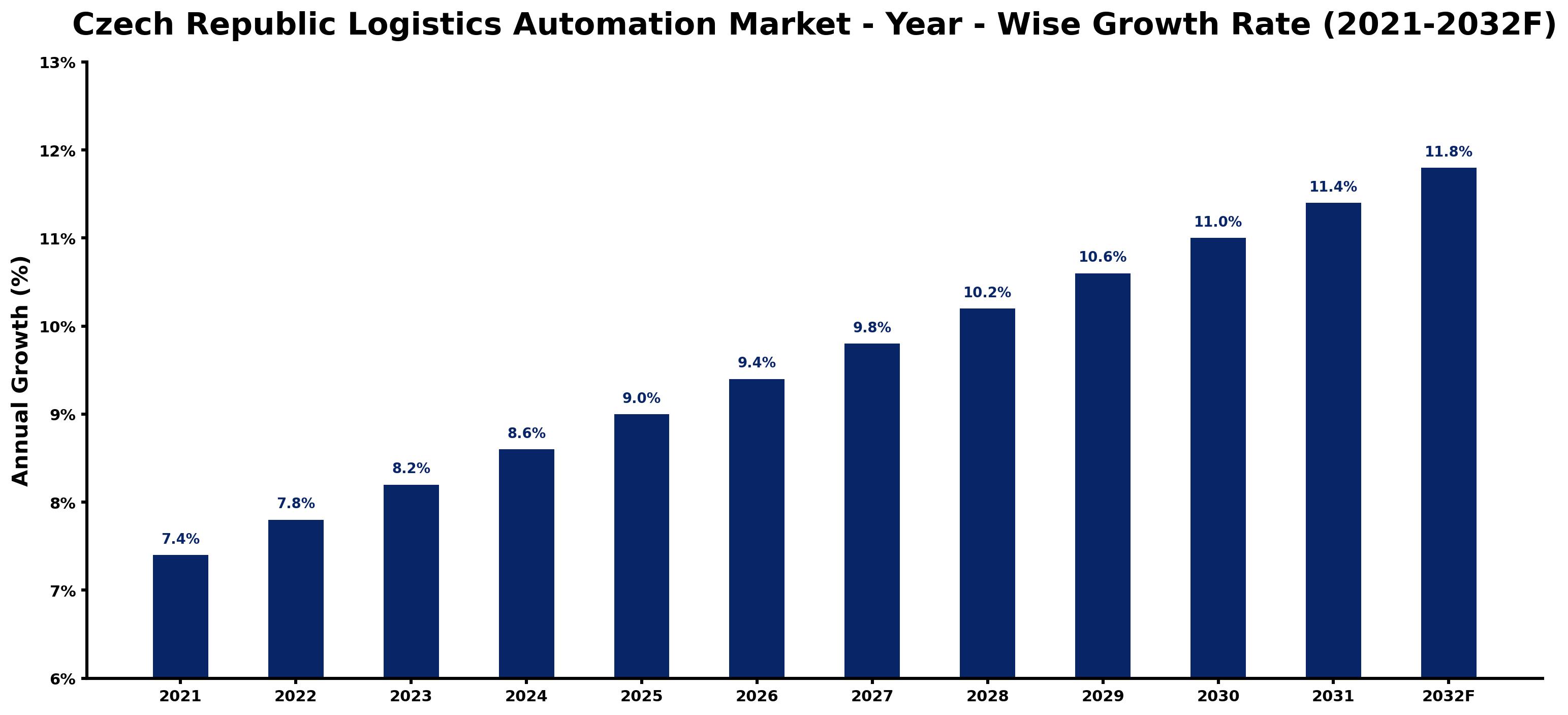
The table below presents the year‑wise growth rates along with the key drivers influencing the market
| Year | Growth Rate | Major Drivers |
| 2021 | 7.4% | Increased demand for automation in warehouse management. |
| 2022 | 7.8% | Czech government funding for smart logistics technology. |
| 2023 | 8.2% | Surge in e-commerce driving automated delivery solutions. |
| 2024 | 8.6% | Growing workforce shortages prompt logistics automation investments. |
| 2025 | 9.0% | Regional trade agreements boosting logistics efficiency innovations. |
| 2026 | 9.4% | Introduction of advanced robotics in local logistics centers. |
| 2027 | 9.8% | Rise of AI-driven logistics optimization software in Czech firms. |
| 2028 | 10.2% | Supportive regulations for drone deliveries in urban areas. |
| 2029 | 10.6% | Growing focus on sustainability in logistics sector operations. |
| 2030 | 11.0% | Emergence of Czech startups in logistics tech innovation. |
| 2031 | 11.4% | Increased foreign investments in automated logistics systems. |
| 2032 | 11.8% | Advanced telematics systems enhancing urban logistics strategies. |
Note: Market size estimations and growth projections presented in this report are based on 6Wresearch's proprietary forecasting methodology, utilizing the latest available industry data, government publications, and primary research inputs.
Czech Republic Logistics Automation Market Key Takeaways
Below are some of the specific key takeaways from the market, including:
- Growing demand for automation technologies in logistics driven by e-commerce expansion.
- Investment in AI, robotics, and IoT is reshaping logistics operations.
- Government initiatives are fostering the adoption of automation solutions across industries.
- Challenges include workforce adaptation and integration with existing systems.
- The market is expected to see substantial growth, with a projected CAGR of 9.6% from 2026 to 2032.
Evaluation of Restraints in Czech Republic Logistics Automation Market
Despite the growth potential, the Czech Republic Logistics Automation Market faces several restraints. A primary concern is the integration of new automated systems with established operations. This requires not only financial investment but also a cultural shift within organizations. Training employees and managing change effectively are crucial to overcoming resistance to automation, which can hinder adoption rates. Additionally, fears around job displacement may also contribute to reluctance among the workforce, creating a complex challenge for companies aiming to implement automation.
Czech Republic Logistics Automation Market Trends
Several trends are shaping the Czech Republic Logistics Automation Market. First, the increasing reliance on data analytics is driving companies to adopt more sophisticated automation solutions that improve decision-making processes. Second, sustainability is becoming a priority, with businesses seeking automation technologies that minimize environmental impact. Finally, the rise of collaborative robotics is enabling more flexible and adaptive warehouse environments, further enhancing efficiency.
Czech Republic Logistics Automation Market Opportunities
Opportunities in the logistics automation sector are abundant. Companies are looking to invest in advanced technologies that can streamline operations, reduce costs, and improve customer satisfaction. The growing focus on digital transformation provides a fertile ground for innovative solutions in supply chain management. Additionally, as the market evolves, partnerships between technology providers and logistics firms will likely present new avenues for growth.
Government Initiatives in the Czech Republic Logistics Automation Market
The Czech government's approach to logistics automation is characterized by a commitment to enhancing supply chain efficiency and competitiveness through policy support. Recent initiatives are focused on encouraging investments in smart logistics systems that streamline transportation and inventory management. This proactive regulatory environment is crucial for driving the adoption of automation technologies in the market.
- A national digital infrastructure upgrade programme aimed at enhancing logistics capabilities, recently completed in early 2025.
- Current initiatives promoting public-private partnerships to foster innovation in logistics automation technologies.
- A regulatory framework introduced in 2025 to incentivize companies adopting automation solutions.
- Ongoing funding initiatives from the government to support research and development in logistics automation.
- Upcoming plans to launch a nationwide campaign to train the workforce on new automation technologies by 2026.
Future Insights of the Czech Republic Logistics Automation Market
Looking ahead to 2026-2032, the Czech Republic Logistics Automation Market is set to evolve significantly. The increasing pace of digital transformation will drive further investments in automation technologies, resulting in enhanced efficiency across supply chains. As businesses adapt to consumer demands for faster and more accurate delivery, those who embrace automation will likely find themselves at a competitive advantage. The emphasis on sustainability will also shape the future direction of logistics automation, with eco-friendly practices becoming integral to operational strategies.
Czech Republic Logistics Automation Market Latest Developments
In the past year, the Czech Republic Logistics Automation Market has seen various developments reflecting the sector's dynamic nature. Companies are increasingly prioritizing automation as they recognize its potential to optimize operations and reduce costs. This period has been marked by a flurry of activity as firms adapt to changing market conditions and consumer expectations.
- A leading regional operator launched a state-of-the-art robotics system in Q2 2025, enhancing order fulfillment capabilities.
- An initiative that began in mid-2025 and remains underway is focused on integrating AI-driven analytics into existing logistics platforms.
- A major technology vendor is expected to roll out a new automated inventory management solution by late 2026, aimed at improving efficiency.
- Partnerships between logistics firms and tech startups have been established to explore innovative automation solutions, currently underway.
- Research and development efforts to introduce sustainable logistics automation solutions are expected to ramp up in early 2026.
Czech Republic Logistics Automation Market - Key Attractiveness of the Report
- 10 Years of Market Numbers
- Historical Data Starting from 2022 to 2025
- Base Year: 2025
- Forecast Data until 2032
- Key Performance Indicators Impacting the Market
- Major Upcoming Developments and Projects
Key Highlights of the Report:
- Czech Republic Logistics Automation Market Outlook
- Market Size of Czech Republic Logistics Automation Market, 2025
- Forecast of Czech Republic Logistics Automation Market, 2032
- Historical Data and Forecast of Czech Republic Logistics Automation Revenues & Volume for the Period 2022-2032F
- Czech Republic Logistics Automation Market Trend Evolution
- Czech Republic Logistics Automation Market Drivers and Challenges
- Czech Republic Logistics Automation Price Trends
- Czech Republic Logistics Automation Porter's Five Forces
- Czech Republic Logistics Automation Industry Life Cycle
- Historical Data and Forecast of Czech Republic Logistics Automation Market Revenues & Volume By Function for the Period 2022-2032F
- Historical Data and Forecast of Czech Republic Logistics Automation Market Revenues & Volume By Inventory and Storage Management for the Period 2022-2032F
- Historical Data and Forecast of Czech Republic Logistics Automation Market Revenues & Volume By Transportation logistics for the Period 2022-2032F
- Historical Data and Forecast of Czech Republic Logistics Automation Market Revenues & Volume By Vertical for the Period 2022-2032F
- Historical Data and Forecast of Czech Republic Logistics Automation Market Revenues & Volume By Retail & eCommerce for the Period 2022-2032F
- Historical Data and Forecast of Czech Republic Logistics Automation Market Revenues & Volume By Manufacturing for the Period 2022-2032F
- Historical Data and Forecast of Czech Republic Logistics Automation Market Revenues & Volume By Healthcare & Pharmaceuticals for the Period 2022-2032F
- Historical Data and Forecast of Czech Republic Logistics Automation Market Revenues & Volume By Food & Beverages for the Period 2022-2032F
- Historical Data and Forecast of Czech Republic Logistics Automation Market Revenues & Volume By Automotive for the Period 2022-2032F
- Historical Data and Forecast of Czech Republic Logistics Automation Market Revenues & Volume By Aerospace and Defense for the Period 2022-2032F
- Historical Data and Forecast of Czech Republic Logistics Automation Market Revenues & Volume By Chemicals for the Period 2022-2032F
- Historical Data and Forecast of Czech Republic Logistics Automation Market Revenues & Volume By Other Verticals (paper and printing, and textiles and clothing) for the Period 2022-2032F
- Historical Data and Forecast of Czech Republic Logistics Automation Market Revenues & Volume By Organization Size for the Period 2022-2032F
- Historical Data and Forecast of Czech Republic Logistics Automation Market Revenues & Volume By SMES for the Period 2022-2032F
- Historical Data and Forecast of Czech Republic Logistics Automation Market Revenues & Volume By Large Enterprises for the Period 2022-2032F
- Historical Data and Forecast of Czech Republic Logistics Automation Market Revenues & Volume By Logistics Type for the Period 2022-2032F
- Historical Data and Forecast of Czech Republic Logistics Automation Market Revenues & Volume By Sales Logistics for the Period 2022-2032F
- Historical Data and Forecast of Czech Republic Logistics Automation Market Revenues & Volume By Production Logistics for the Period 2022-2032F
- Historical Data and Forecast of Czech Republic Logistics Automation Market Revenues & Volume By Recovery Logistics for the Period 2022-2032F
- Historical Data and Forecast of Czech Republic Logistics Automation Market Revenues & Volume By Procurement Logistics for the Period 2022-2032F
- Historical Data and Forecast of Czech Republic Logistics Automation Market Revenues & Volume By Software Application for the Period 2022-2032F
- Historical Data and Forecast of Czech Republic Logistics Automation Market Revenues & Volume By Inventory Management for the Period 2022-2032F
- Historical Data and Forecast of Czech Republic Logistics Automation Market Revenues & Volume By Order Management for the Period 2022-2032F
- Historical Data and Forecast of Czech Republic Logistics Automation Market Revenues & Volume By Yard Management for the Period 2022-2032F
- Historical Data and Forecast of Czech Republic Logistics Automation Market Revenues & Volume By Shipping Management for the Period 2022-2032F
- Historical Data and Forecast of Czech Republic Logistics Automation Market Revenues & Volume By Labor Management for the Period 2022-2032F
- Historical Data and Forecast of Czech Republic Logistics Automation Market Revenues & Volume By Vendor Management for the Period 2022-2032F
- Historical Data and Forecast of Czech Republic Logistics Automation Market Revenues & Volume By Customer Support for the Period 2022-2032F
- Czech Republic Logistics Automation Import Export Trade Statistics
- Market Opportunity Assessment By Function
- Market Opportunity Assessment By Vertical
- Market Opportunity Assessment By Organization Size
- Market Opportunity Assessment By Logistics Type
- Market Opportunity Assessment By Software Application
- Czech Republic Logistics Automation Top Companies Market Share
- Czech Republic Logistics Automation Competitive Benchmarking By Technical and Operational Parameters
- Czech Republic Logistics Automation Company Profiles
- Czech Republic Logistics Automation Key Strategic Recommendations






































