Czech Republic Molecular Spectroscopy Market Size, Share & Growth Rate
The Czech Republic Molecular Spectroscopy Market was estimated at USD 495 Million in 2025 and is projected to reach USD 680 Million by 2032, growing at a CAGR of 4.6% from 2026 to 2032. This growth trajectory is primarily propelled by the increasing investments in R&D within the pharmaceutical and biotechnology sectors. Additionally, the burgeoning demand for advanced spectroscopic technologies is driving applications across various industries, enhancing drug discovery, material analysis, and environmental monitoring.
Czech Republic Molecular Spectroscopy Market Year-wise Growth Rate and Key Drivers
This graph highlights how the Czech Republic Molecular Spectroscopy Market has steadily grown over the years, supported by major growth factors.
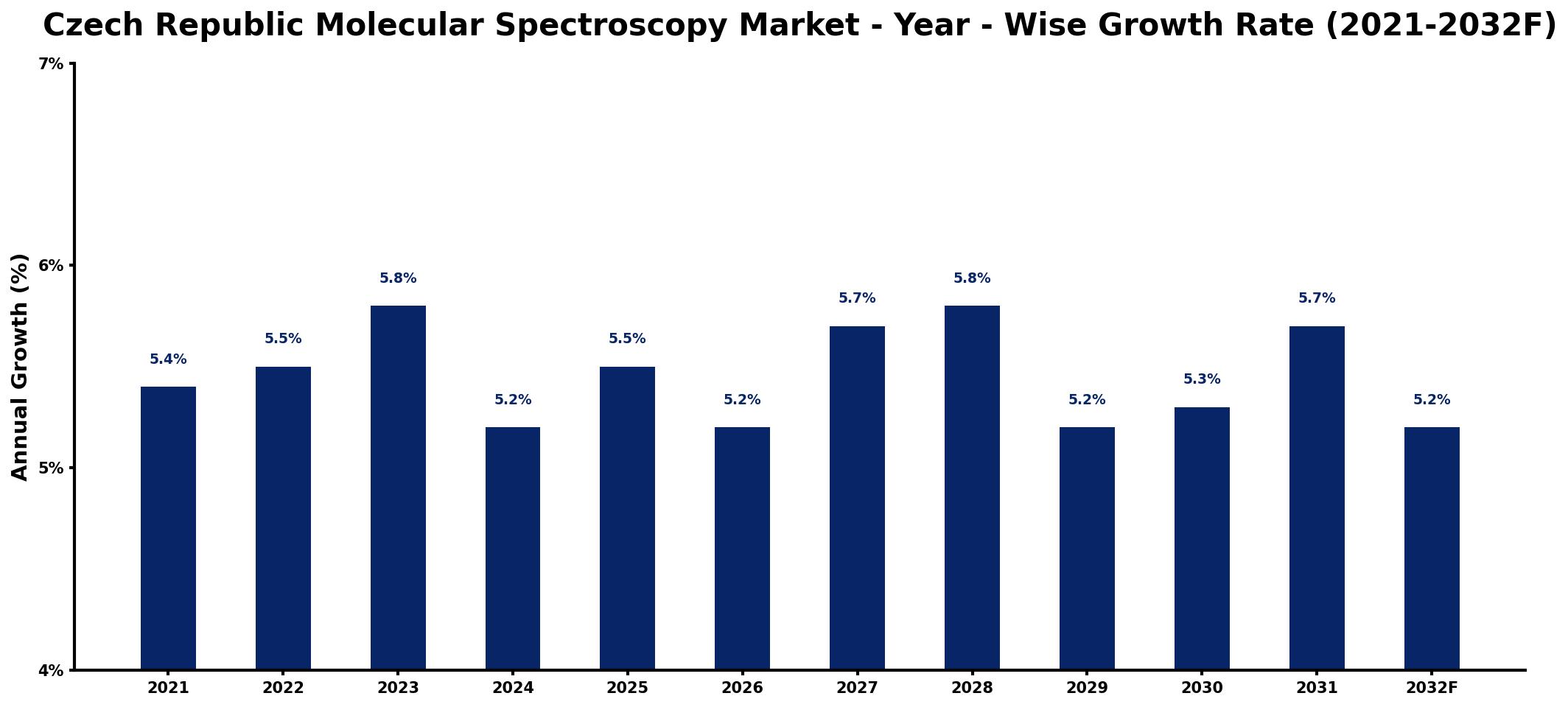
The table below presents the year‑wise growth rates along with the key drivers influencing the market
| Year | Growth Rate | Major Drivers |
| 2021 | 5.4% | Rising demand in pharmaceuticals sector |
| 2022 | 5.5% | Increased investments in research facilities |
| 2023 | 5.8% | Growth in environmental monitoring applications |
| 2024 | 5.2% | Expansion of biotechnology research initiatives |
| 2025 | 5.5% | Surge in educational program funding |
| 2026 | 5.2% | growing regional consumption patterns |
| 2027 | 5.7% | Increased adoption in clinical diagnostics |
| 2028 | 5.8% | Development of advanced analytical techniques |
| 2029 | 5.2% | Rising importance of quality control |
| 2030 | 5.3% | growing automotive sector requirements |
| 2031 | 5.7% | increased capital investment inflows |
| 2032 | 5.2% | Increased focus on personalized medicine |
Note: Market size estimations and growth projections presented in this report are based on 6Wresearch's proprietary forecasting methodology, utilizing the latest available industry data, government publications, and primary research inputs.
Czech Republic Molecular Spectroscopy Market Synopsis
The Czech Republic is witnessing a robust evolution in its molecular spectroscopy market, marked by significant technological advancements. Increasing applications of infrared spectroscopy, nuclear magnetic resonance (NMR), and UV-Visible spectroscopy in diverse sectors are further igniting market growth.
The demand for these sophisticated analytical tools is rooted in their effectiveness for applications such as quality control and process monitoring in pharmaceuticals, food safety, and environmental assessments. As local players innovate and adapt to global trends, the market stands to benefit significantly from collaborative efforts with academic institutions and research organizations.
Czech Republic Molecular Spectroscopy Market Key Takeaways
- Steady market growth fueled by increased R&D investment in pharmaceuticals and biotechnology.
- Growing applications for advanced spectroscopic techniques like Raman and FTIR spectroscopy.
- Emerging trends towards portable spectroscopy solutions for on-site analysis and rapid testing.
- Government support fostering innovation and partnerships within the scientific community.
- Investment opportunities abound, especially in companies and institutions focused on spectroscopy technologies.
Evaluation of Restraints in Czech Republic Molecular Spectroscopy Market
Despite its promising outlook, the Czech Republic molecular spectroscopy market faces notable restraints that could hinder growth. Limited funding for research and development poses a significant barrier to adopting advanced spectroscopic technologies. Moreover, the lack of skilled professionals specializing in molecular spectroscopy creates a knowledge gap that can stifle innovation. The market also contends with competition from international firms, which can overshadow local companies striving to establish themselves. Furthermore, navigating stringent regulatory requirements necessitates considerable investment to ensure compliance, potentially diverting resources from further advancements.
Czech Republic Molecular Spectroscopy Market Trends
Current trends in the Czech Republic's molecular spectroscopy market indicate a robust shift towards automation and the miniaturization of spectroscopic tools. The integration of spectroscopy with complementary analytical methods such as chromatography and mass spectrometry is gaining traction, enhancing analytical capabilities significantly. The demand for portable and handheld spectroscopic devices is also on the rise, driven by the need for rapid, on-site testing in various applications. These trends suggest a market that is not only adapting but evolving to meet the diverse requirements of its user base.
Czech Republic Molecular Spectroscopy Market Opportunities
The landscape for investment within the Czech Republic molecular spectroscopy market is rich with opportunities. The increasing emphasis on research and development in critical sectors, particularly pharmaceuticals and environmental monitoring, underscores the high demand for cutting-edge spectroscopy solutions. Investors can capitalize on the potential of companies specializing in manufacturing spectroscopy instruments and software, as well as research institutions that leverage these technologies for innovative applications. Additionally, forming strategic partnerships with local universities and research facilities can lead to collaborative innovations that strengthen market positions.
Government Initiatives in the Czech Republic Molecular Spectroscopy Market
Government policies play a pivotal role in shaping the Czech Republic molecular spectroscopy market. There are ongoing initiatives aimed at promoting research and development, evidenced by funding and support directed towards academic and research organizations engaged in spectroscopy-related studies. Regulatory frameworks are established to ensure safety and accuracy in spectroscopy practices, ensuring that market players adhere to high standards. By encouraging collaborative efforts between industry leaders and research institutions, these government policies create a fertile environment for technological advancements and innovation.
Future Insights of the Czech Republic Molecular Spectroscopy Market
Looking ahead, the Czech Republic molecular spectroscopy market is set to thrive from 2026 to 2032, buoyed by ongoing advancements in technology and heightened R&D activities across multiple sectors. The increasing focus on stringent quality control and safety regulations will further fuel the market, particularly within pharmaceuticals and food and beverage industries. Additionally, as environmental monitoring and forensic applications of spectroscopy continue to expand, the market presents a multitude of pathways for growth. The presence of key players coupled with relentless innovation signifies a dynamic future for this sector.
Czech Republic Molecular Spectroscopy Market Latest Developments (2025 - 2026)
Recent developments within the Czech Republic molecular spectroscopy market illustrate a focus on the integration of advanced technologies. There has been a notable uptick in partnerships between research institutions and industry stakeholders aimed at developing novel spectroscopy applications. Furthermore, innovations in portable devices and miniaturized solutions have gained traction, reflecting a growing demand for flexible analytical tools. The market is also witnessing increased collaborations to enhance the capabilities of existing technologies, paving the way for new applications and improved performance standards.
Czech Republic Molecular Spectroscopy Market - Key Attractiveness of the Report
- 10 Years of Market Numbers
- Historical Data Starting from 2022 to 2025
- Base Year: 2025
- Forecast Data until 2032
- Key Performance Indicators Impacting the Market
- Major Upcoming Developments and Projects
Key Highlights of the Report:
- Czech Republic Molecular Spectroscopy Market Outlook
- Market Size of Czech Republic Molecular Spectroscopy Market, 2025
- Forecast of Czech Republic Molecular Spectroscopy Market, 2032
- Historical Data and Forecast of Czech Republic Molecular Spectroscopy Revenues & Volume for the Period 2022-2032F
- Czech Republic Molecular Spectroscopy Market Trend Evolution
- Czech Republic Molecular Spectroscopy Market Drivers and Challenges
- Czech Republic Molecular Spectroscopy Price Trends
- Czech Republic Molecular Spectroscopy Porter's Five Forces
- Czech Republic Molecular Spectroscopy Industry Life Cycle
- Historical Data and Forecast of Czech Republic Molecular Spectroscopy Market Revenues & Volume By Type of Spectroscopy for the Period 2022-2032F
- Historical Data and Forecast of Czech Republic Molecular Spectroscopy Market Revenues & Volume By NMR Spectroscopy for the Period 2022-2032F
- Historical Data and Forecast of Czech Republic Molecular Spectroscopy Market Revenues & Volume By Raman Spectroscopy for the Period 2022-2032F
- Historical Data and Forecast of Czech Republic Molecular Spectroscopy Market Revenues & Volume By UV-visible Spectroscopy for the Period 2022-2032F
- Historical Data and Forecast of Czech Republic Molecular Spectroscopy Market Revenues & Volume By Mass Spectroscopy for the Period 2022-2032F
- Historical Data and Forecast of Czech Republic Molecular Spectroscopy Market Revenues & Volume By Infrared Spectroscopy for the Period 2022-2032F
- Historical Data and Forecast of Czech Republic Molecular Spectroscopy Market Revenues & Volume By Near-infrared Spectroscopy for the Period 2022-2032F
- Historical Data and Forecast of Czech Republic Molecular Spectroscopy Market Revenues & Volume By Others for the Period 2022-2032F
- Historical Data and Forecast of Czech Republic Molecular Spectroscopy Market Revenues & Volume By Application for the Period 2022-2032F
- Historical Data and Forecast of Czech Republic Molecular Spectroscopy Market Revenues & Volume By Pharmaceutical Applications for the Period 2022-2032F
- Historical Data and Forecast of Czech Republic Molecular Spectroscopy Market Revenues & Volume By Food and Beverage Testing for the Period 2022-2032F
- Historical Data and Forecast of Czech Republic Molecular Spectroscopy Market Revenues & Volume By Biotechnology and Biopharmaceutical Applications for the Period 2022-2032F
- Historical Data and Forecast of Czech Republic Molecular Spectroscopy Market Revenues & Volume By Environmental Testing for the Period 2022-2032F
- Historical Data and Forecast of Czech Republic Molecular Spectroscopy Market Revenues & Volume By Academic Research for the Period 2022-2032F
- Historical Data and Forecast of Czech Republic Molecular Spectroscopy Market Revenues & Volume By Other for the Period 2022-2032F
- Czech Republic Molecular Spectroscopy Import Export Trade Statistics
- Market Opportunity Assessment By Type of Spectroscopy
- Market Opportunity Assessment By Application
- Czech Republic Molecular Spectroscopy Top Companies Market Share
- Czech Republic Molecular Spectroscopy Competitive Benchmarking By Technical and Operational Parameters
- Czech Republic Molecular Spectroscopy Company Profiles
- Czech Republic Molecular Spectroscopy Key Strategic Recommendations






































