Czech Republic Nickel Market Size (2020-2030)
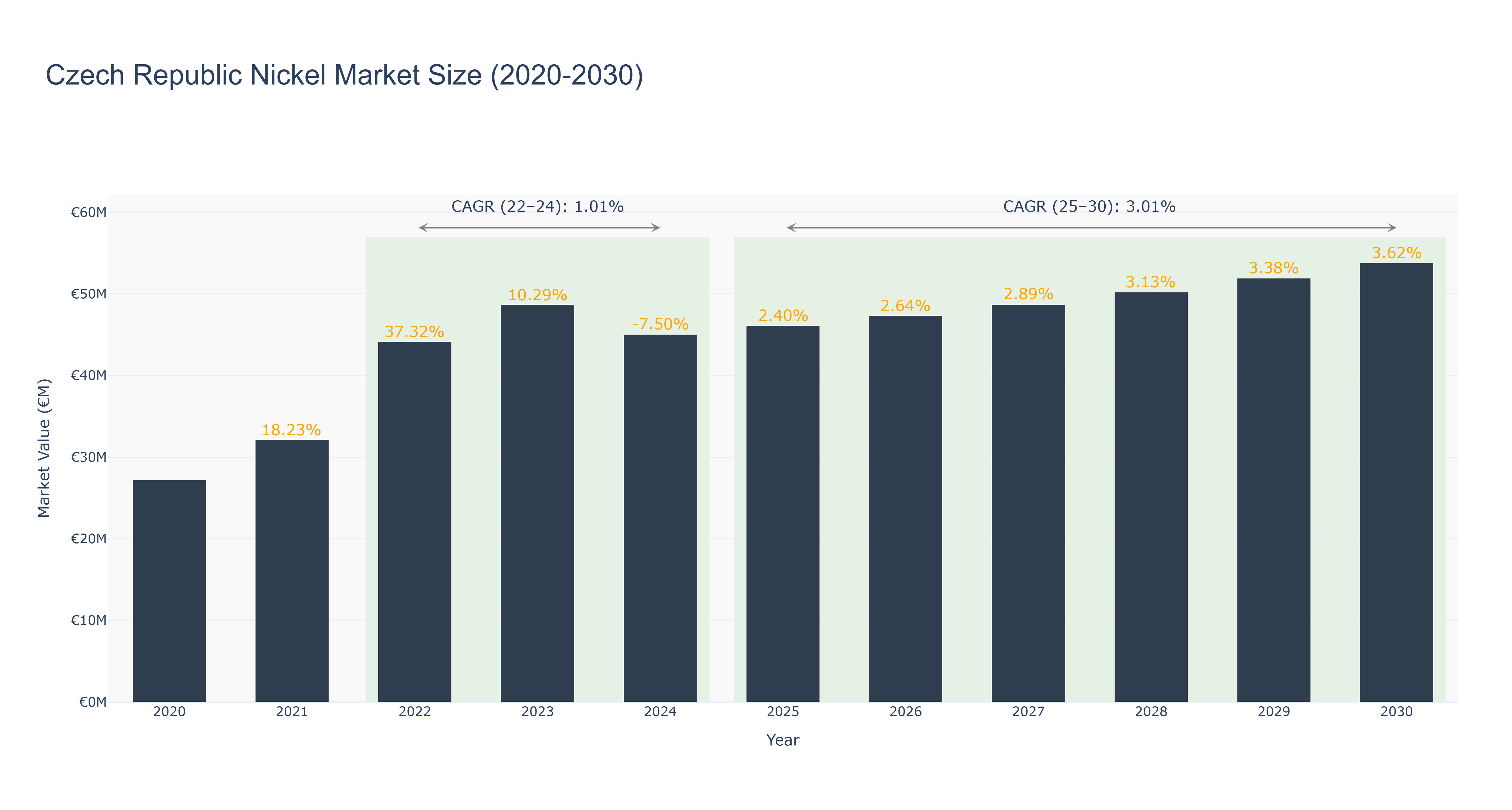
Czech Republic Nickel Market has shown a steady growth trend over the years. The peak market size of €53.80 million is forecasted for 2030, with a CAGR of 3.62% from 2025 to 2030. The market experienced a slight dip in 2024 to €45.03 million due to a temporary downturn in global demand, but quickly rebounded. The recent CAGR from 2022 to 2024 was 1.01%, indicating a stable growth trajectory. Industry drivers such as technological advancements in nickel extraction and processing have contributed to the market's resilience. Looking ahead, upcoming mining projects in the Czech Republic are expected to further boost the nickel market, ensuring sustained growth and investment opportunities in the coming years.
Czech Republic Nickel Market: Production & Trade Performance (2019-2025)
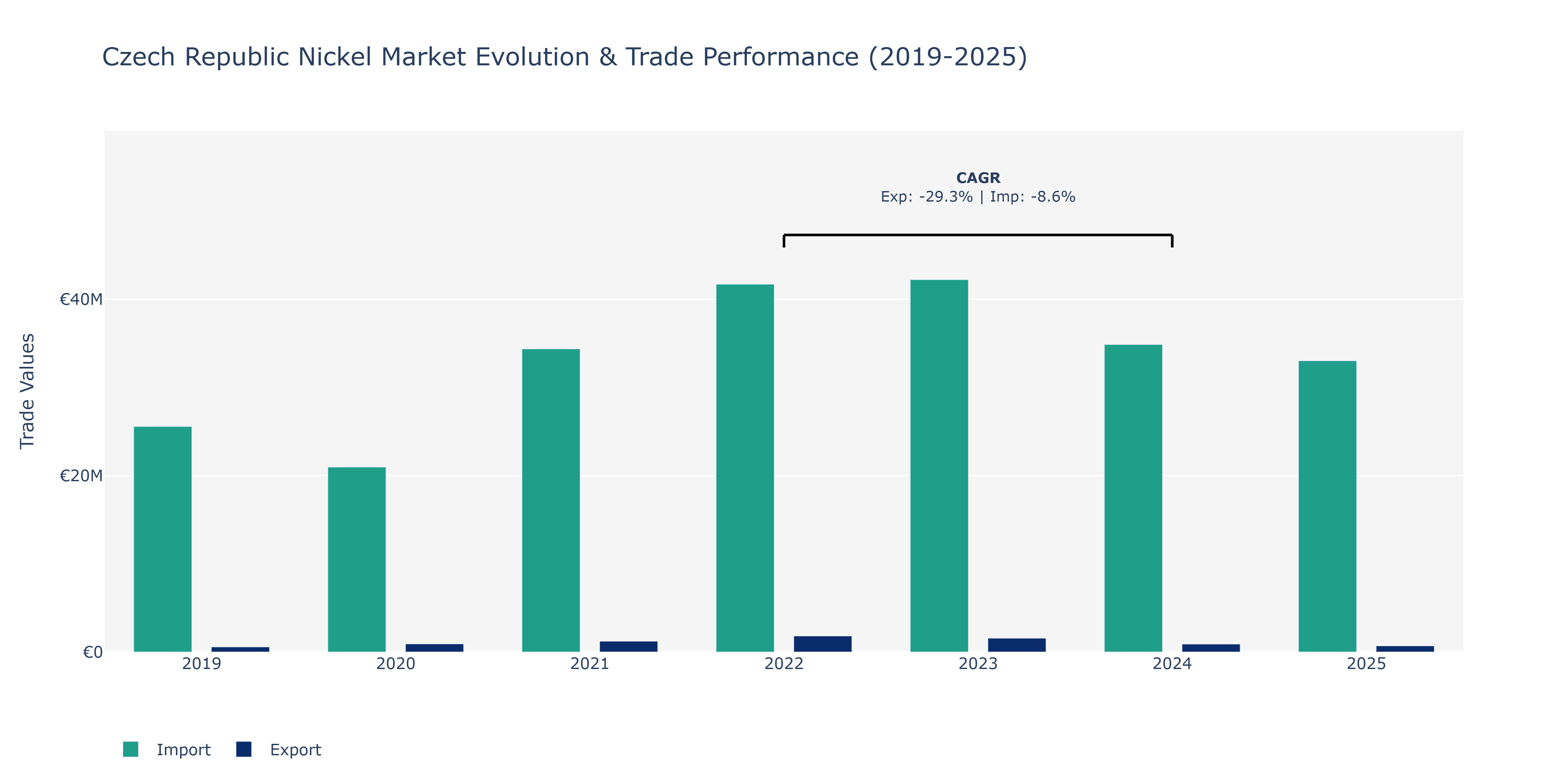
Between 2019 and 2025, the Czech Republic Nickel Market experienced fluctuations in both exports and imports. Exports saw a peak in 2022 at €1.82 million, followed by a notable decline to €910.28 thousand in 2024. This drop could be attributed to various factors such as changes in global demand, price volatility, or internal market dynamics affecting production levels. In contrast, imports followed a similar trend, peaking in 2023 at €42.24 million before decreasing slightly to €33.04 million in 2025. The decline in imports from 2023 to 2025 could be driven by factors like evolving trade agreements, changes in domestic consumption patterns, or advancements in local production capabilities. The fluctuations in both exports and imports highlight the market's sensitivity to external factors and the need for strategic planning to navigate uncertainties effectively.
Key Highlights of the Report:
- Czech Republic Nickel Market Outlook
- Market Size of Czech Republic Nickel Market, 2025
- Forecast of Czech Republic Nickel Market, 2032
- Historical Data and Forecast of Czech Republic Nickel Revenues & Volume for the Period 2022 - 2032F
- Czech Republic Nickel Market Trend Evolution
- Czech Republic Nickel Market Drivers and Challenges
- Czech Republic Nickel Price Trends
- Czech Republic Nickel Porter's Five Forces
- Czech Republic Nickel Industry Life Cycle
- Historical Data and Forecast of Czech Republic Nickel Market Revenues & Volume By Applications for the Period 2022 - 2032F
- Historical Data and Forecast of Czech Republic Nickel Market Revenues & Volume By Stainless Steel for the Period 2022 - 2032F
- Historical Data and Forecast of Czech Republic Nickel Market Revenues & Volume By Super Magnets for the Period 2022 - 2032F
- Historical Data and Forecast of Czech Republic Nickel Market Revenues & Volume By Electroplating Chemicals for the Period 2022 - 2032F
- Historical Data and Forecast of Czech Republic Nickel Market Revenues & Volume By Rechargeable Batteries for the Period 2022 - 2032F
- Historical Data and Forecast of Czech Republic Nickel Market Revenues & Volume By Others for the Period 2022 - 2032F
- Czech Republic Nickel Import Export Trade Statistics
- Market Opportunity Assessment By Applications
- Czech Republic Nickel Top Companies Market Share
- Czech Republic Nickel Competitive Benchmarking By Technical and Operational Parameters
- Czech Republic Nickel Company Profiles
- Czech Republic Nickel Key Strategic Recommendations






































