Czech Republic Organic Food Market Size, Share & Growth Rate
The Czech Republic Organic Food Market was estimated at USD 1198 Million in 2025 and is projected to reach USD 1739 Million by 2032, growing at a CAGR of 5.5% from 2026 to 2032. This impressive growth trajectory is primarily driven by increasing consumer awareness regarding health, environmental sustainability, and a preference for high-quality food products. As consumers shift towards organic options, the market is expected to benefit from growing access to organic food retailers and a wider variety of offerings.
Czech Republic Organic Food Market Year-wise Growth Rate and Key Drivers
This graph highlights how the Czech Republic Organic Food Market has steadily grown over the years, supported by major growth factors.
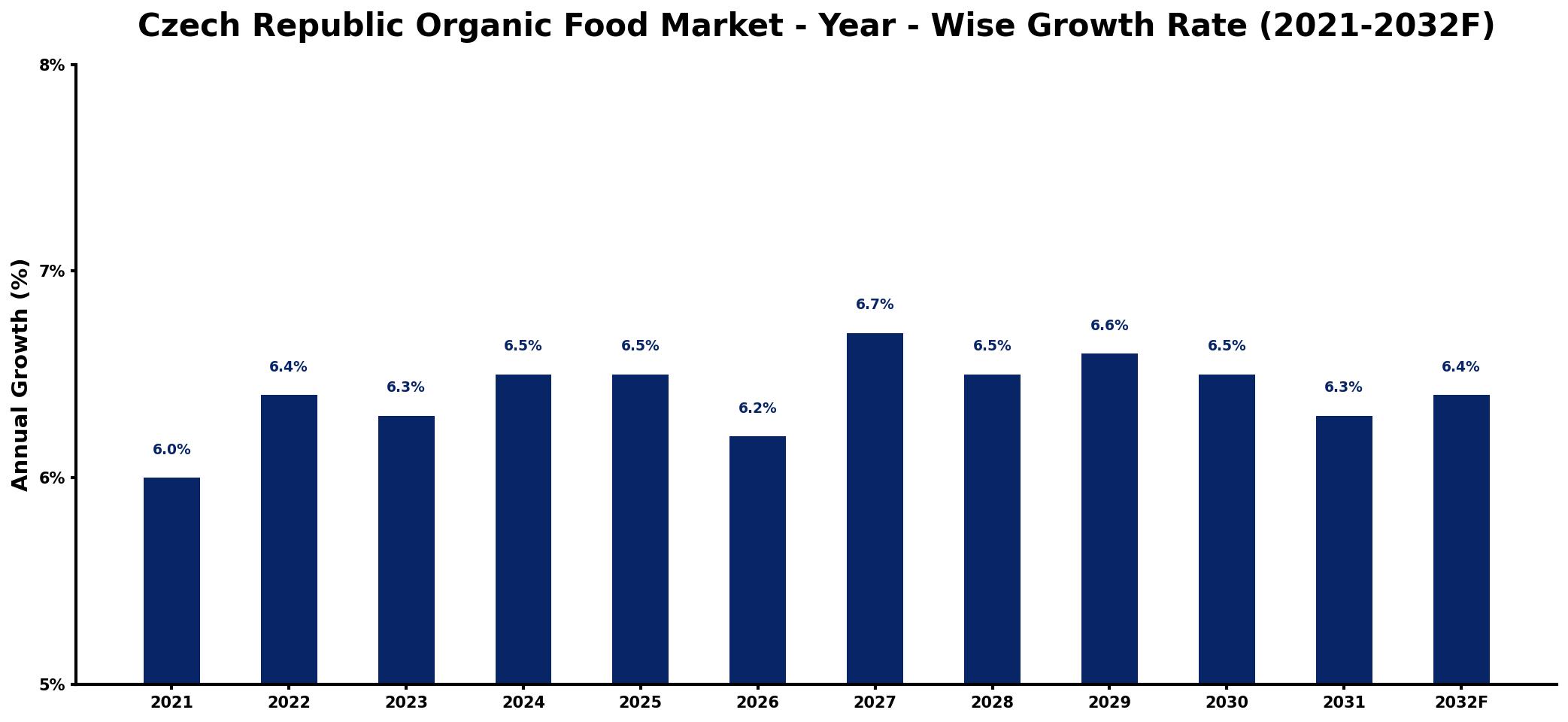
The table below presents the year‑wise growth rates along with the key drivers influencing the market
| Year | Growth Rate | Major Drivers |
| 2021 | 6.0% | Rising consumer health consciousness |
| 2022 | 6.4% | Increased availability in stores |
| 2023 | 6.3% | Growing online shopping trends |
| 2024 | 6.5% | Expansion of local farmers' markets |
| 2025 | 6.5% | Investment in sustainable practices |
| 2026 | 6.2% | Enhanced product labeling regulations |
| 2027 | 6.7% | Increase in eco-friendly packaging |
| 2028 | 6.5% | Broader distribution channels emerging |
| 2029 | 6.6% | Higher demand for clean labels |
| 2030 | 6.5% | Strengthened awareness through campaigns |
| 2031 | 6.3% | Growing interest in plant-based diets |
| 2032 | 6.4% | More certifications for sustainability |
Note: Market size estimations and growth projections presented in this report are based on 6Wresearch's proprietary forecasting methodology, utilizing the latest available industry data, government publications, and primary research inputs.
Czech Republic Organic Food Market Synopsis
The most significant force currently shaping the Czech Republic Organic Food Market is the rising consumer consciousness about health and sustainability. This change in consumer behavior is steering demand toward organic fruits, vegetables, dairy products, and meat, as individuals prioritize their well-being and the environment.
Additionally, the market is expanding due to increased availability of organic products through various channels, including specialty stores, supermarkets, and online platforms. The increasing presence of organic food stores and farmers markets is enhancing consumers access to diverse organic offerings.
Czech Republic Organic Food Market Key Takeaways
- The organic food segment is rapidly growing as consumers seek healthier and sustainably produced options.
- Government support through subsidies and incentives is enhancing market growth potential.
- There is a notable trend towards local and regional organic food producers, appealing to consumers seeking traceable supply chains.
- Online shopping for organic products is gaining popularity, reflecting changing consumer purchasing habits.
- Increasing disposable incomes are influencing consumers to invest in higher-quality, organic food choices.
Evaluation of Restraints in Czech Republic Organic Food Market
Despite promising growth, the Czech Republic Organic Food Market faces several constraints. A relatively low level of consumer awareness and understanding of organic products has resulted in limited market demand. Price sensitivity is another challenge, with many consumers perceiving organic foods as significantly more expensive than conventional alternatives. Furthermore, an underdeveloped distribution network hampers access to organic goods, while the fragmented supply chain leads to inconsistent product availability. These limitations create hurdles that prevent the market from fully realizing its potential.
Czech Republic Organic Food Market Trends
Emerging trends in the Czech Republic Organic Food Market highlight a diversification of product offerings. Consumers are increasingly interested in not just fresh produce but also organic packaged goods and ready-to-eat meals. Moreover, the push for greater transparency is compelling brands to adopt clear labeling and demonstrate their sustainable practices. As digital commerce continues to evolve, online platforms are becoming essential for consumer engagement and product availability, further driving demand.
Czech Republic Organic Food Market Opportunities
Investment opportunities abound in the Czech Republic Organic Food Market as the demand for organic products grows. Potential avenues for investment include organic farming, food processing, and developing distribution networks. Collaborations with local farmers can facilitate innovative product development. Furthermore, establishing dedicated retail outlets and enhancing online sales channels may position investors to capitalize on the upward market trend.
Government Initiatives in the Czech Republic Organic Food Market
The Czech government plays a supportive role in the organic food sector through various initiatives aimed at promoting organic agriculture. The Organic Farming Support Program incentivizes farmers to transition to organic practices, while strict certification regulations ensure that organic products meet high-quality standards. Moreover, funding for research and consumer education campaigns enhances public awareness of organic benefits, fostering a more informed consumer base.
Future Insights of the Czech Republic Organic Food Market
Looking ahead to 2026-2032, the Czech Republic Organic Food Market is poised for continued growth. As more consumers prioritize health and sustainability, the demand for organic options is expected to rise further. Increased disposable incomes, combined with government support for local producers, will likely create a favorable market environment. Innovative marketing strategies and expanded retail options will also contribute to a thriving organic food ecosystem in the coming years.
Czech Republic Organic Food Market Latest Developments (2025 - 2026)
Recent industry developments indicate a sustained focus on enhancing the organic food supply chain. Initiatives aimed at strengthening local organic farming practices have gained traction, alongside innovative collaborations between producers and retailers. Additionally, e-commerce platforms are increasingly integrating user-friendly features to streamline the purchase of organic products, reflecting a shift in consumer shopping behavior.
Czech Republic Organic Food Market - Key Attractiveness of the Report
- 10 Years of Market Numbers
- Historical Data Starting from 2022 to 2025
- Base Year: 2025
- Forecast Data until 2032
- Key Performance Indicators Impacting the Market
- Major Upcoming Developments and Projects
Key Highlights of the Report:
- Czech Republic Organic Food Market Outlook
- Market Size of Czech Republic Organic Food Market, 2025
- Forecast of Czech Republic Organic Food Market, 2032
- Historical Data and Forecast of Czech Republic Organic Food Revenues & Volume for the Period 2022-2032F
- Czech Republic Organic Food Market Trend Evolution
- Czech Republic Organic Food Market Drivers and Challenges
- Czech Republic Organic Food Price Trends
- Czech Republic Organic Food Porter's Five Forces
- Czech Republic Organic Food Industry Life Cycle
- Historical Data and Forecast of Czech Republic Organic Food Market Revenues & Volume By Food Type for the Period 2022-2032F
- Historical Data and Forecast of Czech Republic Organic Food Market Revenues & Volume By Fruit & Vegetables for the Period 2022-2032F
- Historical Data and Forecast of Czech Republic Organic Food Market Revenues & Volume By Meat for the Period 2022-2032F
- Historical Data and Forecast of Czech Republic Organic Food Market Revenues & Volume By Fish & Poultry for the Period 2022-2032F
- Historical Data and Forecast of Czech Republic Organic Food Market Revenues & Volume By Dairy Products for the Period 2022-2032F
- Historical Data and Forecast of Czech Republic Organic Food Market Revenues & Volume By Frozen & Processed Foods for the Period 2022-2032F
- Historical Data and Forecast of Czech Republic Organic Food Market Revenues & Volume By Others for the Period 2022-2032F
- Historical Data and Forecast of Czech Republic Organic Food Market Revenues & Volume By Application for the Period 2022-2032F
- Historical Data and Forecast of Czech Republic Organic Food Market Revenues & Volume By Commercial for the Period 2022-2032F
- Historical Data and Forecast of Czech Republic Organic Food Market Revenues & Volume By Cosmetics & Personal Care for the Period 2022-2032F
- Historical Data and Forecast of Czech Republic Organic Food Market Revenues & Volume By Households for the Period 2022-2032F
- Historical Data and Forecast of Czech Republic Organic Food Market Revenues & Volume By Others for the Period 2022-2032F
- Czech Republic Organic Food Import Export Trade Statistics
- Market Opportunity Assessment By Food Type
- Market Opportunity Assessment By Application
- Czech Republic Organic Food Top Companies Market Share
- Czech Republic Organic Food Competitive Benchmarking By Technical and Operational Parameters
- Czech Republic Organic Food Company Profiles
- Czech Republic Organic Food Key Strategic Recommendations






































