Czech Republic Oscillator Market: Import Trend Analysis
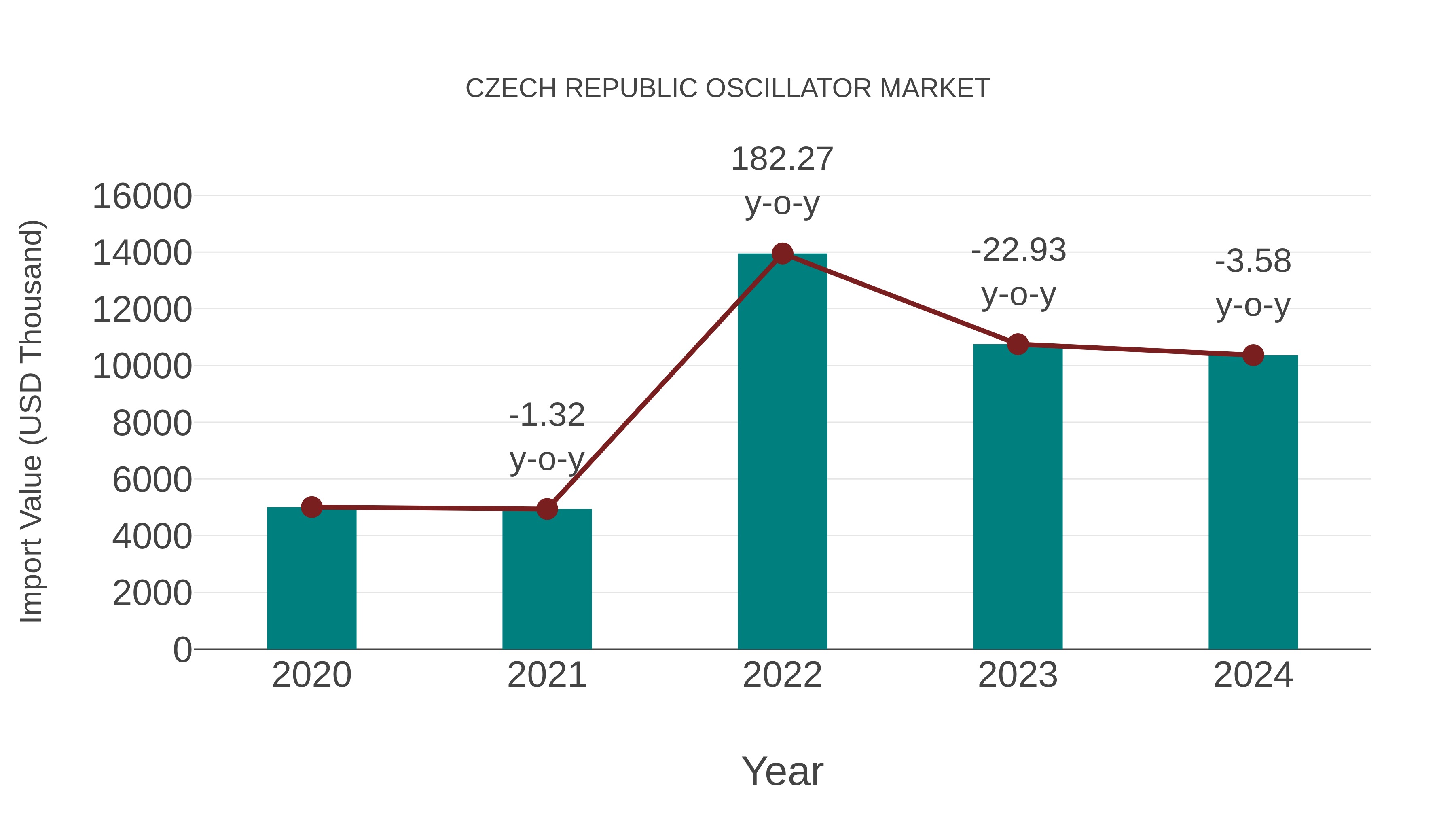
The Czech Republic oscillator market witnessed a robust growth in imports from 2020 to 2024, with a Compound Annual Growth Rate (CAGR) of 19.95%. Despite a slight decline in the year-on-year growth rate in 2023-2024 (-3.58%), the overall trend indicated a significant increase in imports during the period.
Czech Republic Oscillator Market Overview
The Czech Republic oscillator market is experiencing steady growth due to increasing demand for electronic devices across various industries such as automotive, telecommunications, and consumer electronics. The market is driven by advancements in technology, leading to the development of innovative and high-performance oscillators to meet the evolving requirements of end-users. Key players in the market are focusing on product innovation, strategic partnerships, and expansion of distribution channels to gain a competitive edge. The growing adoption of wireless communication technologies and the Internet of Things (IoT) is further fueling the demand for oscillators in the Czech Republic. With the rising trend of automation and digitization, the oscillator market in the Czech Republic is expected to witness continued growth in the coming years.
Czech Republic Oscillator Market Trends and Opportunities
The Czech Republic oscillator market is experiencing steady growth driven by increasing demand for precision timing solutions in various industries such as telecommunications, automotive, and healthcare. Key trends in the market include the rising adoption of MEMS oscillators for their compact size and low power consumption, as well as the growing popularity of advanced technologies like temperature-compensated oscillators (TCXOs) for improved frequency stability. Additionally, the emergence of 5G technology and Internet of Things (IoT) applications is expected to create new opportunities for oscillator manufacturers in the Czech Republic. With a focus on innovation and product development, companies in the market can capitalize on these trends to expand their market presence and cater to evolving customer needs.
Czech Republic Oscillator Market Challenges
In the Czech Republic Oscillator Market, challenges include intense competition from both domestic and international players, leading to pricing pressures and margin erosion. Additionally, keeping up with rapidly evolving technology and the need for continuous innovation to meet changing customer demands poses a challenge for market players. Regulatory compliance and adherence to quality standards also present hurdles, as failure to meet these requirements can result in penalties or loss of business opportunities. Furthermore, the impact of macroeconomic factors such as fluctuations in currency exchange rates and trade policies can affect market stability and growth prospects. Overall, navigating these challenges requires companies in the Czech Republic Oscillator Market to adopt strategic planning, efficient operations, and a customer-centric approach to stay competitive and sustain growth.
Czech Republic Oscillator Market Drivers
The Czech Republic oscillator market is primarily driven by the increasing adoption of electronic devices across various industries, including telecommunications, automotive, and consumer electronics. The demand for oscillators in these sectors is fueled by the growing need for precise timing and frequency control in electronic circuits. Additionally, the rising consumer preference for advanced electronic gadgets with enhanced performance characteristics is driving the market further. Technological advancements in the oscillator industry, such as the development of miniaturized and low-power oscillators, are also contributing to market growth. Furthermore, the expansion of the Internet of Things (IoT) and the deployment of 5G networks are expected to create lucrative opportunities for oscillator manufacturers in the Czech Republic, driving market growth in the coming years.
Czech Republic Oscillator Market Government Policies
The Czech Republic government has implemented various policies in the oscillator market to ensure fair competition and consumer protection. These policies include regulations on product quality standards, certification requirements, and import/export restrictions to maintain market integrity. Additionally, the government has established tax incentives and subsidies for local oscillator manufacturers to promote domestic production and innovation. Environmental regulations and sustainability initiatives are also being enforced to encourage the use of eco-friendly materials and manufacturing processes. Overall, the Czech Republic government`s policies aim to foster a competitive and sustainable oscillator market while safeguarding consumer interests and promoting economic growth in the industry.
Czech Republic Oscillator Market Future Outlook
The future outlook for the Czech Republic Oscillator Market appears promising, with steady growth anticipated in the coming years. Factors such as increasing demand for electronic devices across various industries including telecommunications, automotive, and consumer electronics, are expected to drive the market. Additionally, the rising adoption of advanced technologies such as 5G, Internet of Things (IoT), and artificial intelligence (AI) will create opportunities for oscillator manufacturers in the country. Moreover, the Czech Republic`s favorable business environment, skilled workforce, and strategic location within Europe are likely to attract investments in the oscillator market, further fueling its growth. However, potential challenges such as fluctuating raw material prices and intense competition may need to be navigated by market players to capitalize on the opportunities presented by the evolving market landscape.
Key Highlights of the Report:
- Czech Republic Oscillator Market Outlook
- Market Size of Czech Republic Oscillator Market, 2025
- Forecast of Czech Republic Oscillator Market, 2032
- Historical Data and Forecast of Czech Republic Oscillator Revenues & Volume for the Period 2022 - 2032F
- Czech Republic Oscillator Market Trend Evolution
- Czech Republic Oscillator Market Drivers and Challenges
- Czech Republic Oscillator Price Trends
- Czech Republic Oscillator Porter's Five Forces
- Czech Republic Oscillator Industry Life Cycle
- Historical Data and Forecast of Czech Republic Oscillator Market Revenues & Volume By Type for the Period 2022 - 2032F
- Historical Data and Forecast of Czech Republic Oscillator Market Revenues & Volume By Temperature Compensated Crystal Oscillator (TCXO) for the Period 2022 - 2032F
- Historical Data and Forecast of Czech Republic Oscillator Market Revenues & Volume By Voltage-controlled Crystal Oscillator (VCXO) for the Period 2022 - 2032F
- Historical Data and Forecast of Czech Republic Oscillator Market Revenues & Volume By Oven-controlled Crystal Oscillator (OCXO) for the Period 2022 - 2032F
- Historical Data and Forecast of Czech Republic Oscillator Market Revenues & Volume By MEMS Oscillators for the Period 2022 - 2032F
- Historical Data and Forecast of Czech Republic Oscillator Market Revenues & Volume By Mounting Type for the Period 2022 - 2032F
- Historical Data and Forecast of Czech Republic Oscillator Market Revenues & Volume By Surface Mount for the Period 2022 - 2032F
- Historical Data and Forecast of Czech Republic Oscillator Market Revenues & Volume By Thru-hole for the Period 2022 - 2032F
- Historical Data and Forecast of Czech Republic Oscillator Market Revenues & Volume By Others for the Period 2022 - 2032F
- Historical Data and Forecast of Czech Republic Oscillator Market Revenues & Volume By End-user Industry for the Period 2022 - 2032F
- Historical Data and Forecast of Czech Republic Oscillator Market Revenues & Volume By Consumer Electronics for the Period 2022 - 2032F
- Historical Data and Forecast of Czech Republic Oscillator Market Revenues & Volume By Automotive for the Period 2022 - 2032F
- Historical Data and Forecast of Czech Republic Oscillator Market Revenues & Volume By Telecom and Networking for the Period 2022 - 2032F
- Historical Data and Forecast of Czech Republic Oscillator Market Revenues & Volume By Aerospace and Defense for the Period 2022 - 2032F
- Historical Data and Forecast of Czech Republic Oscillator Market Revenues & Volume By Research and Medical for the Period 2022 - 2032F
- Historical Data and Forecast of Czech Republic Oscillator Market Revenues & Volume By Industrial for the Period 2022 - 2032F
- Czech Republic Oscillator Import Export Trade Statistics
- Market Opportunity Assessment By Type
- Market Opportunity Assessment By Mounting Type
- Market Opportunity Assessment By End-user Industry
- Czech Republic Oscillator Top Companies Market Share
- Czech Republic Oscillator Competitive Benchmarking By Technical and Operational Parameters
- Czech Republic Oscillator Company Profiles
- Czech Republic Oscillator Key Strategic Recommendations






































