Czech Republic Potassium chlorate Market Size, Share & Growth Rate
The Czech Republic Potassium chlorate Market was estimated at USD 259 Million in 2025 and is projected to reach USD 358 Million by 2032, growing at a CAGR of 4.7% from 2026 to 2032. This upward trajectory is primarily fueled by increasing demand across sectors such as agriculture and pyrotechnics. As industrial activities expand and innovation within these sectors continues, the need for potassium chlorate as an oxidizing agent and herbicide is expected to drive market growth effectively.
Czech Republic Potassium chlorate Market Year-wise Growth Rate and Key Drivers
This graph highlights how the Czech Republic Potassium chlorate Market has steadily grown over the years, supported by major growth factors.
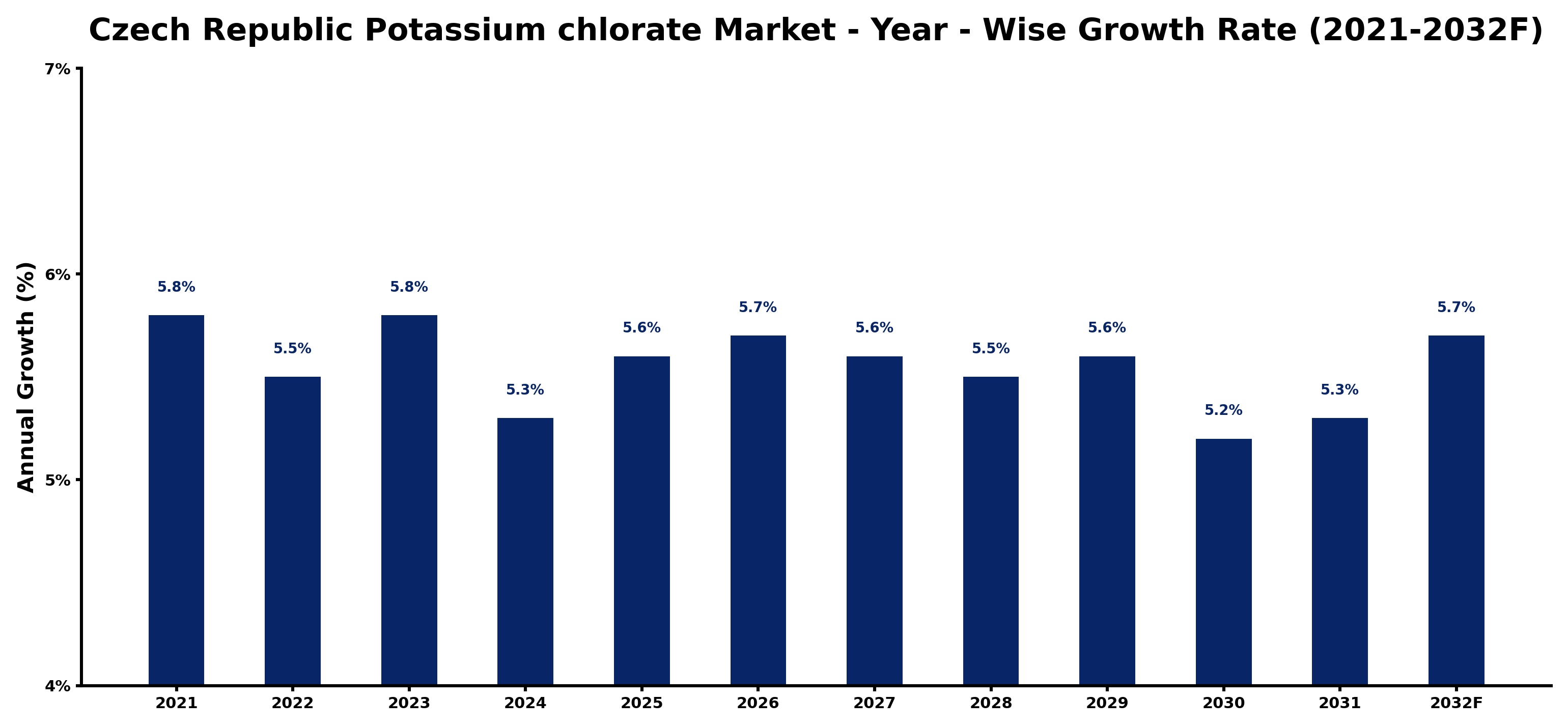
The table below presents the year‑wise growth rates along with the key drivers influencing the market
| Year | Growth Rate | Major Drivers |
| 2021 | 5.8% | New manufacturing facilities enhance potassium chlorate production capabilities |
| 2022 | 5.5% | Improved production techniques boosted potassium chlorate manufacturing capacity |
| 2023 | 5.8% | Domestic fertilizer production ramped up potassium chlorate procurement efforts |
| 2024 | 5.3% | Domestic chemical plants upgrade equipment for higher potassium chlorate output |
| 2025 | 5.6% | New manufacturing plants boost local potassium chlorate production capacity |
| 2026 | 5.7% | New facility upgrades boost potassium chlorate production efficiency |
| 2027 | 5.6% | Local manufacturers invest in advanced potassium chlorate production facilities |
| 2028 | 5.5% | Planned facility upgrades optimize potassium chlorate production capabilities |
| 2029 | 5.6% | Domestic potassium chlorate manufacturing expanded to meet rising fertilizer demands |
| 2030 | 5.2% | Export driven demand for potassium chlorate spurred local manufacturing investments |
| 2031 | 5.3% | Local chemical producers expanded capacity to meet export demands |
| 2032 | 5.7% | Export driven investments in production technology enhanced potassium chlorate efficiency |
Note - Market size estimations and growth projections presented in this report are based on 6Wresearch’s advanced forecasting approach, validated with industry datasets as of June 2026.
Czech Republic Potassium chlorate Market Synopsis
The Czech Republic's potassium chlorate market is currently positioned for significant expansion, largely due to its versatile applications. The chemical compound serves a crucial role in the manufacture of fireworks and matches, sectors that are witnessing growth amidst rising consumer demand.
Moreover, the agricultural sector's reliance on potassium chlorate for effective weed control further underlines its importance in the local economy. This diverse applicability ensures the market's resilience and continuous development as manufacturers seek innovative formulations.
Czech Republic Potassium chlorate Market Key Takeaways
- Continued growth is anticipated across various industries, particularly agriculture and pyrotechnics.
- Investment in R&D is leading to safer and more efficient potassium chlorate formulations.
- Regulatory frameworks are evolving, impacting production and usage standards.
- Competitive pressures are prompting players to innovate and diversify their product offerings.
- Sustainable practices are increasingly shaping market dynamics and consumer preferences.
Evaluation of Restraints in Czech Republic Potassium chlorate Market
Despite positive growth indicators, the Czech Republic potassium chlorate market faces several restraints. Stringent regulatory guidelines surrounding the handling, storage, and application of potassium chlorate pose considerable challenges for manufacturers. These regulations not only demand compliance but also incur additional operational costs, making it essential for companies to maintain rigorous safety and management protocols. Furthermore, the emergence of alternative chemical products is intensifying competition, potentially impacting market share and pricing strategies.
Czech Republic Potassium chlorate Market Trends
Several key trends are shaping the Czech Republic potassium chlorate market. A notable shift towards environmentally friendly chemical alternatives is prompting manufacturers to explore innovative formulations that reduce environmental impact. Additionally, as industries ramp up R&D investments, there is a push for enhanced safety and efficiency in potassium chlorate applications. The ongoing expansion of the pyrotechnics industry, particularly during festive seasons, also remains a significant demand driver.
Czech Republic Potassium chlorate Market Opportunities
The growth prospects for the Czech Republic potassium chlorate market are compelling. Opportunities abound in the agricultural sector, where potassium chlorate's effectiveness as a herbicide aligns with the increasing need for efficient weed management solutions. Additionally, the fireworks and matches manufacturing sectors are expected to expand, leading to heightened demand for high-quality potassium chlorate. Investors may find promising avenues for growth, especially as companies aim to enhance their market presence through strategic partnerships and technological advancements.
Government Initiatives in the Czech Republic Potassium chlorate Market
Government policy regarding the potassium chlorate market is predominantly influenced by the European Chemicals Agency (ECHA) regulations under the REACH framework. These guidelines necessitate comprehensive registration, evaluation, and compliance measures for the production and utilization of potassium chlorate. Furthermore, the Czech government enforces rigorous safety standards concerning chemical handling and transportation, which aim to protect public health and the environment. Such regulations underscore the importance of adherence to best practices within the industry.
Future Insights of the Czech Republic Potassium chlorate Market
Looking ahead to 2026-2032, the Czech Republic potassium chlorate market is positioned for sustained growth. The agricultural demand for herbicides is expected to remain robust, complemented by a thriving pyrotechnics industry. Continuous advancements in product formulations and a commitment to safety will also play critical roles in shaping the market landscape. However, it will be crucial for industry players to navigate regulatory challenges and remain vigilant to competitive threats from alternative products.
Czech Republic Potassium chlorate Market Latest Developments (May 2025 - June 2026)
The recent period has seen significant activity within the Czech Republic potassium chlorate market, particularly regarding innovation in safer formulations. Companies are increasingly focusing on research initiatives aimed at optimizing production processes while adhering to strict regulatory frameworks. Additionally, collaboration with agricultural stakeholders has become a focal point as businesses seek to enhance their product applications in weed management and crop protection.
Czech Republic Potassium chlorate Market - Key Attractiveness of the Report
- 10 Years of Market Numbers
- Historical Data Starting from 2022 to 2025
- Base Year: 2025
- Forecast Data until 2032
- Key Performance Indicators Impacting the Market
- Major Upcoming Developments and Projects
Key Highlights of the Report:
- Czech Republic Potassium chlorate Market Outlook
- Market Size of Czech Republic Potassium chlorate Market, 2025
- Forecast of Czech Republic Potassium chlorate Market, 2032
- Historical Data and Forecast of Czech Republic Potassium chlorate Revenues & Volume for the Period 2022-2032F
- Czech Republic Potassium chlorate Market Trend Evolution
- Czech Republic Potassium chlorate Market Drivers and Challenges
- Czech Republic Potassium chlorate Price Trends
- Czech Republic Potassium chlorate Porter's Five Forces
- Czech Republic Potassium chlorate Industry Life Cycle
- Historical Data and Forecast of Czech Republic Potassium chlorate Market Revenues & Volume By Product type for the Period 2022-2032F
- Historical Data and Forecast of Czech Republic Potassium chlorate Market Revenues & Volume By Pharmaceutical Grade for the Period 2022-2032F
- Historical Data and Forecast of Czech Republic Potassium chlorate Market Revenues & Volume By Chemical Grade for the Period 2022-2032F
- Historical Data and Forecast of Czech Republic Potassium chlorate Market Revenues & Volume By End-use for the Period 2022-2032F
- Historical Data and Forecast of Czech Republic Potassium chlorate Market Revenues & Volume By Explosives for the Period 2022-2032F
- Historical Data and Forecast of Czech Republic Potassium chlorate Market Revenues & Volume By Matches for the Period 2022-2032F
- Historical Data and Forecast of Czech Republic Potassium chlorate Market Revenues & Volume By Disinfectants for the Period 2022-2032F
- Historical Data and Forecast of Czech Republic Potassium chlorate Market Revenues & Volume By Bleaches for the Period 2022-2032F
- Historical Data and Forecast of Czech Republic Potassium chlorate Market Revenues & Volume By Medical for the Period 2022-2032F
- Czech Republic Potassium chlorate Import Export Trade Statistics
- Market Opportunity Assessment By Product type
- Market Opportunity Assessment By End-use
- Czech Republic Potassium chlorate Top Companies Market Share
- Czech Republic Potassium chlorate Competitive Benchmarking By Technical and Operational Parameters
- Czech Republic Potassium chlorate Company Profiles
- Czech Republic Potassium chlorate Key Strategic Recommendations






































