Czech Republic Radioactive Waste Management Market Size, Share & Growth Rate
The Czech Republic Radioactive Waste Management Market was estimated at USD 481 Million in 2025 and is projected to reach USD 632 Million by 2032, growing at a CAGR of 4.0% from 2026 to 2032. This growth is driven by a robust regulatory environment focused on environmental safety and enhanced public health initiatives. As nuclear power generation and medical applications continue to proliferate in the region, the need for sophisticated waste management solutions has never been more critical.
Czech Republic Radioactive Waste Management Market Year-wise Growth Rate and Key Drivers
This graph highlights how the Czech Republic Radioactive Waste Management Market has steadily grown over the years, supported by major growth factors.
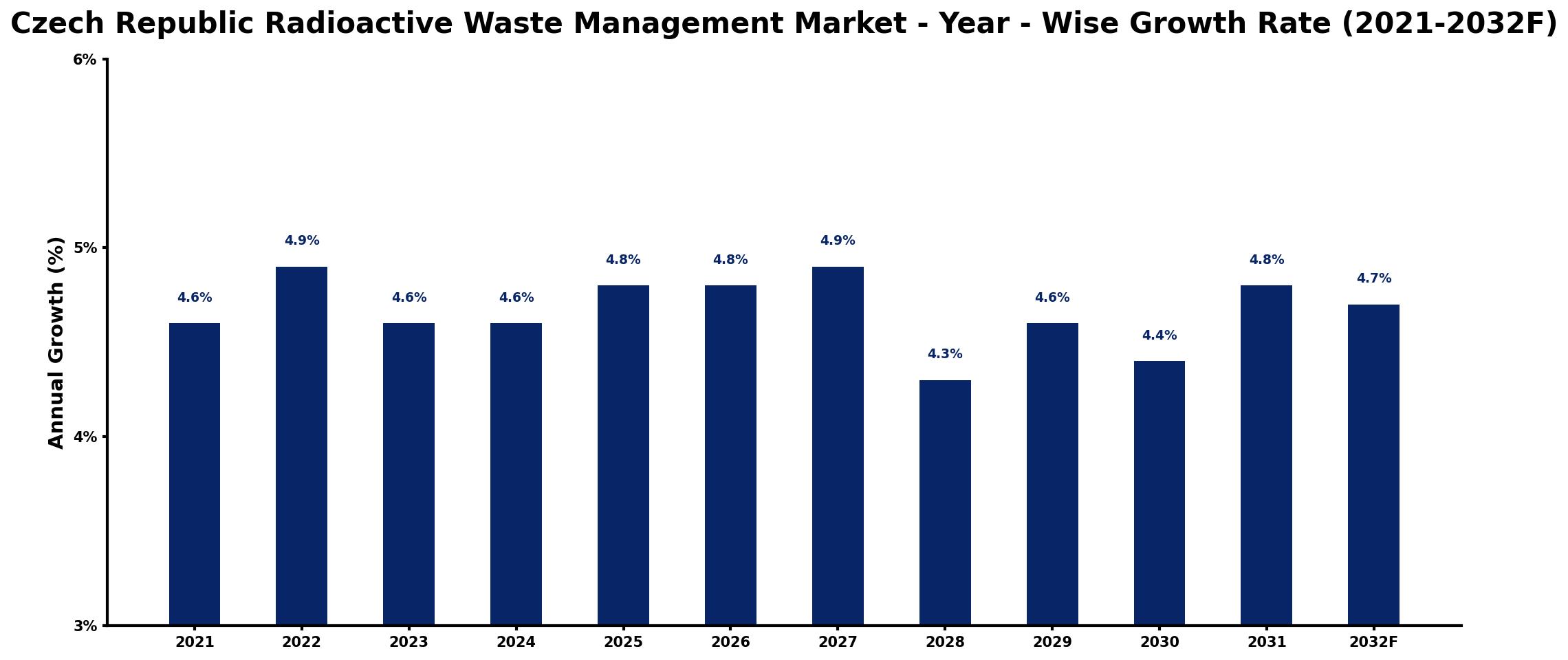
The table below presents the year‑wise growth rates along with the key drivers influencing the market
| Year | Growth Rate | Major Drivers |
| 2021 | 4.6% | Increased government funding initiatives |
| 2022 | 4.9% | Rising public safety concerns |
| 2023 | 4.6% | Advancements in technology adoption |
| 2024 | 4.6% | Growing emphasis on sustainability |
| 2025 | 4.8% | Expansion of regulatory frameworks |
| 2026 | 4.8% | Increased private sector investment |
| 2027 | 4.9% | Development of new infrastructure |
| 2028 | 4.3% | Heightened international cooperation efforts |
| 2029 | 4.6% | Rising demand for clean energy |
| 2030 | 4.4% | Emergence of innovative solutions |
| 2031 | 4.8% | Strengthened community engagement programs |
| 2032 | 4.7% | Ongoing research and development focus |
Note: Market size estimations and growth projections presented in this report are based on 6Wresearch's proprietary forecasting methodology, utilizing the latest available industry data, government publications, and primary research inputs.
Czech Republic Radioactive Waste Management Market Synopsis
The strongest force currently shaping the Czech Republic Radioactive Waste Management Market is the heightened emphasis on regulatory compliance and environmental protection. Operators are increasingly compelled to adopt advanced technologies that not only meet stringent regulatory standards but also align with sustainability initiatives.
In parallel, the market is experiencing shifts towards innovative recycling methods and effective public engagement strategies. These developments are crucial for addressing community concerns and fostering acceptance of radioactive waste management practices, thereby influencing market growth.
Czech Republic Radioactive Waste Management Market Key Takeaways
- The market is projected to grow significantly, reaching USD 632 Million by 2032.
- Regulatory compliance and environmental safety are primary market drivers.
- Innovation in waste management technologies is gaining traction.
- Public perception plays a critical role in the successful implementation of waste management strategies.
- Government policies are increasingly promoting sustainable waste disposal practices.
Evaluation of Restraints in Czech Republic Radioactive Waste Management Market
The Czech Republic Radioactive Waste Management Market faces notable constraints that can hinder its growth trajectory. Chief among these is the challenge of regulatory compliance; as environmental legislation becomes more stringent, operators must navigate complex frameworks to avoid penalties. Moreover, public perception remains a double-edged sword. Community skepticism towards radioactive waste management practices often necessitates extensive outreach efforts, which can divert resources and impact the speed of project implementation. Addressing these issues requires both strategic communication and continuous investment in technological advancements.
Czech Republic Radioactive Waste Management Market Trends
Current trends indicate a shift towards more sustainable waste management technologies, including advanced recycling methods that minimize environmental impact. Furthermore, the integration of digital tools for monitoring and reporting waste management practices is becoming increasingly popular. These innovations not only enhance operational efficiency but also improve transparency, catering to public demand for accountability in radioactive waste management. The market is also witnessing collaborations between public and private sectors aimed at developing comprehensive waste management strategies.
Czech Republic Radioactive Waste Management Market Opportunities
There are substantial growth and investment opportunities in the Czech Republic Radioactive Waste Management Market, particularly in the development of next-generation waste treatment technologies. The increasing focus on recycling and waste minimization presents an avenue for innovation and partnership among companies specializing in this field. Moreover, government initiatives aimed at enhancing infrastructure for waste management provide a conducive environment for businesses willing to invest in sustainable solutions. The ongoing need for community engagement and education also opens up opportunities for companies that can effectively communicate their commitment to safety and environmental stewardship.
Government Initiatives in the Czech Republic Radioactive Waste Management Market
The Czech government has implemented a series of regulations and initiatives that significantly influence the radioactive waste management sector. Key policies focus on ensuring responsible waste disposal practices and promoting environmental safety in the nuclear energy sector. Recent government spending has been directed towards enhancing waste management infrastructure, while programs aimed at fostering innovation and sustainability are gaining traction. These initiatives reflect the government's commitment to address public concerns while facilitating the adoption of advanced waste management technologies.
Future Insights of the Czech Republic Radioactive Waste Management Market
Looking ahead to the period from 2026 to 2032, the Czech Republic Radioactive Waste Management Market is poised for sustained growth, driven by ongoing technological advancements and an increasingly supportive regulatory framework. The focus on sustainability will shape the future landscape, compelling stakeholders to integrate innovative solutions that not only adhere to regulations but also appeal to community values. As public health and environmental safety continue to dominate discussions surrounding nuclear waste, companies that prioritize transparency and responsibility will likely lead the market.
Czech Republic Radioactive Waste Management Market Latest Developments (2025 - 2026)
Recent developments in the Czech Republic Radioactive Waste Management Market include increased investments in research and development aimed at improving waste treatment technologies. Collaborative initiatives between the government and private sectors have emerged to enhance community outreach programs, fostering better understanding and acceptance of waste management practices. Additionally, advancements in data analytics and digital monitoring systems are being adopted to ensure compliance with environmental regulations, thereby increasing operational efficiency across the industry.
Czech Republic Radioactive Waste Management Market - Key Attractiveness of the Report
- 10 Years of Market Numbers
- Historical Data Starting from 2022 to 2025
- Base Year: 2025
- Forecast Data until 2032
- Key Performance Indicators Impacting the Market
- Major Upcoming Developments and Projects
Key Highlights of the Report:
- Czech Republic Radioactive Waste Management Market Outlook
- Market Size of Czech Republic Radioactive Waste Management Market, 2025
- Forecast of Czech Republic Radioactive Waste Management Market, 2032
- Historical Data and Forecast of Czech Republic Radioactive Waste Management Revenues & Volume for the Period 2022-2032F
- Czech Republic Radioactive Waste Management Market Trend Evolution
- Czech Republic Radioactive Waste Management Market Drivers and Challenges
- Czech Republic Radioactive Waste Management Price Trends
- Czech Republic Radioactive Waste Management Porter's Five Forces
- Czech Republic Radioactive Waste Management Industry Life Cycle
- Historical Data and Forecast of Czech Republic Radioactive Waste Management Market Revenues & Volume By Type for the Period 2022-2032F
- Historical Data and Forecast of Czech Republic Radioactive Waste Management Market Revenues & Volume By Exempt Waste and Very Low-Level Waste(VLLW) for the Period 2022-2032F
- Historical Data and Forecast of Czech Republic Radioactive Waste Management Market Revenues & Volume By Low-Level Waste(LLW) for the Period 2022-2032F
- Historical Data and Forecast of Czech Republic Radioactive Waste Management Market Revenues & Volume By Intermediate-Level Waste(ILW) for the Period 2022-2032F
- Historical Data and Forecast of Czech Republic Radioactive Waste Management Market Revenues & Volume By High-Level Waste(HLW) for the Period 2022-2032F
- Historical Data and Forecast of Czech Republic Radioactive Waste Management Market Revenues & Volume By Application for the Period 2022-2032F
- Historical Data and Forecast of Czech Republic Radioactive Waste Management Market Revenues & Volume By Industrial for the Period 2022-2032F
- Historical Data and Forecast of Czech Republic Radioactive Waste Management Market Revenues & Volume By Utility for the Period 2022-2032F
- Czech Republic Radioactive Waste Management Import Export Trade Statistics
- Market Opportunity Assessment By Type
- Market Opportunity Assessment By Application
- Czech Republic Radioactive Waste Management Top Companies Market Share
- Czech Republic Radioactive Waste Management Competitive Benchmarking By Technical and Operational Parameters
- Czech Republic Radioactive Waste Management Company Profiles
- Czech Republic Radioactive Waste Management Key Strategic Recommendations






































