Czech Republic Retail Industry Market Size, Share & Growth Rate
The Czech Republic Retail Industry Market was estimated at USD 261 Million in 2025 and is projected to reach USD 333 Million by 2032, growing at a CAGR of 3.5% from 2026 to 2032. This growth trajectory is driven by an expanding middle class with increasing disposable incomes, which fuels consumer spending across both essential and luxury segments. Additionally, the surge in e-commerce and the ongoing emphasis on personalized shopping experiences are contributing significantly to the market's robust performance.
Czech Republic Retail Industry Market Year-wise Growth Rate and Key Drivers
This graph highlights how the Czech Republic Retail Industry Market has steadily grown over the years, supported by major growth factors.
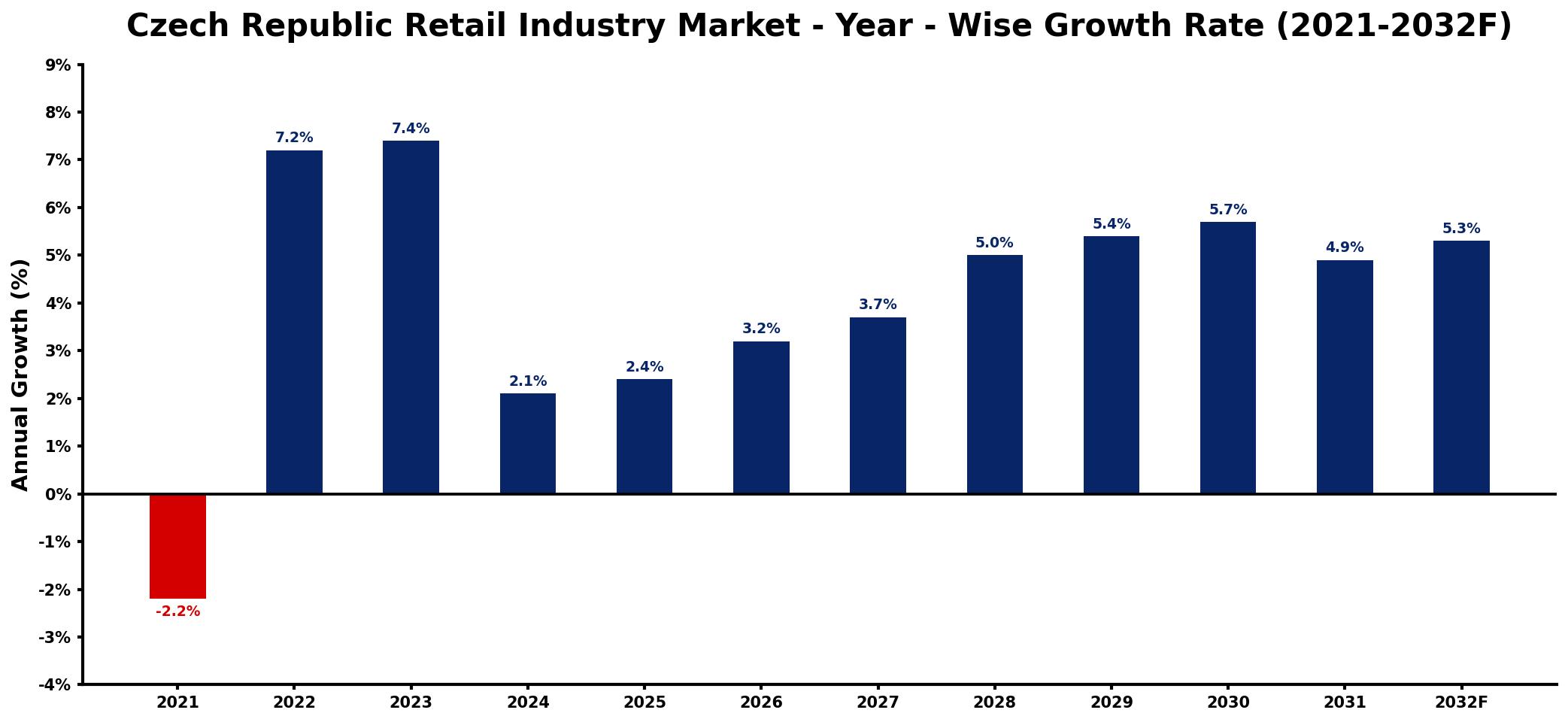
The table below presents the year‑wise growth rates along with the key drivers influencing the market
| Year | Growth Rate | Major Drivers |
| 2021 | -2.2% | decreased consumer spending patterns |
| 2022 | 7.2% | rising consumer confidence levels |
| 2023 | 7.4% | increased online shopping adoption |
| 2024 | 2.1% | expansion of local brands |
| 2025 | 2.4% | growth in e-commerce platforms |
| 2026 | 3.2% | enhanced supply chain efficiency |
| 2027 | 3.7% | increased foreign investments influx |
| 2028 | 5.0% | expanding demographic purchasing power |
| 2029 | 5.4% | growing demand for sustainability |
| 2030 | 5.7% | technological advancements in logistics |
| 2031 | 4.9% | rising popularity of convenience shopping |
| 2032 | 5.3% | increased focus on customer experience |
Note: Market size estimations and growth projections presented in this report are based on 6Wresearch's proprietary forecasting methodology, utilizing the latest available industry data, government publications, and primary research inputs.
Czech Republic Retail Industry Market Synopsis
The most prominent force shaping the Czech Republic retail market today is the rapid rise of e-commerce, transforming how consumers engage with retail brands. As online shopping becomes increasingly ingrained in consumer behavior, traditional retailers are compelled to adapt their strategies to meet new expectations for convenience and variety.
Equally important is the growing consumer preference for sustainability. Shoppers are now seeking out eco-friendly products and practices, prompting retailers to integrate sustainable solutions into their operations. This evolving demand not only enhances brand loyalty but also presents a unique opportunity for businesses to differentiate themselves in a competitive marketplace.
Czech Republic Retail Industry Market Key Takeaways
- The retail market is experiencing sustained growth, driven by increased disposable incomes and changing consumer preferences.
- E-commerce has gained significant ground, becoming a vital channel for consumer engagement and sales.
- Personalization and loyalty programs are increasingly essential for enhancing customer satisfaction and retention.
- Sustainability is emerging as a key factor influencing purchasing decisions among Czech consumers.
- Government initiatives are supporting the online retail sector, facilitating smoother operations for businesses.
Evaluation of Restraints in Czech Republic Retail Industry Market
Despite the overall positive trajectory, the Czech Republic retail market faces certain restraints that can hinder growth. The competition from burgeoning e-commerce platforms puts immense pressure on brick-and-mortar retailers, often resulting in reduced foot traffic and profitability challenges. Furthermore, rising operational costs—particularly related to real estate and labor—are tightening margins for many businesses. Supply chain disruptions stemming from global issues add another layer of complexity, leading to delays and increased prices that could dampen consumer spending. Retailers must navigate these challenges strategically to maintain their competitive edge.
Czech Republic Retail Industry Market Trends
Several current and emerging trends are shaping demand within the Czech Republic retail industry. Firstly, the integration of advanced technology in retail spaces, such as augmented reality (AR) and artificial intelligence (AI), is enhancing customer engagement and operational efficiency. Additionally, omnichannel retailing is becoming essential, allowing consumers to interact seamlessly across physical and digital platforms. Lastly, a growing focus on health and wellness is prompting retailers to expand their offerings to include healthier product options, aligning with consumer priorities.
Czech Republic Retail Industry Market Opportunities
As the retail landscape evolves, genuine growth and investment opportunities are emerging. Companies that harness data analytics can better understand consumer preferences and trends, allowing for targeted marketing strategies. Additionally, expanding e-commerce capabilities offers significant potential, particularly for retailers looking to reach underserved rural areas. Emphasizing sustainable practices not only meets consumer demand but also enhances brand image, presenting another avenue for growth. Furthermore, partnerships with local producers for unique product offerings can attract discerning consumers seeking authenticity and quality.
Government Initiatives in the Czech Republic Retail Industry Market
The Czech government is actively supporting the retail sector through a variety of initiatives aimed at fostering a favorable environment for growth. Policies focused on consumer protection and fair trade practices ensure that the retail landscape remains competitive and equitable. Additionally, measures to simplify VAT processes for online transactions facilitate the growth of e-commerce, while enhancements in digital infrastructure aim to improve accessibility for businesses and consumers alike, particularly in rural areas.
Future Insights of the Czech Republic Retail Industry Market
Looking ahead to 2026-2032, the Czech Republic retail industry is poised for continued expansion, primarily fueled by the sustained rise in disposable incomes and the ongoing shift towards online shopping. Retailers that successfully adapt to the demands for personalization and sustainability will likely find significant opportunities for differentiation and loyalty. Furthermore, technological advancements in logistics and customer engagement are expected to streamline operations and enhance the shopping experience, positioning the market for robust growth in the coming years.
Czech Republic Retail Industry Market Latest Developments (2025 - 2026)
Recent developments in the Czech Republic retail industry indicate a growing focus on integrating innovative technologies to improve the shopping experience. Retailers are increasingly investing in e-commerce platforms and enhancing their logistics capabilities to meet the rising consumer expectations for faster delivery and better service. Additionally, a noticeable shift towards omnichannel retailing is emerging, as businesses seek to create seamless shopping journeys across both online and offline channels, addressing the changing dynamics of consumer behavior.
Czech Republic Retail Industry Market - Key Attractiveness of the Report
- 10 Years of Market Numbers
- Historical Data Starting from 2022 to 2025
- Base Year: 2025
- Forecast Data until 2032
- Key Performance Indicators Impacting the Market
- Major Upcoming Developments and Projects
Key Highlights of the Report:
- Czech Republic Retail Industry Market Outlook
- Market Size of Czech Republic Retail Industry Market, 2025
- Forecast of Czech Republic Retail Industry Market, 2032
- Historical Data and Forecast of Czech Republic Retail Industry Revenues & Volume for the Period 2022-2032F
- Czech Republic Retail Industry Market Trend Evolution
- Czech Republic Retail Industry Market Drivers and Challenges
- Czech Republic Retail Industry Price Trends
- Czech Republic Retail Industry Porter's Five Forces
- Czech Republic Retail Industry Industry Life Cycle
- Historical Data and Forecast of Czech Republic Retail Industry Market Revenues & Volume By Product for the Period 2022-2032F
- Historical Data and Forecast of Czech Republic Retail Industry Market Revenues & Volume By Food and Beverages for the Period 2022-2032F
- Historical Data and Forecast of Czech Republic Retail Industry Market Revenues & Volume By Personal and Household Care for the Period 2022-2032F
- Historical Data and Forecast of Czech Republic Retail Industry Market Revenues & Volume By Apparel, Footwear, and Accessories for the Period 2022-2032F
- Historical Data and Forecast of Czech Republic Retail Industry Market Revenues & Volume By Furniture, Toys, and Hobby for the Period 2022-2032F
- Historical Data and Forecast of Czech Republic Retail Industry Market Revenues & Volume By Electronic and Household Appliances for the Period 2022-2032F
- Historical Data and Forecast of Czech Republic Retail Industry Market Revenues & Volume By Other Products for the Period 2022-2032F
- Historical Data and Forecast of Czech Republic Retail Industry Market Revenues & Volume By Distribution Channel for the Period 2022-2032F
- Historical Data and Forecast of Czech Republic Retail Industry Market Revenues & Volume By Supermarkets/Hypermarkets for the Period 2022-2032F
- Historical Data and Forecast of Czech Republic Retail Industry Market Revenues & Volume By Convenience Stores for the Period 2022-2032F
- Historical Data and Forecast of Czech Republic Retail Industry Market Revenues & Volume By Department Stores for the Period 2022-2032F
- Historical Data and Forecast of Czech Republic Retail Industry Market Revenues & Volume By Specialty Stores for the Period 2022-2032F
- Historical Data and Forecast of Czech Republic Retail Industry Market Revenues & Volume By Online for the Period 2022-2032F
- Historical Data and Forecast of Czech Republic Retail Industry Market Revenues & Volume By Other Distribution Channels for the Period 2022-2032F
- Czech Republic Retail Industry Import Export Trade Statistics
- Market Opportunity Assessment By Product
- Market Opportunity Assessment By Distribution Channel
- Czech Republic Retail Industry Top Companies Market Share
- Czech Republic Retail Industry Competitive Benchmarking By Technical and Operational Parameters
- Czech Republic Retail Industry Company Profiles
- Czech Republic Retail Industry Key Strategic Recommendations






































