Czech Republic Retail Market Size, Share & Growth Rate
The Czech Republic Retail Market was estimated at USD 848 Million in 2025 and is projected to reach USD 1586 Million by 2032, growing at a CAGR of 9.4% from 2026 to 2032. This impressive trajectory is primarily driven by increasing disposable incomes among consumers and a pronounced shift towards online shopping. As consumers increasingly prioritize convenience, the blend of e-commerce and traditional retail is set to redefine the landscape.
Czech Republic Retail Market Year-wise Growth Rate and Key Drivers
This graph highlights how the Czech Republic Retail Market has steadily grown over the years, supported by major growth factors.
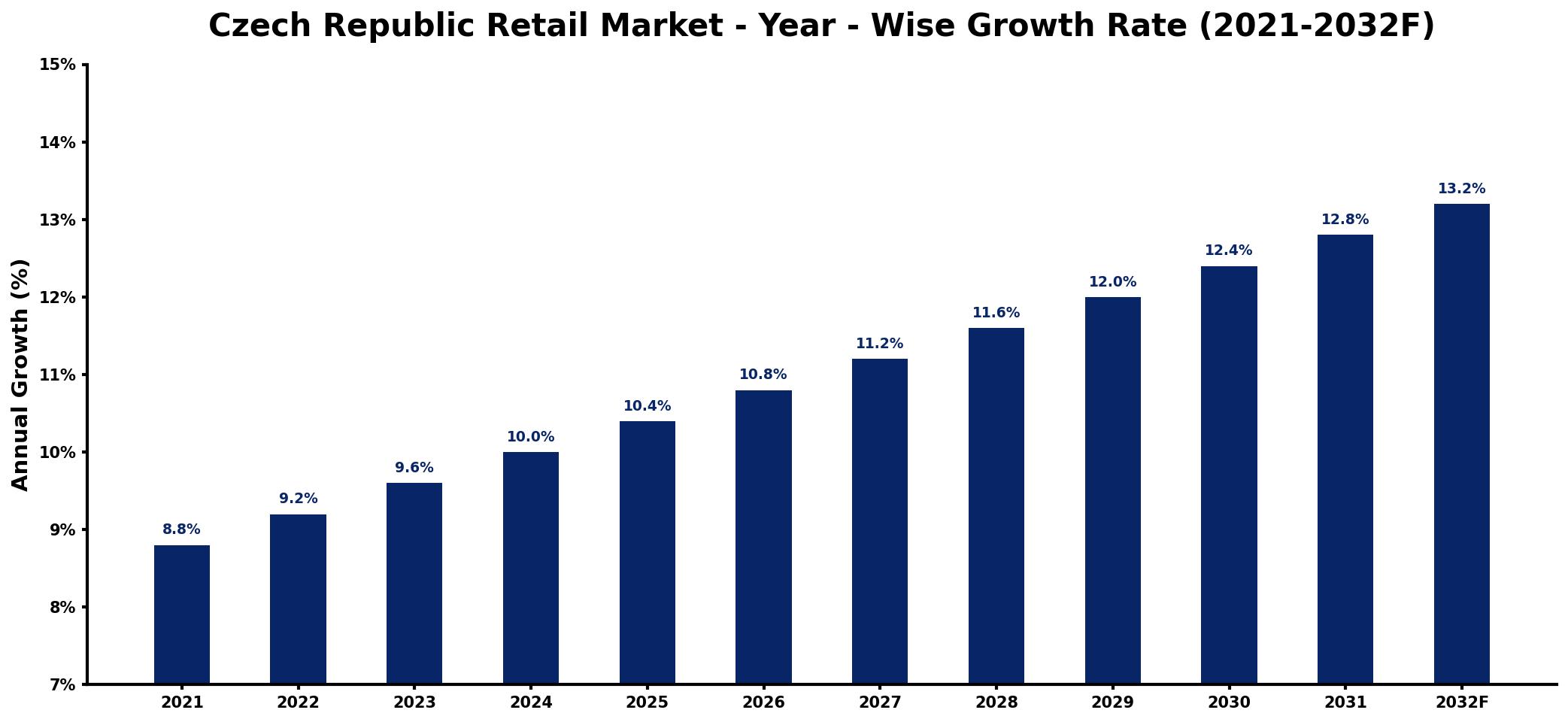
The table below presents the year‑wise growth rates along with the key drivers influencing the market
| Year | Growth Rate | Major Drivers |
| 2021 | 8.8% | E-commerce adoption accelerates significantly |
| 2022 | 9.2% | Consumer spending rebounds strongly |
| 2023 | 9.6% | Increased urbanization drives demand |
| 2024 | 10.0% | Technology investments enhance operations |
| 2025 | 10.4% | Sustainability trends influence purchasing |
| 2026 | 10.8% | Diverse product offerings expand appeal |
| 2027 | 11.2% | Rising disposable income boosts sales |
| 2028 | 11.6% | Omnichannel strategies improve accessibility |
| 2029 | 12.0% | Health and wellness trends rise |
| 2030 | 12.4% | Digital transformation reshapes industry |
| 2031 | 12.8% | Experiential shopping experiences flourish |
| 2032 | 13.2% | Global supply chains stabilize efficiently |
Note: Market size estimations and growth projections presented in this report are based on 6Wresearch's proprietary forecasting methodology, utilizing the latest available industry data, government publications, and primary research inputs.
Czech Republic Retail Market Synopsis
The strongest force shaping the Czech Republic retail market today is the rapid expansion of e-commerce, influencing consumer purchasing behaviors significantly. This shift not only highlights changing preferences but also emphasizes the importance of innovation in retail strategies, as brands strive to adapt to evolving consumer needs.
Moreover, as sustainability and ethical considerations gain traction, retailers are compelled to focus on offering eco-friendly products. This growing demand underscores a broader movement towards transparency and responsibility in supply chains, reshaping the competitive dynamics of the market.
Czech Republic Retail Market Key Takeaways
- The retail market is projected to grow significantly, fueled by rising disposable incomes and increasing consumer confidence.
- Consumer preferences are shifting towards convenience, quality, and sustainable products, driving innovation in retail.
- Brick-and-mortar stores are evolving by creating unique in-store experiences to compete with e-commerce.
- Government policies are supporting fair competition and consumer protection, benefiting both consumers and retailers.
- Investment opportunities in e-commerce and experiential retail are on the rise as consumer behavior continues to evolve.
Evaluation of Restraints in Czech Republic Retail Market
Despite the market's growth potential, several restraints pose challenges for retailers. The heightened competition between traditional and online retailers necessitates enhanced customer experiences, which can strain resources. Fluctuating consumer preferences, coupled with the uncertainty of economic conditions, complicate demand forecasting and inventory management. Furthermore, navigating regulatory frameworks for consumer protection and data compliance adds an additional layer of complexity for businesses operating in this dynamic market.
Czech Republic Retail Market Trends
The Czech Republic retail market is currently witnessing several key trends. E-commerce remains a major focal point, with an increasing number of consumers opting for online shopping due to its convenience and competitive pricing. Additionally, the integration of mobile shopping and digital payment methods is reshaping traditional retail formats, pushing businesses to adopt technology-driven solutions. Another critical trend is the growing consumer interest in sustainability, compelling retailers to incorporate eco-friendly practices and products into their offerings.
Czech Republic Retail Market Opportunities
The Czech Republic retail market presents a wealth of investment opportunities, particularly in the realm of e-commerce. As digital shopping becomes more prevalent, investors can capitalize on the need for robust online platforms and logistics solutions. Moreover, the increasing emphasis on sustainability opens avenues for brands that prioritize eco-friendly practices. Experiential retail, characterized by innovative shopping experiences and unique store concepts, also holds great potential as consumers seek more engaging ways to shop.
Government Initiatives in the Czech Republic Retail Market
The regulatory environment for the Czech Republic retail market is designed to foster fair competition and protect consumer rights. Key policies, such as the Act on Retail Chains, aim to establish equitable relationships between suppliers and retailers. Additionally, the Czech Trade Inspection Authority plays a critical role in monitoring compliance with consumer protection laws. The government is also implementing initiatives to support small and medium-sized enterprises, providing financial assistance and training to enhance their capabilities in a competitive landscape.
Future Insights of the Czech Republic Retail Market
Looking ahead to 2026-2032, the Czech Republic retail market is poised for steady growth as consumer behaviors continue to evolve. Rising disposable incomes and an increasing preference for online shopping will fuel this expansion. Retailers are expected to invest in technology to enhance customer engagement, personalize shopping experiences, and adapt to changing demands. However, ongoing challenges such as competitive pricing pressures and regulatory changes will require agility and innovation to thrive in this rapidly evolving sector.
Czech Republic Retail Market Latest Developments (2025 - 2026)
Recent developments in the Czech retail market indicate a strong emphasis on digital transformation as retailers upgrade their e-commerce platforms and integrate advanced technologies. There has been a noticeable rise in collaborations focused on sustainability, with brands exploring eco-friendly packaging and supply chain transparency. Additionally, brick-and-mortar stores are reimagining their layouts and services to create more immersive shopping experiences, keeping pace with changing consumer preferences and expectations.
Czech Republic Retail Market - Key Attractiveness of the Report
- 10 Years of Market Numbers
- Historical Data Starting from 2022 to 2025
- Base Year: 2025
- Forecast Data until 2032
- Key Performance Indicators Impacting the Market
- Major Upcoming Developments and Projects
Key Highlights of the Report:
- Czech Republic Retail Market Outlook
- Market Size of Czech Republic Retail Market, 2025
- Forecast of Czech Republic Retail Market, 2032
- Historical Data and Forecast of Czech Republic Retail Revenues & Volume for the Period 2022-2032F
- Czech Republic Retail Market Trend Evolution
- Czech Republic Retail Market Drivers and Challenges
- Czech Republic Retail Price Trends
- Czech Republic Retail Porter's Five Forces
- Czech Republic Retail Industry Life Cycle
- Historical Data and Forecast of Czech Republic Retail Market Revenues & Volume By Product for the Period 2022-2032F
- Historical Data and Forecast of Czech Republic Retail Market Revenues & Volume By Food and Beverages for the Period 2022-2032F
- Historical Data and Forecast of Czech Republic Retail Market Revenues & Volume By Personal and Household Care for the Period 2022-2032F
- Historical Data and Forecast of Czech Republic Retail Market Revenues & Volume By Apparel for the Period 2022-2032F
- Historical Data and Forecast of Czech Republic Retail Market Revenues & Volume By Footwear and Accessories for the Period 2022-2032F
- Historical Data and Forecast of Czech Republic Retail Market Revenues & Volume By Furniture for the Period 2022-2032F
- Historical Data and Forecast of Czech Republic Retail Market Revenues & Volume By Toys for the Period 2022-2032F
- Historical Data and Forecast of Czech Republic Retail Market Revenues & Volume By Electronic and Household Appliances for the Period 2022-2032F
- Historical Data and Forecast of Czech Republic Food and Beverages Retail Market Revenues & Volume By Other Products for the Period 2022-2032F
- Historical Data and Forecast of Czech Republic Retail Market Revenues & Volume By Distribution Channel for the Period 2022-2032F
- Historical Data and Forecast of Czech Republic Retail Market Revenues & Volume By Supermarkets/Hypermarkets for the Period 2022-2032F
- Historical Data and Forecast of Czech Republic Retail Market Revenues & Volume By Convenience Stores for the Period 2022-2032F
- Historical Data and Forecast of Czech Republic Retail Market Revenues & Volume By Department Stores for the Period 2022-2032F
- Historical Data and Forecast of Czech Republic Retail Market Revenues & Volume By Specialty Stores for the Period 2022-2032F
- Historical Data and Forecast of Czech Republic Retail Market Revenues & Volume By Online for the Period 2022-2032F
- Historical Data and Forecast of Czech Republic Retail Market Revenues & Volume By Other Distribution Channels for the Period 2022-2032F
- Czech Republic Retail Import Export Trade Statistics
- Market Opportunity Assessment By Product
- Market Opportunity Assessment By Distribution Channel
- Czech Republic Retail Top Companies Market Share
- Czech Republic Retail Competitive Benchmarking By Technical and Operational Parameters
- Czech Republic Retail Company Profiles
- Czech Republic Retail Key Strategic Recommendations






































