Czech Republic Salicylic Acid Market Size (2020-2030)
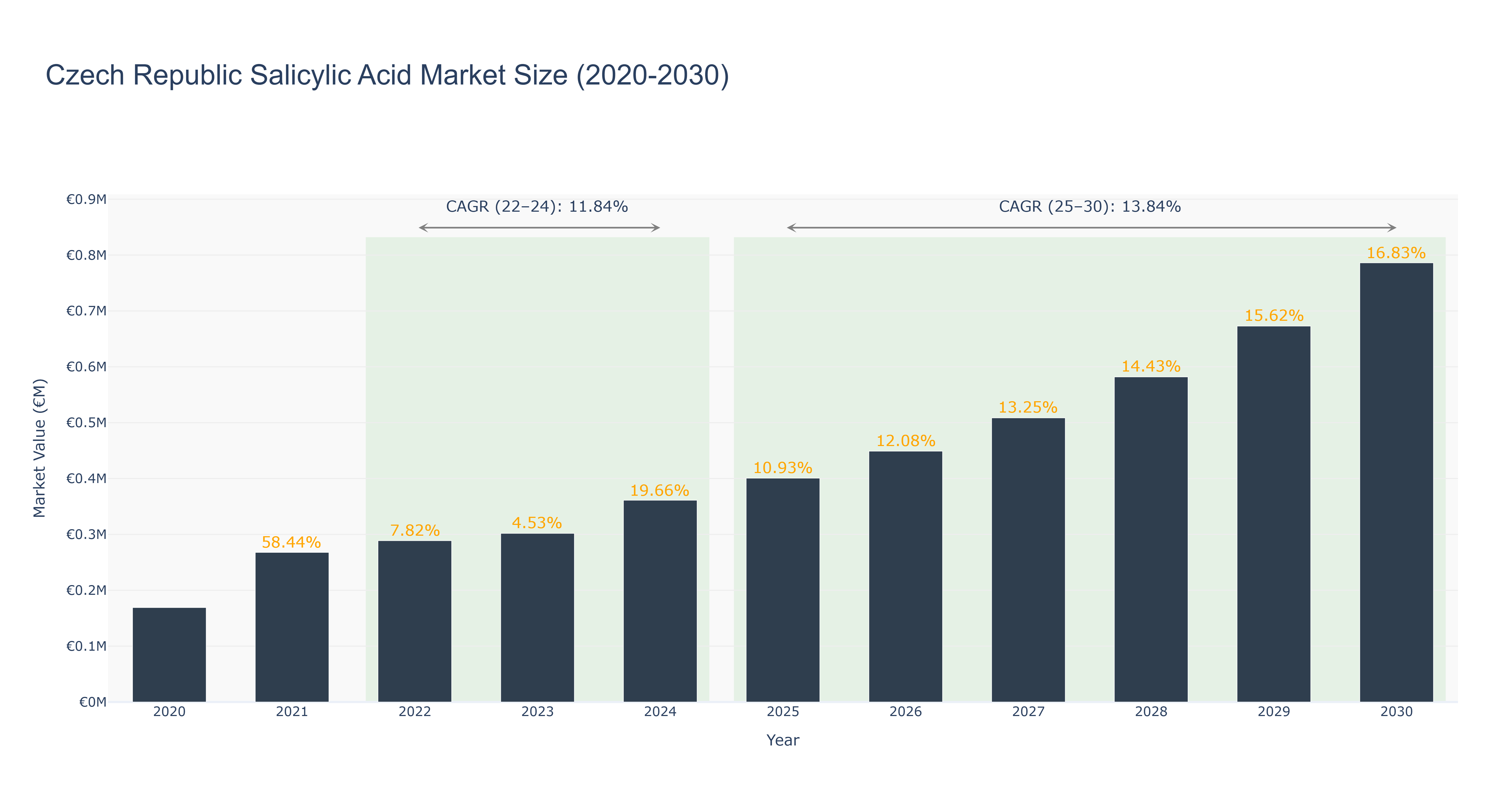
The Czech Republic Salicylic Acid Market has demonstrated significant growth, with the market size expanding from €169.03 thousand in 2020 to €361.18 thousand in 2024, reflecting a robust actual CAGR of 11.84% between 2022 and 2024. The peak market size was observed in 2024, driven by increasing demand across pharmaceuticals and cosmetics, alongside growing awareness of salicylic acid's benefits. Looking ahead, the forecasted period from 2025 to 2030 anticipates continued growth, with projected market sizes reaching €400.65 thousand in 2025 and €786.12 thousand by 2030, corresponding to a CAGR of 13.84%. This upward trajectory is likely fueled by advancements in formulation technologies and an expanding application base, including dermatological treatments and acne products. As the market evolves, ongoing research and development initiatives are expected to drive innovation, further enhancing salicylic acid's market presence in the Czech Republic.
Czech Republic Salicylic Acid Market: Production & Trade Performance (2019-2025)
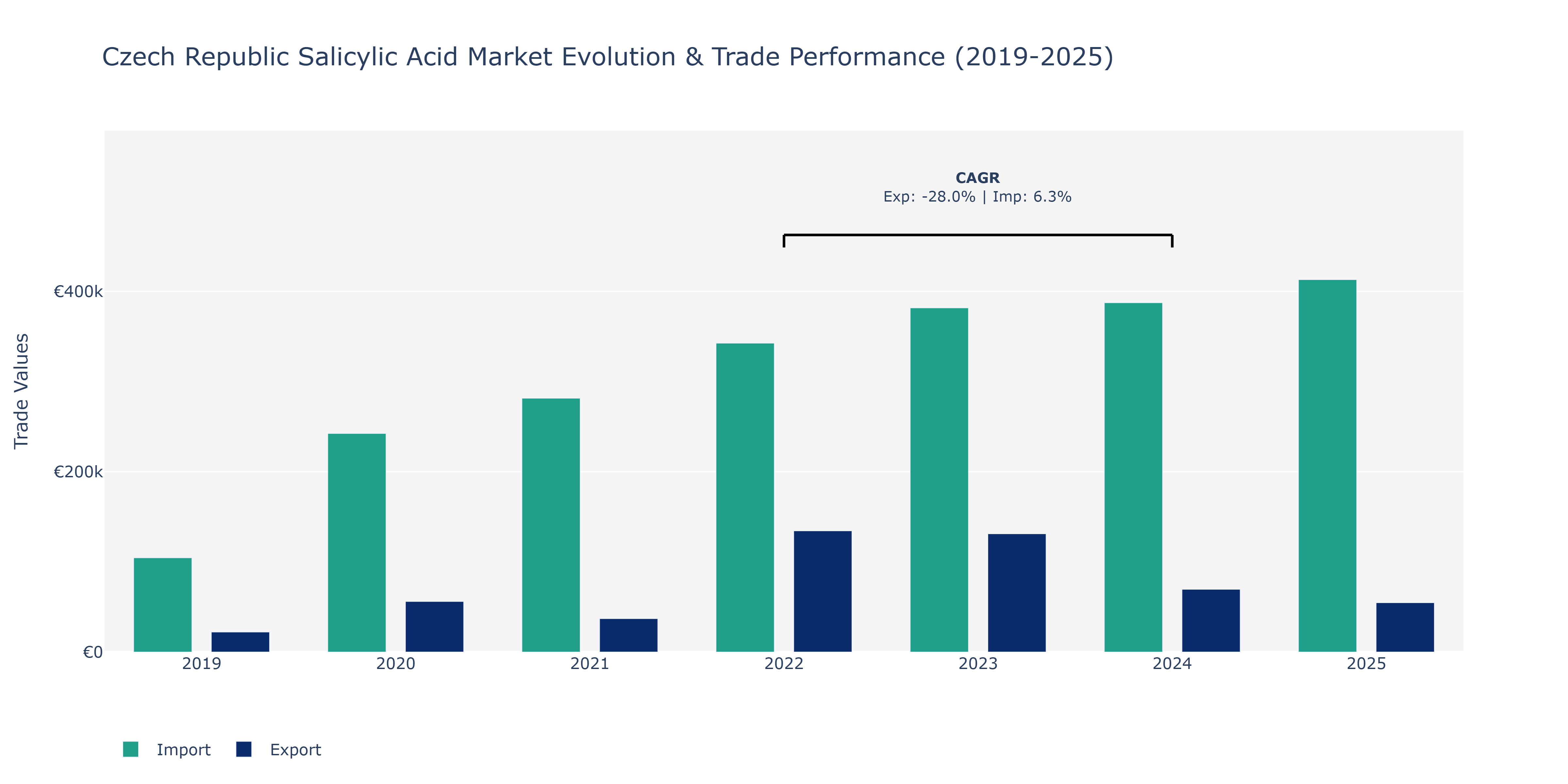
Between 2019 and 2025, Czech Republic's Salicylic Acid market saw notable fluctuations in both exports and imports. In 2019, exports stood at €22.23 thousand but surged significantly to €134.47 thousand in 2022, a peak point likely driven by increased demand or production capacity. However, by 2025, exports decreased to around €54.69 thousand. Conversely, imports experienced a steady increase during the same period, rising from €104.59 thousand in 2019 to approximately €413.15 thousand in 2025. This upward trend can be attributed to growing demand for salicylic acid in various industries like pharmaceuticals and cosmetics, reflecting the country's reliance on imports to meet this demand. The contrasting trends in exports and imports suggest a shift in market dynamics, possibly influenced by global supply chain disruptions or changes in domestic production capabilities. Further analysis into production capacities and international trade agreements could provide deeper insights into these fluctuations.
Czech Republic Salicylic Acid Market Overview
The Czech Republic Salicylic Acid Market is experiencing steady growth driven by increasing demand from various industries including pharmaceuticals, personal care, and agriculture. Salicylic acid is primarily used in skincare products for its anti-inflammatory and exfoliating properties, which is fueling its adoption in the cosmetics industry. Furthermore, the pharmaceutical sector is utilizing salicylic acid in the production of medications for various skin conditions and pain relief. In agriculture, salicylic acid is being used as a plant hormone to enhance crop growth and resistance to diseases. The market is characterized by the presence of both domestic manufacturers and international players, offering a wide range of product offerings. With a growing focus on sustainability and natural ingredients in products, the demand for salicylic acid is expected to further rise in the Czech Republic market.
Czech Republic Salicylic Acid Market Trends
In the Czech Republic, the Salicylic Acid market is experiencing a growing demand due to the increasing awareness of skincare and personal hygiene. The market is witnessing a trend towards natural and organic skincare products, leading to a rise in the use of salicylic acid in various formulations. Consumers are seeking products with effective acne-fighting properties, further driving the demand for salicylic acid-based treatments. Additionally, the rise of e-commerce platforms has made it easier for consumers to access a wide range of skincare products, including those containing salicylic acid. Overall, the Czech Republic Salicylic Acid market is poised for continued growth as consumers prioritize skincare routines and seek out effective solutions for common skin concerns.
Czech Republic Salicylic Acid Market Challenges
In the Czech Republic, the Salicylic Acid market faces challenges such as increasing competition from imported products, pricing pressures due to fluctuating raw material costs, and the need for continuous innovation to meet changing consumer preferences. Regulatory hurdles related to the approval and registration of products also pose challenges for companies operating in this market. Additionally, the market may face issues related to sustainability and environmental concerns, as consumers are increasingly demanding eco-friendly and ethically sourced products. Overall, companies in the Czech Republic Salicylic Acid market need to navigate these challenges by focusing on product differentiation, cost efficiency, regulatory compliance, and sustainability practices to maintain a competitive edge and seize growth opportunities in the market.
Czech Republic Salicylic Acid Market Investment Opportunities
In the Czech Republic, the salicylic acid market presents promising investment opportunities due to increasing demand for skincare and pharmaceutical products. Salicylic acid is widely used in the cosmetics industry for its beneficial properties in treating acne and other skin conditions, driving its market growth. Additionally, the pharmaceutical sector utilizes salicylic acid in various medications, further expanding its market potential. Investing in salicylic acid production or distribution in the Czech Republic can be lucrative as the market continues to grow. With a strong focus on innovation and quality standards in the country, investing in this market can offer long-term sustainability and profitability for investors looking to capitalize on the rising demand for skincare and pharmaceutical products containing salicylic acid.
Czech Republic Salicylic Acid Market Government Policy
In the Czech Republic, the sale of salicylic acid is regulated by the State Institute for Drug Control (SUKL) under the Ministry of Health. Salicylic acid is classified as a pharmaceutical substance and is subject to strict regulations regarding its manufacturing, distribution, and sale. Companies looking to market products containing salicylic acid must obtain approval from SUKL, ensuring compliance with quality standards and safety requirements. Additionally, advertising and labeling of salicylic acid products are monitored to prevent misleading claims or improper use. Overall, government policies in the Czech Republic aim to ensure the safe and effective use of salicylic acid in pharmaceutical and cosmetic products while protecting consumer health and safety.
Czech Republic Salicylic Acid Market Future Outlook
The future outlook for the Czech Republic Salicylic Acid Market appears to be promising, with steady growth anticipated in the coming years. The increasing demand for salicylic acid in various industries such as pharmaceuticals, skincare, and food & beverages is expected to drive market growth. Additionally, the growing awareness regarding the benefits of salicylic acid in treating skin conditions like acne and psoriasis is likely to further boost market expansion. The Czech Republic`s stable economic environment and supportive government initiatives for the chemical industry are also favorable factors for market growth. However, challenges such as fluctuating raw material prices and stringent regulations may pose some obstacles. Overall, the Czech Republic Salicylic Acid Market is poised for growth, driven by increasing applications and demand across multiple sectors.
Key Highlights of the Report:
- Czech Republic Salicylic Acid Market Outlook
- Market Size of Czech Republic Salicylic Acid Market, 2021
- Forecast of Czech Republic Salicylic Acid Market, 2027
- Historical Data and Forecast of Czech Republic Salicylic Acid Revenues & Volume for the Period 2018 - 2027
- Czech Republic Salicylic Acid Market Trend Evolution
- Czech Republic Salicylic Acid Market Drivers and Challenges
- Czech Republic Salicylic Acid Price Trends
- Czech Republic Salicylic Acid Porter's Five Forces
- Czech Republic Salicylic Acid Industry Life Cycle
- Historical Data and Forecast of Czech Republic Salicylic Acid Market Revenues & Volume By Application for the Period 2018 - 2027
- Historical Data and Forecast of Czech Republic Salicylic Acid Market Revenues & Volume By Pharmaceutical for the Period 2018 - 2027
- Historical Data and Forecast of Czech Republic Salicylic Acid Market Revenues & Volume By Food & Preservatives for the Period 2018 - 2027
- Historical Data and Forecast of Czech Republic Salicylic Acid Market Revenues & Volume By Cosmetics for the Period 2018 - 2027
- Historical Data and Forecast of Czech Republic Salicylic Acid Market Revenues & Volume By Others for the Period 2018 - 2027
- Czech Republic Salicylic Acid Import Export Trade Statistics
- Market Opportunity Assessment By Application
- Czech Republic Salicylic Acid Top Companies Market Share
- Czech Republic Salicylic Acid Competitive Benchmarking By Technical and Operational Parameters
- Czech Republic Salicylic Acid Company Profiles
- Czech Republic Salicylic Acid Key Strategic Recommendations






































