Czech Republic Torque Sensor Market: Import Trend Analysis
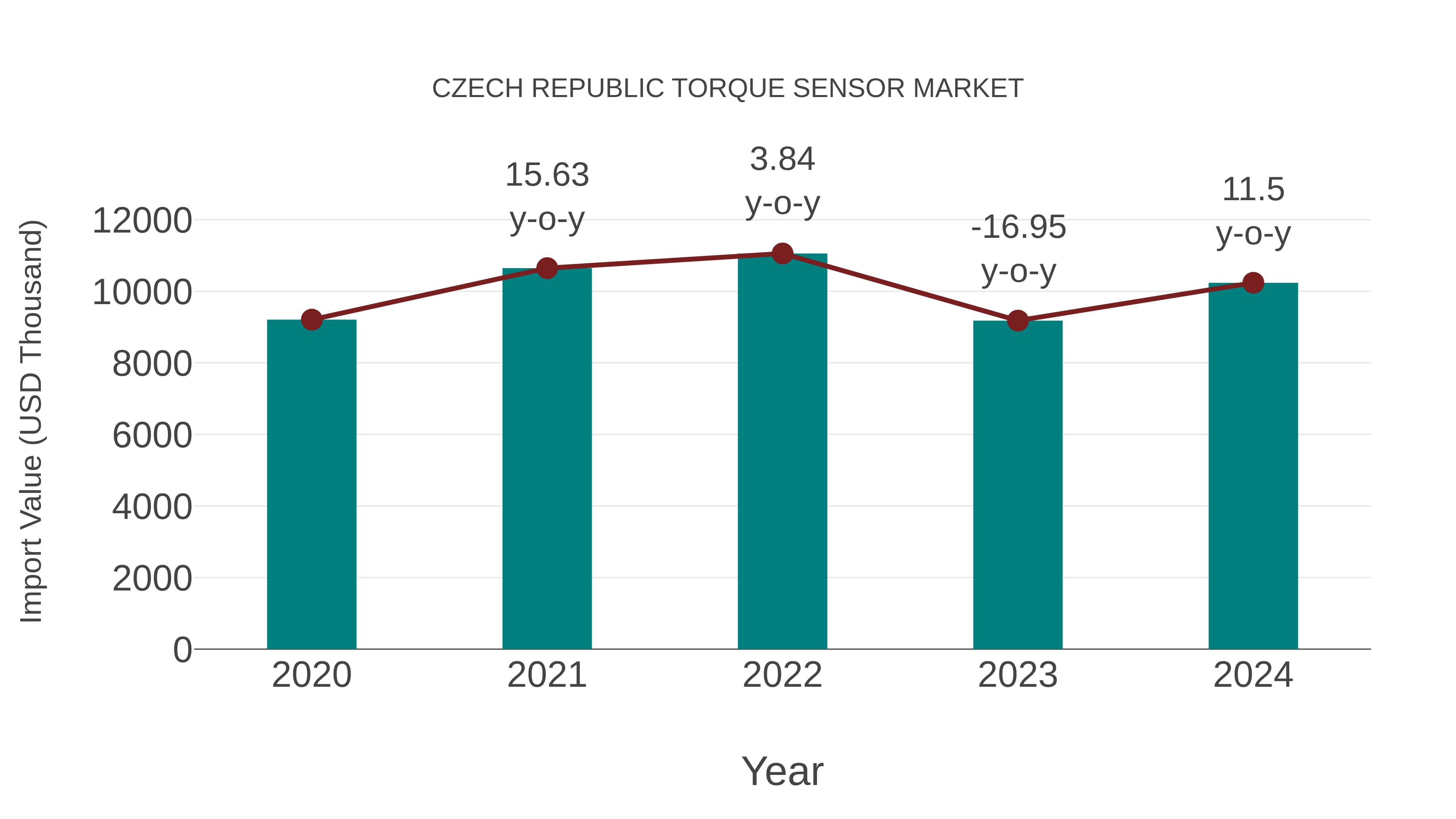
The Czech Republic torque sensor market witnessed a steady increase in imports from 2020 to 2024. The compound annual growth rate (CAGR) for this period was 2.69%. Notably, the year-on-year growth rate spiked to 11.50% in 2023-2024, indicating a significant surge in imports during those years.
Czech Republic Torque Sensor Market Overview
The torque sensor market in the Czech Republic is witnessing significant growth driven by the increasing need for precise torque measurement in various applications, including automotive, aerospace, and industrial machinery. Torque sensors are critical for ensuring the reliability and safety of mechanical systems by monitoring the torque applied to shafts and other components. The growing trend toward automation and the demand for quality control in manufacturing processes are key factors fueling the market. Additionally, advancements in sensor technology, including wireless and miniaturized torque sensors, are enhancing their applicability across a wide range of industries, thus broadening the market landscape.
Drivers of the market
The torque sensor market in the Czech Republic is primarily driven by the growing need for accurate torque measurement in various industries, including automotive, aerospace, and industrial automation. The increasing focus on quality control and product reliability is prompting manufacturers to invest in advanced torque measurement solutions. Moreover, the rising adoption of electric and hybrid vehicles is creating demand for torque sensors to monitor and optimize performance. Additionally, technological advancements in sensor technology, such as wireless and compact designs, are enhancing the applicability of torque sensors across diverse sectors, contributing to market expansion.
Challenges of the market
One of the primary challenges in the Czech Republic torque sensor market is the increasing demand for high-precision, non-contact sensors, which require expensive technologies to produce. The market also struggles with intense competition from international suppliers, making it difficult for local manufacturers to scale up production. Moreover, the need for custom-designed solutions across various industries leads to longer lead times and higher production costs. Integration of torque sensors with advanced digital systems further complicates the landscape, requiring significant technological upgrades.
Government Policy of the market
Government policies in the Czech Republic that focus on industrial modernization and automotive innovation play a key role in the growth of the torque sensor market. With a strong focus on advancing the automotive sector, policies that support electric vehicle (EV) production and the reduction of emissions boost demand for torque sensors in vehicle systems. Additionally, incentives for research in sensor technology and smart manufacturing are pivotal in shaping this market.
Key Highlights of the Report:
- Czech Republic Torque Sensor Market Outlook
- Market Size of Czech Republic Torque Sensor Market, 2025
- Forecast of Czech Republic Torque Sensor Market, 2032
- Historical Data and Forecast of Czech Republic Torque Sensor Revenues & Volume for the Period 2022-2032F
- Czech Republic Torque Sensor Market Trend Evolution
- Czech Republic Torque Sensor Market Drivers and Challenges
- Czech Republic Torque Sensor Price Trends
- Czech Republic Torque Sensor Porter's Five Forces
- Czech Republic Torque Sensor Industry Life Cycle
- Historical Data and Forecast of Czech Republic Torque Sensor Market Revenues & Volume By Type for the Period 2022-2032F
- Historical Data and Forecast of Czech Republic Torque Sensor Market Revenues & Volume By Rotary Torque Sensors for the Period 2022-2032F
- Historical Data and Forecast of Czech Republic Torque Sensor Market Revenues & Volume By Reaction Torque Sensors for the Period 2022-2032F
- Historical Data and Forecast of Czech Republic Torque Sensor Market Revenues & Volume By Application for the Period 2022-2032F
- Historical Data and Forecast of Czech Republic Torque Sensor Market Revenues & Volume By Automotive for the Period 2022-2032F
- Historical Data and Forecast of Czech Republic Torque Sensor Market Revenues & Volume By Test & Measurement for the Period 2022-2032F
- Historical Data and Forecast of Czech Republic Torque Sensor Market Revenues & Volume By Industrial for the Period 2022-2032F
- Historical Data and Forecast of Czech Republic Torque Sensor Market Revenues & Volume By Aerospace & Defense for the Period 2022-2032F
- Historical Data and Forecast of Czech Republic Torque Sensor Market Revenues & Volume By Others for the Period 2022-2032F
- Historical Data and Forecast of Czech Republic Torque Sensor Market Revenues & Volume By Technology for the Period 2022-2032F
- Historical Data and Forecast of Czech Republic Torque Sensor Market Revenues & Volume By Strain Gauge for the Period 2022-2032F
- Historical Data and Forecast of Czech Republic Torque Sensor Market Revenues & Volume By Surface Acoustic Wave (SAW) for the Period 2022-2032F
- Historical Data and Forecast of Czech Republic Torque Sensor Market Revenues & Volume By Optical for the Period 2022-2032F
- Historical Data and Forecast of Czech Republic Torque Sensor Market Revenues & Volume By Magnetoelastic for the Period 2022-2032F
- Czech Republic Torque Sensor Import Export Trade Statistics
- Market Opportunity Assessment By Type
- Market Opportunity Assessment By Application
- Market Opportunity Assessment By Technology
- Czech Republic Torque Sensor Top Companies Market Share
- Czech Republic Torque Sensor Competitive Benchmarking By Technical and Operational Parameters
- Czech Republic Torque Sensor Company Profiles
- Czech Republic Torque Sensor Key Strategic Recommendations






































