Czech Republic Toys and Hobby Goods Market: Import Trend Analysis
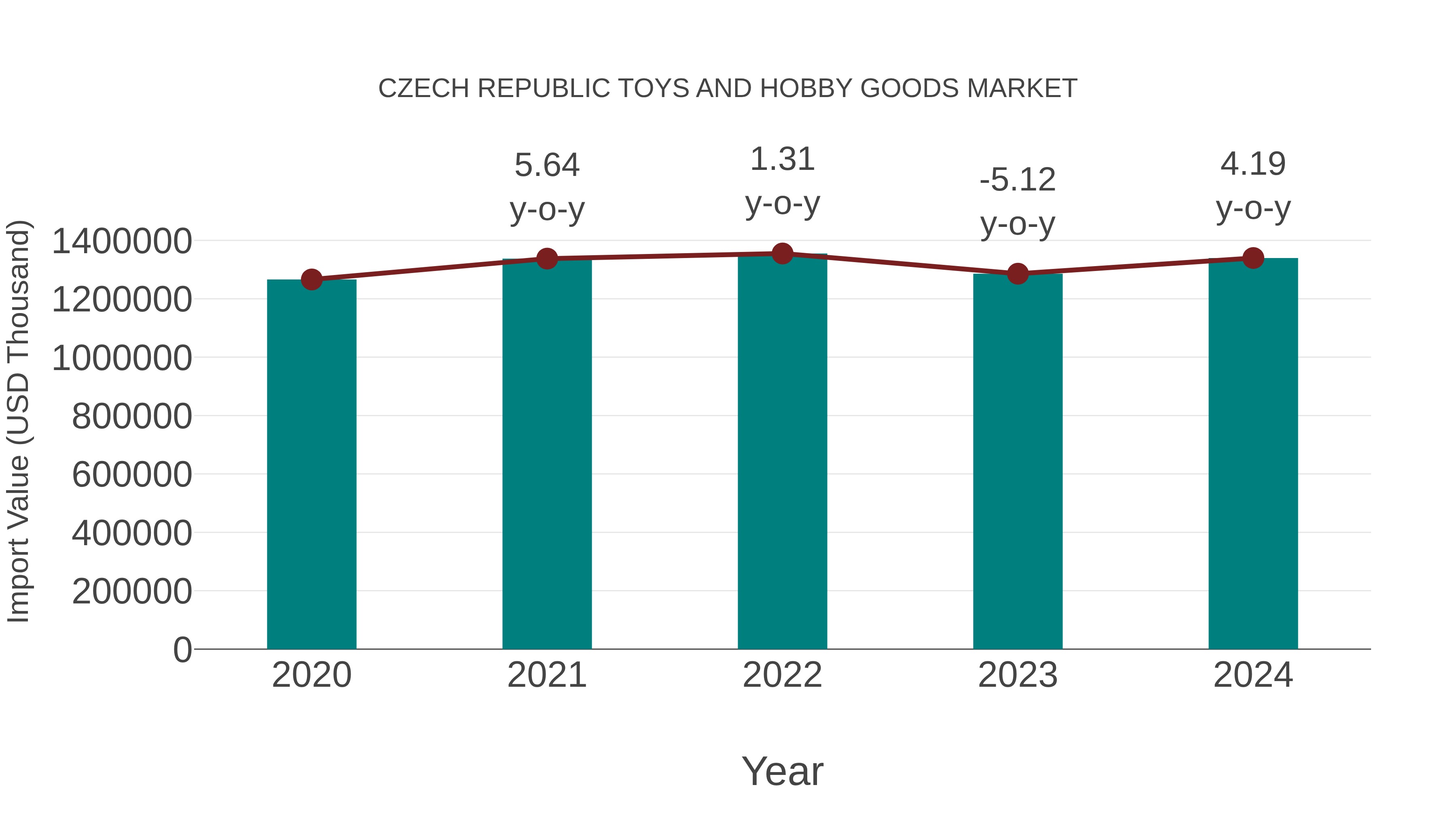
The Czech Republic toys and hobby goods market experienced a steady increase in imports from 2020 to 2024. The compound annual growth rate (CAGR) of 1.42% during this period, along with a year-on-year growth rate of 4.19% in 20232024, contributed to the overall rise in imports.
Czech Republic Toys and Hobby Goods Market Synopsis
The Czech Republic toys and hobby goods market is expected to register a CAGR of 4.4% during the forecast period 2020-2026. The demand for toys and hobbies in the country are driven by rising population, increasing disposable income, surging e-commerce sales, growing awareness about various new products available in the market and shifting consumer preference towards digitalization of these products. Also, with an improving economic situation, it has been observed that parents have become more willing to invest money on their children`s development which is boosting this industry further as well as promoting non-traditional play activities that make use of technology such as computer games among others.
Key Highlights of the Report:
- Czech Republic Toys and Hobby Goods Market Outlook
- Market Size of Czech Republic Toys and Hobby Goods Market, 2019
- Forecast of Czech Republic Toys and Hobby Goods Market, 2026
- Historical Data and Forecast of Czech Republic Toys and Hobby Goods Revenues & Volume for the Period 2016 - 2026
- Czech Republic Toys and Hobby Goods Market Trend Evolution
- Czech Republic Toys and Hobby Goods Market Drivers and Challenges
- Czech Republic Toys and Hobby Goods Price Trends
- Czech Republic Toys and Hobby Goods Porter's Five Forces
- Czech Republic Toys and Hobby Goods Industry Life Cycle
- Historical Data and Forecast of Czech Republic Toys and Hobby Goods Market Revenues & Volume By Type for the Period 2016 - 2026
- Historical Data and Forecast of Czech Republic Toys and Hobby Goods Market Revenues & Volume By Sports Toys for the Period 2016 - 2026
- Historical Data and Forecast of Czech Republic Toys and Hobby Goods Market Revenues & Volume By Intellectual Toys for the Period 2016 - 2026
- Historical Data and Forecast of Czech Republic Toys and Hobby Goods Market Revenues & Volume By Education Toys for the Period 2016 - 2026
- Historical Data and Forecast of Czech Republic Toys and Hobby Goods Market Revenues & Volume By Decorative Toys for the Period 2016 - 2026
- Historical Data and Forecast of Czech Republic Toys and Hobby Goods Market Revenues & Volume By Other for the Period 2016 - 2026
- Historical Data and Forecast of Czech Republic Toys and Hobby Goods Market Revenues & Volume By Application for the Period 2016 - 2026
- Historical Data and Forecast of Czech Republic Toys and Hobby Goods Market Revenues & Volume By Online Sales for the Period 2016 - 2026
- Historical Data and Forecast of Czech Republic Toys and Hobby Goods Market Revenues & Volume By Offline Sales for the Period 2016 - 2026
- Historical Data and Forecast of Czech Republic Toys and Hobby Goods Market Revenues & Volume By Others for the Period 2016 - 2026
- Czech Republic Toys and Hobby Goods Import Export Trade Statistics
- Market Opportunity Assessment By Type
- Market Opportunity Assessment By Application
- Czech Republic Toys and Hobby Goods Top Companies Market Share
- Czech Republic Toys and Hobby Goods Competitive Benchmarking By Technical and Operational Parameters
- Czech Republic Toys and Hobby Goods Company Profiles
- Czech Republic Toys and Hobby Goods Key Strategic Recommendations






































