Czech Republic Transaction Monitoring Market Size & Growth Rate (2026-2032)
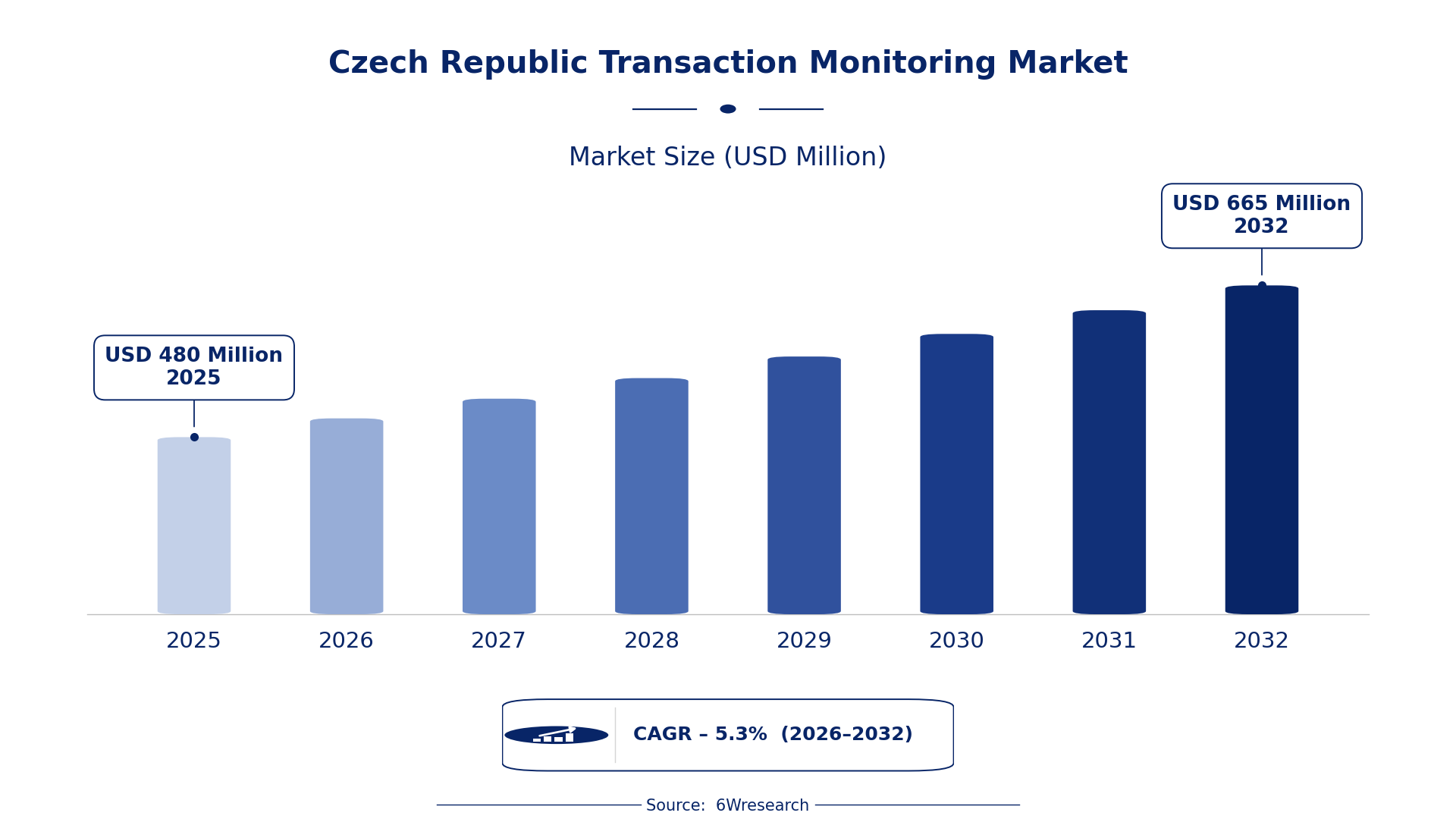
The Czech Republic Transaction Monitoring Market was estimated at USD 480 Million in 2025 and is projected to reach USD 665 Million by 2032, growing at a CAGR of 5.3% from 2026 to 2032.
Czech Republic Transaction Monitoring Market Synopsis
The demand for advanced transaction monitoring systems in the Czech Republic is surging as financial institutions face mounting pressure to comply with rigorous regulations. Institutions are not only required to detect fraudulent activities but also to implement systems that ensure real-time analysis of transactions, making adaptability critical.
As digital banking continues to grow, the landscape for transaction monitoring is evolving. Organizations are increasingly investing in machine learning and AI technologies to enhance their monitoring capabilities, thereby making significant strides in detecting suspicious patterns efficiently.
Czech Republic Transaction Monitoring Market Year-wise Growth Rate and Key Drivers
This graph illustrates the annual growth rates of the Czech Republic Transaction Monitoring Market from 2021 to 2032, highlighting a steady upward trajectory and projected expansion over the forecast period.
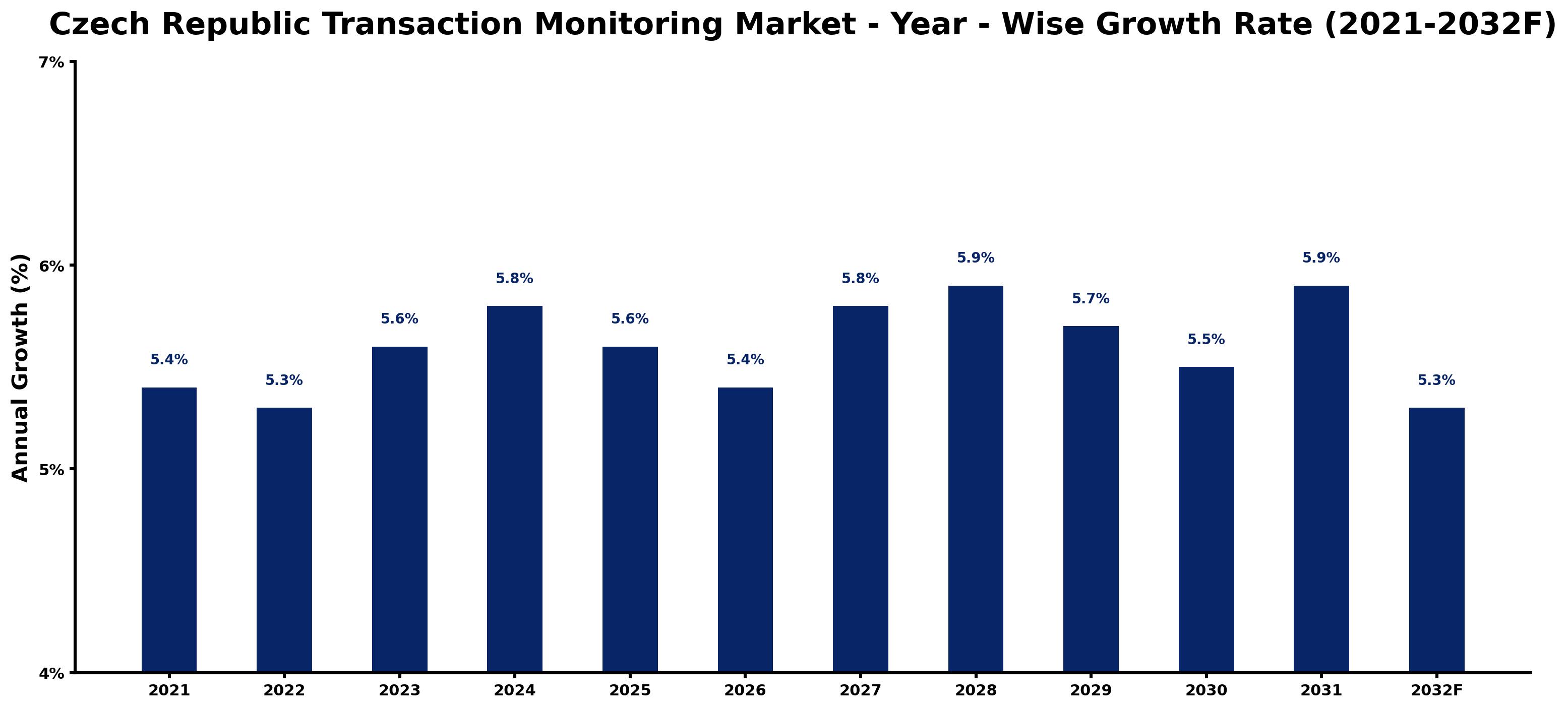
The table below presents the year‑wise growth rates along with the key drivers influencing the market
| Year | Growth Rate | Major Drivers |
| 2021 | 5.4% | Strengthened AML regulations by Czech National Bank |
| 2022 | 5.3% | Growing focus on KYC compliance in banking sector |
| 2023 | 5.6% | Increased investment in cybersecurity infrastructure solutions |
| 2024 | 5.8% | Boost in digital financial services adoption among consumers |
| 2025 | 5.6% | Emergence of fintech startups enhancing compliance capabilities |
| 2026 | 5.4% | Mandatory reporting to Financial Analytical Office advances monitoring |
| 2027 | 5.8% | Rise in cross-border transactions boosts transaction scrutiny |
| 2028 | 5.9% | Awareness campaigns on fraud prevention leading to heightened monitoring |
| 2029 | 5.7% | Collaboration with EU on anti-money laundering strategies |
| 2030 | 5.5% | Enhanced technology adoption for real-time transaction analysis |
| 2031 | 5.9% | Implementation of new data protection regulations encourages compliance tools |
| 2032 | 5.3% | Ongoing shifts to digital commerce increase fraud risk awareness |
Note: Market size estimations and growth projections presented in this report are based on 6Wresearch's proprietary forecasting methodology, utilizing the latest available industry data, government publications, and primary research inputs.
Czech Republic Transaction Monitoring Market Key Takeaways
Below are some of the specific key takeaways from the market, including:
- The integration of AI technologies is revolutionizing the detection of fraudulent activities.
- Regulatory requirements are pushing financial institutions to adopt more sophisticated monitoring systems.
- Digital banking's rise necessitates advanced solutions for real-time data analysis.
- Investment in machine learning is reducing false positives and improving accuracy.
- Compliance with EU directives is a driving factor for market growth.
Evaluation of Restraints in Czech Republic Transaction Monitoring Market
The transaction monitoring market in the Czech Republic faces challenges primarily due to the complexity of modern financial transactions. As financial crimes evolve, the technologies need consistent updates and innovations, leading to resource allocation issues for many institutions. Additionally, the variation in regulatory requirements across jurisdictions can complicate compliance efforts. This necessitates a strategic approach to not only adopt new technologies but also to integrate them effectively within existing banking infrastructures.
Czech Republic Transaction Monitoring Market Trends
Several trends are emerging in the Czech Republic's transaction monitoring market. One significant trend is the adoption of cloud-based solutions, which offer flexibility and scalability. Additionally, real-time monitoring capabilities are becoming a standard expectation rather than an option, pushing companies to innovate rapidly. Lastly, there is a notable shift toward collaborative frameworks among financial institutions to share intelligence on suspicious activities, enhancing overall security.
Czech Republic Transaction Monitoring Market Opportunities
Opportunities abound in the Czech Republic transaction monitoring market, particularly in the areas of AI-driven analytics and customer behavior modeling. As financial institutions aim to improve their fraud detection capabilities, partnerships with technology firms specializing in machine learning present avenues for growth. on top of that, the ongoing regulatory changes will prompt further investments in compliance technologies, creating a fertile ground for new solutions.
Government Initiatives in the Czech Republic Transaction Monitoring Market
Government policy in the Czech Republic is significantly influencing the transaction monitoring market, driven by the necessity to align with European Union regulations. The focus is on enhancing compliance frameworks to combat financial crimes effectively, ensuring that financial institutions are equipped with the necessary tools to monitor transactions appropriately.
- A regulatory framework established in 2023 mandating that financial institutions implement advanced transaction monitoring systems.
- A national digital infrastructure upgrade initiative currently underway aims to bolster the capacity for real-time transaction analysis.
- Ongoing workshops and training programs initiated by the Czech Financial Analytical Office to improve compliance understanding among financial institutions.
- A public-private partnership planned for 2026 to develop innovative transaction monitoring solutions, enhancing collaborative efforts among stakeholders.
Future Insights of the Czech Republic Transaction Monitoring Market
Looking ahead to 2026-2032, the Czech Republic transaction monitoring market is set for substantial evolution. With increasing regulatory demands, institutions will prioritize investments in technology that not only comply but also predict and mitigate risks. As innovations in AI and machine learning mature, transaction monitoring systems will become integral in safeguarding against financial crime while enhancing operational efficiency. The drive for sophisticated analytics will shape competitive dynamics, pushing organizations to differentiate through their monitoring capabilities.
Czech Republic Transaction Monitoring Market Latest Developments
Recent developments in the Czech Republic transaction monitoring market reflect a growing focus on technology-driven solutions. Institutions are increasingly recognizing the importance of integrating cutting-edge technologies to stay ahead of financial crime. This shift indicates a significant transformation in how transactions are monitored and analyzed.
- A major technology vendor launched a new AI-powered transaction monitoring tool in early 2025, aimed at improving detection capabilities.
- An ongoing initiative started in late 2025 focuses on enhancing interoperability between different financial institutions' monitoring systems.
- A leading financial institution is currently piloting a blockchain-based transaction monitoring system, expected to provide greater transparency.
- Plans for a new regulatory compliance framework are slated for introduction by mid-2026, designed to streamline monitoring processes across institutions.
Czech Republic Transaction Monitoring Market - Key Attractiveness of the Report
- 10 Years of Market Numbers
- Historical Data Starting from 2022 to 2025
- Base Year: 2025
- Forecast Data until 2032
- Key Performance Indicators Impacting the Market
- Major Upcoming Developments and Projects
Key Highlights of the Report:
- Czech Republic Transaction Monitoring Market Outlook
- Market Size of Czech Republic Transaction Monitoring Market, 2025
- Forecast of Czech Republic Transaction Monitoring Market, 2032
- Historical Data and Forecast of Czech Republic Transaction Monitoring Revenues & Volume for the Period 2022-2032F
- Czech Republic Transaction Monitoring Market Trend Evolution
- Czech Republic Transaction Monitoring Market Drivers and Challenges
- Czech Republic Transaction Monitoring Price Trends
- Czech Republic Transaction Monitoring Porter's Five Forces
- Czech Republic Transaction Monitoring Industry Life Cycle
- Historical Data and Forecast of Czech Republic Transaction Monitoring Market Revenues & Volume By Application Area for the Period 2022-2032F
- Historical Data and Forecast of Czech Republic Transaction Monitoring Market Revenues & Volume By AML for the Period 2022-2032F
- Historical Data and Forecast of Czech Republic Transaction Monitoring Market Revenues & Volume By FDP for the Period 2022-2032F
- Historical Data and Forecast of Czech Republic Transaction Monitoring Market Revenues & Volume By Compliance Management for the Period 2022-2032F
- Historical Data and Forecast of Czech Republic Transaction Monitoring Market Revenues & Volume By Customer Identity Management for the Period 2022-2032F
- Historical Data and Forecast of Czech Republic Transaction Monitoring Market Revenues & Volume By Component for the Period 2022-2032F
- Historical Data and Forecast of Czech Republic Transaction Monitoring Market Revenues & Volume By Solution for the Period 2022-2032F
- Historical Data and Forecast of Czech Republic Transaction Monitoring Market Revenues & Volume By Services for the Period 2022-2032F
- Historical Data and Forecast of Czech Republic Transaction Monitoring Market Revenues & Volume By Function for the Period 2022-2032F
- Historical Data and Forecast of Czech Republic Transaction Monitoring Market Revenues & Volume By Case Management for the Period 2022-2032F
- Historical Data and Forecast of Czech Republic Transaction Monitoring Market Revenues & Volume By KYC/Customer Onboarding for the Period 2022-2032F
- Historical Data and Forecast of Czech Republic Transaction Monitoring Market Revenues & Volume By Dashboard and Reporting for the Period 2022-2032F
- Historical Data and Forecast of Czech Republic Transaction Monitoring Market Revenues & Volume By Watch List Screening for the Period 2022-2032F
- Historical Data and Forecast of Czech Republic Transaction Monitoring Market Revenues & Volume By Deployment Mode for the Period 2022-2032F
- Historical Data and Forecast of Czech Republic Transaction Monitoring Market Revenues & Volume By On-Premises for the Period 2022-2032F
- Historical Data and Forecast of Czech Republic Transaction Monitoring Market Revenues & Volume By Cloud for the Period 2022-2032F
- Historical Data and Forecast of Czech Republic Transaction Monitoring Market Revenues & Volume By Organization Size for the Period 2022-2032F
- Historical Data and Forecast of Czech Republic Transaction Monitoring Market Revenues & Volume By SMEs for the Period 2022-2032F
- Historical Data and Forecast of Czech Republic Transaction Monitoring Market Revenues & Volume By Large Enterprises for the Period 2022-2032F
- Historical Data and Forecast of Czech Republic Transaction Monitoring Market Revenues & Volume By Vertical for the Period 2022-2032F
- Historical Data and Forecast of Czech Republic Transaction Monitoring Market Revenues & Volume By Banking, Financial Services, and Insurance for the Period 2022-2032F
- Historical Data and Forecast of Czech Republic Transaction Monitoring Market Revenues & Volume By Government and Defense for the Period 2022-2032F
- Historical Data and Forecast of Czech Republic Transaction Monitoring Market Revenues & Volume By IT and Telecom for the Period 2022-2032F
- Historical Data and Forecast of Czech Republic Transaction Monitoring Market Revenues & Volume By Retail for the Period 2022-2032F
- Historical Data and Forecast of Czech Republic Transaction Monitoring Market Revenues & Volume By Healthcare for the Period 2022-2032F
- Historical Data and Forecast of Czech Republic Transaction Monitoring Market Revenues & Volume By Energy and Utilities for the Period 2022-2032F
- Historical Data and Forecast of Czech Republic Transaction Monitoring Market Revenues & Volume By Manufacturing for the Period 2022-2032F
- Historical Data and Forecast of Czech Republic Transaction Monitoring Market Revenues & Volume By Others for the Period 2022-2032F
- Czech Republic Transaction Monitoring Import Export Trade Statistics
- Market Opportunity Assessment By Application Area
- Market Opportunity Assessment By Component
- Market Opportunity Assessment By Function
- Market Opportunity Assessment By Deployment Mode
- Market Opportunity Assessment By Organization Size
- Market Opportunity Assessment By Vertical
- Czech Republic Transaction Monitoring Top Companies Market Share
- Czech Republic Transaction Monitoring Competitive Benchmarking By Technical and Operational Parameters
- Czech Republic Transaction Monitoring Company Profiles
- Czech Republic Transaction Monitoring Key Strategic Recommendations






































