Czech Republic Trolley Market Size, Share & Growth Rate
The Czech Republic Trolley Market was estimated at USD 971 Million in 2025 and is projected to reach USD 1420 Million by 2032, growing at a CAGR of 5.6% from 2026 to 2032. This growth is propelled by a significant shift toward sustainable public transportation solutions, as urbanization continues to rise in major cities. The increasing investment in trolley infrastructure coupled with government initiatives aimed at promoting eco-friendly transport further supports this upward trajectory.
Czech Republic Trolley Market Year-wise Growth Rate and Key Drivers
This graph highlights how the Czech Republic Trolley Market has steadily grown over the years, supported by major growth factors.
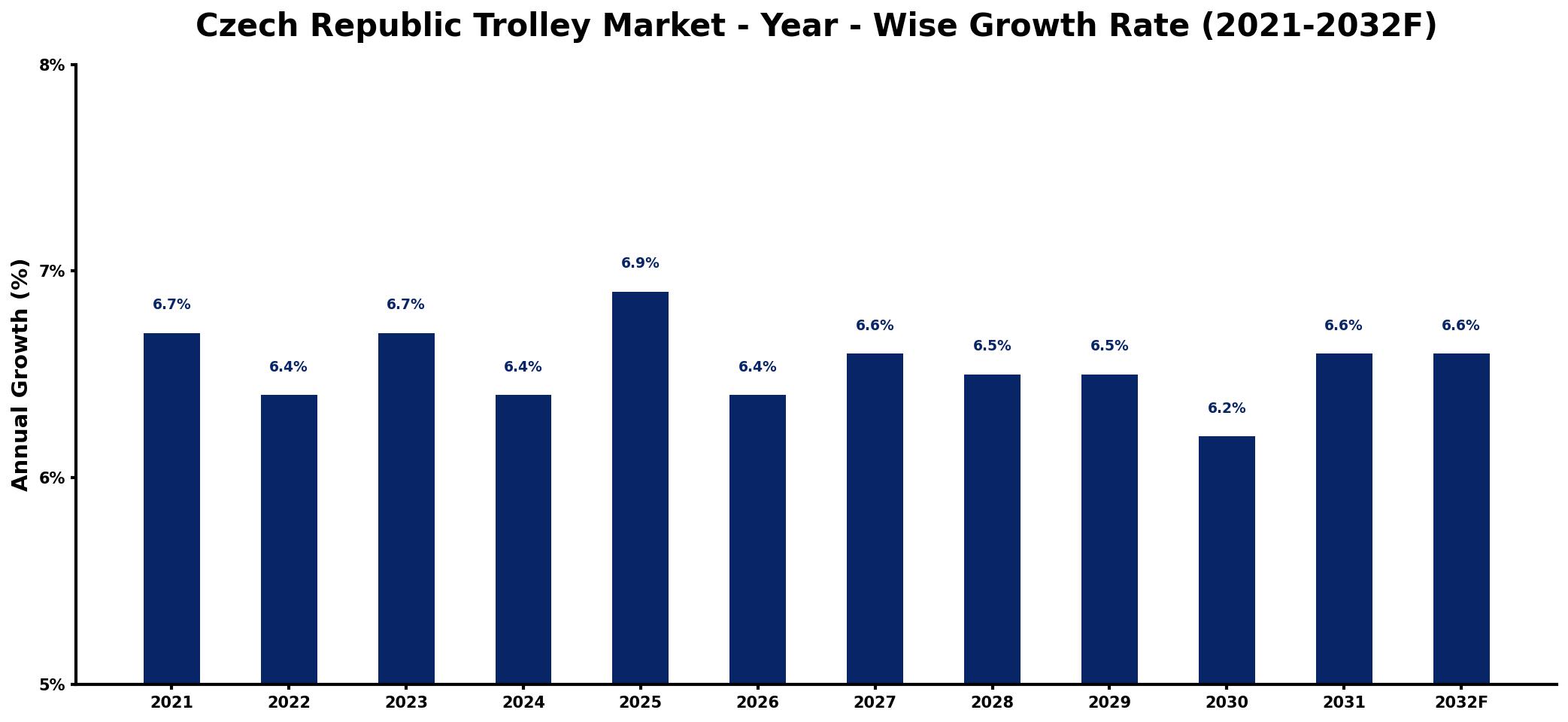
The table below presents the year‑wise growth rates along with the key drivers influencing the market
| Year | Growth Rate | Major Drivers |
| 2021 | 6.7% | Increased consumer spending habits |
| 2022 | 6.4% | Growing e-commerce logistics demands |
| 2023 | 6.7% | Expansion of urban infrastructure projects |
| 2024 | 6.4% | Rising popularity of sustainable transport |
| 2025 | 6.9% | Investments in smart technology integration |
| 2026 | 6.4% | Enhanced distribution network efficiency |
| 2027 | 6.6% | Surge in online retail growth |
| 2028 | 6.5% | Development of green transportation initiatives |
| 2029 | 6.5% | Growth in urban population density |
| 2030 | 6.2% | Increased focus on public transport |
| 2031 | 6.6% | Rising consumer preference for mobility |
| 2032 | 6.6% | rising end-use demand growth |
Note: Market size estimations and growth projections presented in this report are based on 6Wresearch's proprietary forecasting methodology, utilizing the latest available industry data, government publications, and primary research inputs.
Czech Republic Trolley Market Synopsis
The most influential factor currently shaping the Czech Republic Trolley Market is the growing urban population, which demands efficient and reliable public transport options. Trolleys are increasingly recognized for their low carbon emissions and ability to reduce traffic congestion in city centers, making them an attractive choice for both municipalities and commuters.
In addition, advancements in trolley technology, including the development of electric and automated systems, have enhanced their appeal. As cities modernize their transport systems, the emphasis on sustainability and quality of life is prompting a reevaluation of traditional transportation models, with trolleys at the forefront of this transformation.
Czech Republic Trolley Market Key Takeaways
- Urbanization is driving the demand for efficient public transport solutions, particularly trolleys.
- Government initiatives focused on reducing carbon emissions are fostering market growth.
- Technological advancements in trolley systems are enhancing their viability and attractiveness.
- Maintenance and operational costs continue to challenge the expansion of trolley systems in smaller municipalities.
- Collapsible and portable trolley designs are gaining popularity among city residents.
Evaluation of Restraints in Czech Republic Trolley Market
Despite its growth prospects, the Czech Republic Trolley Market faces several real constraints. Competition from alternative transportation modes, such as buses and personal vehicles, can limit trolley adoption. Changing urban lifestyles demand innovation in trolley designs to meet contemporary needs. Additionally, the financial burden of maintenance and operational costs often deters municipalities, especially smaller ones, from investing in trolley systems. Urban infrastructure improvements are also essential but can strain local budgets, further complicating growth in this sector.
Czech Republic Trolley Market Trends
Key trends shaping the Czech Republic Trolley Market include a strong movement towards electrification and automation in transport solutions. As cities strive to enhance air quality and sustainability, electric trolleys are becoming increasingly prevalent. There is also a noticeable shift towards portable and collapsible trolley designs, catering to the needs of urban dwellers who value convenience and mobility. Furthermore, the integration of digital technologies into trolley systems for improved operational efficiency is an emerging trend, which promises to reshape the market landscape.
Czech Republic Trolley Market Opportunities
The market offers genuine growth and investment opportunities, particularly in the development of electric and hybrid trolley systems. Furthermore, there is significant potential in upgrading existing trolley infrastructure to improve efficiency and expand service areas. Manufacturers focusing on smart trolley technology could capitalize on the increasing demand for automated public transport solutions. Additionally, the trend of urban living fosters opportunities for portable and collapsible trolleys, which cater to the lifestyle needs of city residents.
Government Initiatives in the Czech Republic Trolley Market
Government policy plays a crucial role in shaping the Czech Republic Trolley Market. Initiatives to bolster public transport and promote sustainable urban infrastructure are key drivers for the market. Policies aimed at enhancing local manufacturing and improving safety standards are also significant. Additionally, public funding for transport infrastructure improvements can create a favorable environment for trolley expansion, aligning with governmental goals of reducing carbon footprints and enhancing urban mobility.
Future Insights of the Czech Republic Trolley Market
Looking ahead to 2026-2032, the Czech Republic Trolley Market is poised for notable advancements driven by ongoing urbanization and an increased focus on sustainability. As cities invest in modernizing their transport systems, trolleys will likely become integral to urban mobility solutions. The emphasis on electric and automated technologies will not only make trolleys more appealing but also contribute to the overall reduction of urban traffic congestion. This convergence of technology and infrastructure development presents a promising horizon for the trolley market.
Czech Republic Trolley Market Latest Developments (2025 - 2026)
Recent developments in the Czech Republic Trolley Market indicate a robust shift towards the electrification of trolley systems. Municipalities are increasingly prioritizing investments in electric trolleys to meet sustainability goals. In parallel, advancements in automated trolley technology are being trialed in select urban areas, enhancing operational efficiency and passenger experience. The ongoing improvements in urban infrastructure further underline the commitment to fostering an efficient public transport network that integrates seamlessly with the daily lives of citizens.
Czech Republic Trolley Market - Key Attractiveness of the Report
- 10 Years of Market Numbers
- Historical Data Starting from 2022 to 2025
- Base Year: 2025
- Forecast Data until 2032
- Key Performance Indicators Impacting the Market
- Major Upcoming Developments and Projects
Key Highlights of the Report:
- Czech Republic Trolley Market Outlook
- Market Size of Czech Republic Trolley Market, 2025
- Forecast of Czech Republic Trolley Market, 2032
- Historical Data and Forecast of Czech Republic Trolley Revenues & Volume for the Period 2022-2032F
- Czech Republic Trolley Market Trend Evolution
- Czech Republic Trolley Market Drivers and Challenges
- Czech Republic Trolley Price Trends
- Czech Republic Trolley Porter's Five Forces
- Czech Republic Trolley Industry Life Cycle
- Historical Data and Forecast of Czech Republic Trolley Market Revenues & Volume By Product for the Period 2022-2032F
- Historical Data and Forecast of Czech Republic Trolley Market Revenues & Volume By Manual for the Period 2022-2032F
- Historical Data and Forecast of Czech Republic Trolley Market Revenues & Volume By Electric for the Period 2022-2032F
- Historical Data and Forecast of Czech Republic Trolley Market Revenues & Volume By Application for the Period 2022-2032F
- Historical Data and Forecast of Czech Republic Trolley Market Revenues & Volume By Commercial for the Period 2022-2032F
- Historical Data and Forecast of Czech Republic Trolley Market Revenues & Volume By Non-commercial for the Period 2022-2032F
- Historical Data and Forecast of Czech Republic Trolley Market Revenues & Volume By Distribution for the Period 2022-2032F
- Historical Data and Forecast of Czech Republic Trolley Market Revenues & Volume By Offline for the Period 2022-2032F
- Historical Data and Forecast of Czech Republic Trolley Market Revenues & Volume By Online for the Period 2022-2032F
- Czech Republic Trolley Import Export Trade Statistics
- Market Opportunity Assessment By Product
- Market Opportunity Assessment By Application
- Market Opportunity Assessment By Distribution
- Czech Republic Trolley Top Companies Market Share
- Czech Republic Trolley Competitive Benchmarking By Technical and Operational Parameters
- Czech Republic Trolley Company Profiles
- Czech Republic Trolley Key Strategic Recommendations






































