Czech Republic Wool Market Size, Share & Growth Rate
The Czech Republic Wool Market was estimated at USD 314 Million in 2025 and is projected to reach USD 422 Million by 2032, growing at a CAGR of 4.3% from 2026 to 2032. This growth trajectory is primarily fueled by the rising consumer preference for sustainable and eco-friendly materials, as well as the increasing application of high-quality Czech wool in various sectors including fashion and home textiles. Additionally, local producers are enhancing their offerings by integrating traditional craftsmanship with modern design innovations, making Czech wool more appealing in both domestic and international markets.
Czech Republic Wool Market Growth Rate Analysis (2021-2032)
The Czech Republic wool market is exhibiting stable growth, starting with a solid 5.0% increase in 2021, followed by a slight dip to 4.9% in 2022 due to supply chain disruptions. However, the market rebounded with a consistent 5% growth rate through 2024, bolstered by rising consumer demand for sustainable and organic materials, aligning with increasing awareness of eco-friendly practices. Continued investments in advanced textile technologies and infrastructure improvements are driving efficiency in production. Notably, a gradual uptick to 5.4% in 2025 and 2026 reflects the impact of enhanced digitalization in manufacturing processes. Though growth slightly moderates to around 4.9% by 2031, the overall trend remains positive.
Czech Republic Wool Market Year-wise Growth Rate and Key Drivers
This graph highlights how the Czech Republic Wool Market has steadily grown over the past five years, supported by major growth factors.
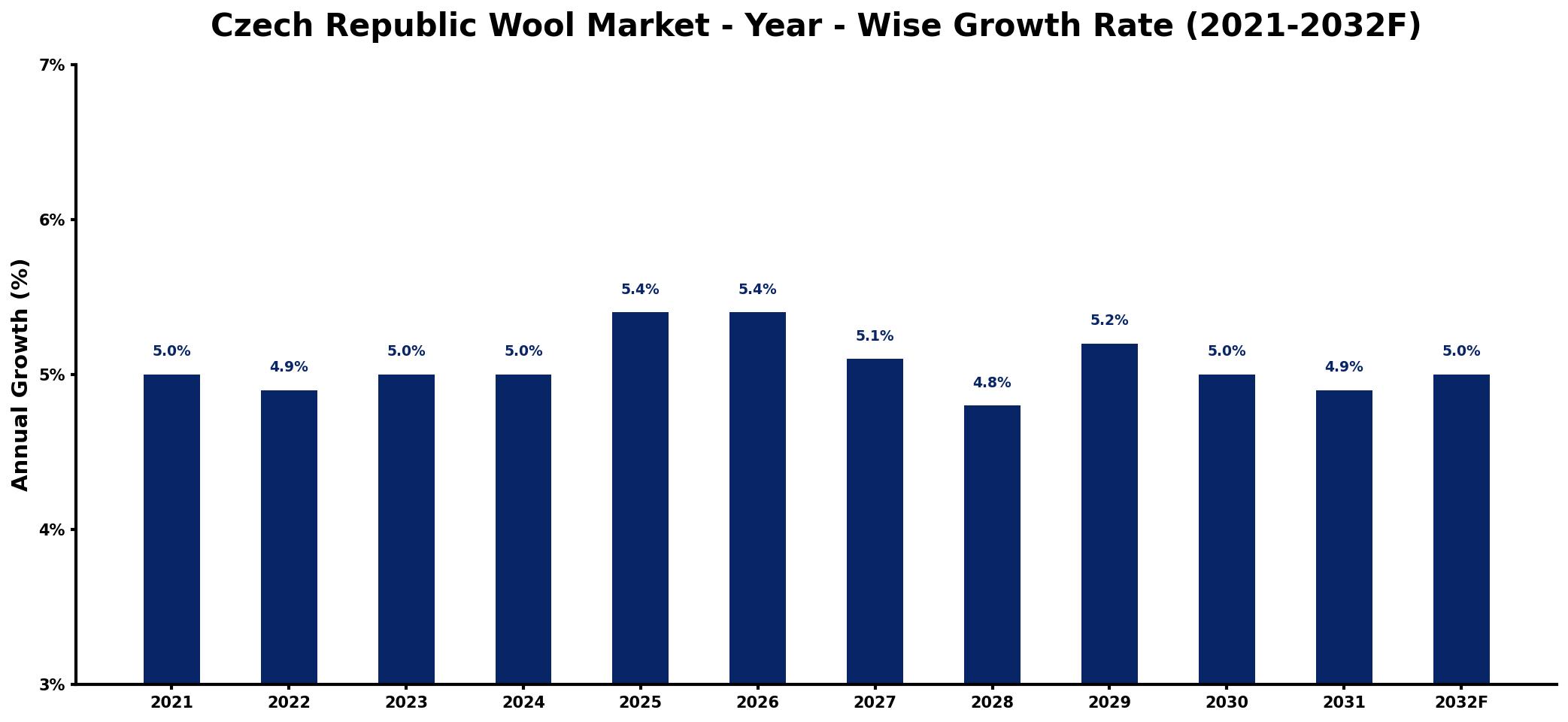
The table below presents the year‑wise growth rates along with the key drivers influencing the market
| Year | Growth Rate | Major Drivers |
| 2021 | 5.0% | Increased consumer interest in sustainability |
| 2022 | 4.9% | Growth in eco-friendly fashion trends |
| 2023 | 5.0% | Rising demand for natural fibers |
| 2024 | 5.0% | Expansion of local textile production |
| 2025 | 5.4% | Investment in renewable fiber technologies |
| 2026 | 5.4% | Boost in export opportunities abroad |
| 2027 | 5.1% | Development of innovative textile applications |
| 2028 | 4.8% | Strengthening of artisan craft markets |
| 2029 | 5.2% | Surge in online retail platforms |
| 2030 | 5.0% | Increase in agricultural support programs |
| 2031 | 4.9% | rising end-use demand growth |
| 2032 | 5.0% | Emergence of sustainable fashion brands |
Note: Market size estimations and growth projections presented in this report are based on 6Wresearch's proprietary forecasting methodology, utilizing the latest available industry data, government publications, and primary research inputs.
Czech Republic Wool Market Synopsis
The Czech Republic's wool market is experiencing a notable revival, with a robust demand for premium wool products. Driven by a growing awareness of sustainable practices, consumers are increasingly turning to wool as a natural, biodegradable fiber that aligns with their eco-conscious values.
This market is anchored by a rich heritage of wool production characterized by high-quality craftsmanship. With a network of dedicated local producers and manufacturers, the Czech wool industry is well-positioned to cater to both niche luxury markets and broader consumer demands.
Czech Republic Wool Market Key Takeaways
- The market is anticipated to reach USD 422 Million by 2032, driven by a growing focus on sustainable products.
- Local producers are emphasizing transparency and animal welfare to meet consumer expectations.
- There is an increasing trend towards innovative applications of wool beyond traditional textiles.
- Collaborations between wool producers and designers are fostering unique and environmentally friendly product lines.
- The aging population of sheep farmers presents a potential challenge for the industry's labor supply.
Evaluation of Restraints in Czech Republic Wool Market
While the Czech Republic Wool Market is poised for growth, several restraints are worth noting. Fluctuations in global wool prices continue to present challenges to producers, impacting their profit margins and pricing strategies. Furthermore, competition from synthetic fibers, which often offer lower prices, poses a significant threat. Changing consumer preferences, with some shifting towards more affordable alternatives, could also dampen the demand for traditional wool products. Additionally, the skilled labor shortage in wool processing could hinder production capabilities, requiring strategic investments in training and development.
Czech Republic Wool Market Trends
The Czech wool market is currently witnessing several key trends shaping its landscape. Notably, the demand for ethically sourced and sustainable wool is on the rise, as consumers increasingly prioritize eco-friendly products. Innovative uses of wool are emerging, particularly in sustainable packaging and insulation materials, diversifying its application beyond clothing and textiles. Collaborations between wool producers and designers are leading to unique product offerings that align with contemporary consumer values, blending traditional craftsmanship with modern aesthetics. Furthermore, there is a noticeable shift towards creating circular fashion systems within the industry.
Czech Republic Wool Market Opportunities
The Czech Republic Wool Market holds significant investment potential as it aligns with the global shift towards sustainability. Opportunities abound in wool farming, processing, and innovative product development, especially in luxury and designer segments. Investors can capitalize on the skilled workforce and established manufacturing infrastructure in the country. Additionally, partnerships with local wool producers can help navigate the European market landscape effectively, providing avenues for expansion and growth.
Government Initiatives in the Czech Republic Wool Market
The Czech government has enacted various policies aimed at enhancing the welfare of sheep and promoting sustainable wool production. Regulations ensure ethical farming practices while encouraging environmentally friendly methods. Furthermore, public initiatives are in place to support organic wool production and ensure fair trade practices. These efforts not only protect local wool producers but also aim to elevate the overall quality and marketability of Czech wool both domestically and internationally.
Future Insights of the Czech Republic Wool Market
Looking ahead to 2026-2032, the Czech Republic Wool Market is expected to sustain moderate growth, driven by the ongoing demand for eco-friendly products. The rising awareness of wool's natural properties—such as insulation and durability—will likely continue to fuel market expansion. However, challenges including fluctuating raw material prices and the ongoing competition from synthetic fibers may temper this growth. Ultimately, the market's resilience will hinge on its ability to innovate and adapt to the evolving preferences of environmentally conscious consumers.
Czech Republic Wool Market Latest Developments (2025 - 2026)
In the recent months leading up to mid-2026, the Czech wool market has seen notable shifts, particularly in consumer preferences towards sustainable products. Local producers are actively engaging in collaborations with designers to create unique collections that emphasize eco-friendliness. Meanwhile, government support for sustainable farming practices continues to strengthen the industry's foundations, helping producers adhere to ethical standards and maintain quality. As the market navigates these developments, it remains poised for steady growth.
Czech Republic Wool Market - Key Attractiveness of the Report
- 10 Years of Market Numbers
- Historical Data Starting from 2022 to 2025
- Base Year: 2025
- Forecast Data until 2032
- Key Performance Indicators Impacting the Market
- Major Upcoming Developments and Projects
Key Highlights of the Report:
- Czech Republic Wool Market Outlook
- Market Size of Czech Republic Wool Market, 2025
- Forecast of Czech Republic Wool Market, 2032
- Historical Data and Forecast of Czech Republic Wool Revenues & Volume for the Period 2022-2032F
- Czech Republic Wool Market Trend Evolution
- Czech Republic Wool Market Drivers and Challenges
- Czech Republic Wool Price Trends
- Czech Republic Wool Porter's Five Forces
- Czech Republic Wool Industry Life Cycle
- Historical Data and Forecast of Czech Republic Wool Market Revenues & Volume By Source for the Period 2022-2032F
- Historical Data and Forecast of Czech Republic Wool Market Revenues & Volume By Merino Wool for the Period 2022-2032F
- Historical Data and Forecast of Czech Republic Wool Market Revenues & Volume By Peruvian Highland Wool for the Period 2022-2032F
- Historical Data and Forecast of Czech Republic Wool Market Revenues & Volume By Teeswater Wool for the Period 2022-2032F
- Historical Data and Forecast of Czech Republic Wool Market Revenues & Volume By Shetland Wool for the Period 2022-2032F
- Historical Data and Forecast of Czech Republic Wool Market Revenues & Volume By Cashmere Wool for the Period 2022-2032F
- Historical Data and Forecast of Czech Republic Wool Market Revenues & Volume By others for the Period 2022-2032F
- Historical Data and Forecast of Czech Republic Wool Market Revenues & Volume By Type for the Period 2022-2032F
- Historical Data and Forecast of Czech Republic Wool Market Revenues & Volume By Fine wool (? 25 ) for the Period 2022-2032F
- Historical Data and Forecast of Czech Republic Wool Market Revenues & Volume By Medium wool (25 to 35 ) for the Period 2022-2032F
- Historical Data and Forecast of Czech Republic Wool Market Revenues & Volume By Coarse wool (? 35 ) for the Period 2022-2032F
- Historical Data and Forecast of Czech Republic Wool Market Revenues & Volume By Application for the Period 2022-2032F
- Historical Data and Forecast of Czech Republic Wool Market Revenues & Volume By Apparels for the Period 2022-2032F
- Historical Data and Forecast of Czech Republic Wool Market Revenues & Volume By Interior Textiles for the Period 2022-2032F
- Czech Republic Wool Import Export Trade Statistics
- Market Opportunity Assessment By Source
- Market Opportunity Assessment By Type
- Market Opportunity Assessment By Application
- Czech Republic Wool Top Companies Market Share
- Czech Republic Wool Competitive Benchmarking By Technical and Operational Parameters
- Czech Republic Wool Company Profiles
- Czech Republic Wool Key Strategic Recommendations






































