Denmark Cyclohexane Market Size (2020-2030)
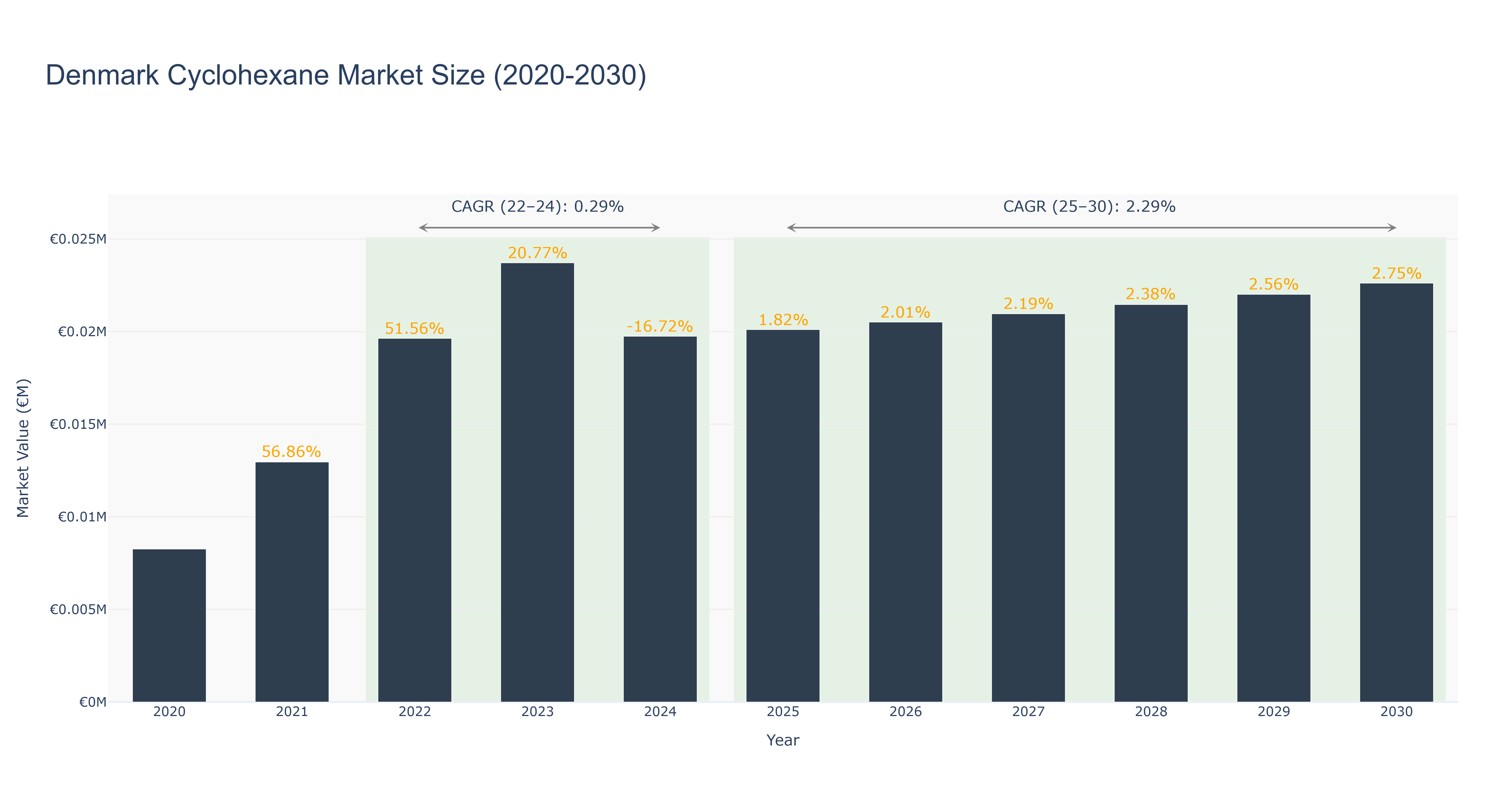
The Denmark Cyclohexane Market experienced significant growth from 2020 to 2022, peaking at €19.64 thousand in 2022, with robust annual growth rates of 56.86% in 2021 and 51.56% in 2022, driven by increased demand in various industrial applications. However, the market faced a downturn in 2024, with a decline of 16.72%, resulting in a projected market size of €19.75 thousand, reflecting a modest CAGR of 0.29% for the actual period from 2022 to 2024. Looking forward to the forecasted period from 2025 to 2030, the market is expected to stabilize with a CAGR of 2.29%, gradually increasing to €22.62 thousand by 2030. This growth is anticipated to be supported by ongoing developments in the chemical manufacturing sector and advancements in production technologies, which may enhance efficiency and reduce costs, positioning the market for steady recovery and expansion.
Denmark Cyclohexane Market: Production & Trade Performance (2019-2025)
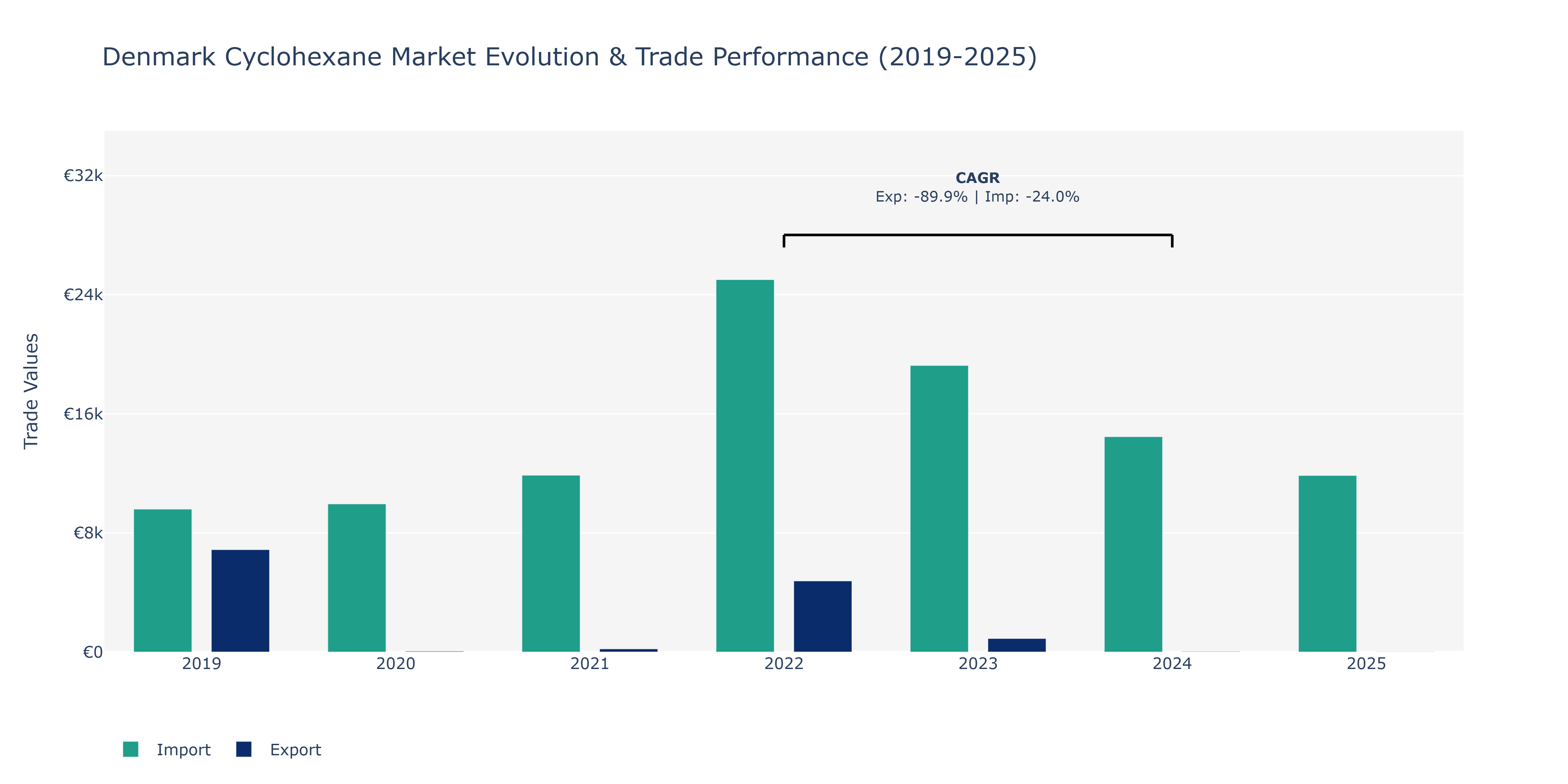
In the Denmark Cyclohexane Market, exports experienced substantial fluctuations over the specified years, reaching a peak of €4.776 thousand in 2022 after a sharp decline from €6.88 thousand in 2019 to €58 in 2020. This significant drop in 2020 could be attributed to various factors, including global economic disruptions caused by the COVID-19 pandemic affecting demand and supply chains. Similarly, imports showed a notable increase from €9.6 thousand in 2019 to €25.011 thousand in 2022, indicating growing demand for cyclohexane in the Danish market, possibly driven by industrial expansion and increased manufacturing activities. The subsequent decrease in imports to €14.462 thousand in 2024 could be a result of market stabilization post-pandemic, aligning with the negative CAGR of -23.96% during 2022-2024. The slight uptick in exports to €909 in 2023 followed by a drop to €49 in 2024 might reflect market uncertainties and varying international trade dynamics during this period. The declining trend in both exports and imports post-2022 could signal the need for market players to reassess their strategies in response to evolving market conditions and trade patterns within the cyclohexane industry.
Denmark Cyclohexane Market Overview
The cyclohexane market in Denmark is expanding, driven by its applications in the production of chemicals and solvents. Cyclohexane is a key feedstock for manufacturing nylon and other synthetic fibers, making it essential for the textile and automotive industries. The growing demand for these end-products is propelling the cyclohexane market forward. Additionally, the increasing focus on sustainable practices is driving innovation in the production and use of cyclohexane, as manufacturers seek eco-friendly alternatives and processes.
Drivers of the market
The cyclohexane market in Denmark is driven by its use in the production of nylon, which is widely used in textiles and plastics. The increasing demand for synthetic fibers and engineering plastics is boosting the market for cyclohexane.
Challenges of the market
The Denmark Cyclohexane Market struggles with fluctuating raw material prices and environmental concerns related to its production. The industry must also comply with stringent regulations aimed at reducing carbon emissions and chemical waste, which increases operational costs for manufacturers.
Government Policy of the market
Government policies affecting the cyclohexane market in Denmark emphasize environmental safety and chemical management. Regulations that promote the responsible use and handling of chemicals drive demand for safer production practices. Furthermore, government initiatives supporting research into alternative solvents align with Denmark`s commitment to reducing environmental impact and enhancing public safety.
Key Highlights of the Report:
- Denmark Cyclohexane Market Outlook
- Market Size of Denmark Cyclohexane Market, 2024
- Forecast of Denmark Cyclohexane Market, 2031
- Historical Data and Forecast of Denmark Cyclohexane Revenues & Volume for the Period 2021-2031
- Denmark Cyclohexane Market Trend Evolution
- Denmark Cyclohexane Market Drivers and Challenges
- Denmark Cyclohexane Price Trends
- Denmark Cyclohexane Porter`s Five Forces
- Denmark Cyclohexane Industry Life Cycle
- Historical Data and Forecast of Denmark Cyclohexane Market Revenues & Volume By Application for the Period 2021-2031
- Historical Data and Forecast of Denmark Cyclohexane Market Revenues & Volume By Adipic acid for the Period 2021-2031
- Historical Data and Forecast of Denmark Cyclohexane Market Revenues & Volume By Caprolactam for the Period 2021-2031
- Historical Data and Forecast of Denmark Cyclohexane Market Revenues & Volume By Others for the Period 2021-2031
- Historical Data and Forecast of Denmark Cyclohexane Market Revenues & Volume By End-use for the Period 2021-2031
- Historical Data and Forecast of Denmark Cyclohexane Market Revenues & Volume By Nylon 6 for the Period 2021-2031
- Historical Data and Forecast of Denmark Cyclohexane Market Revenues & Volume By Nylon 66 for the Period 2021-2031
- Historical Data and Forecast of Denmark Cyclohexane Market Revenues & Volume By Others for the Period 2021-2031
- Denmark Cyclohexane Import Export Trade Statistics
- Market Opportunity Assessment By Application
- Market Opportunity Assessment By End-use
- Denmark Cyclohexane Top Companies Market Share
- Denmark Cyclohexane Competitive Benchmarking By Technical and Operational Parameters
- Denmark Cyclohexane Company Profiles
- Denmark Cyclohexane Key Strategic Recommendations






































