Denmark Oscillator Market Top 5 Importing Countries and Market Competition (HHI) Analysis
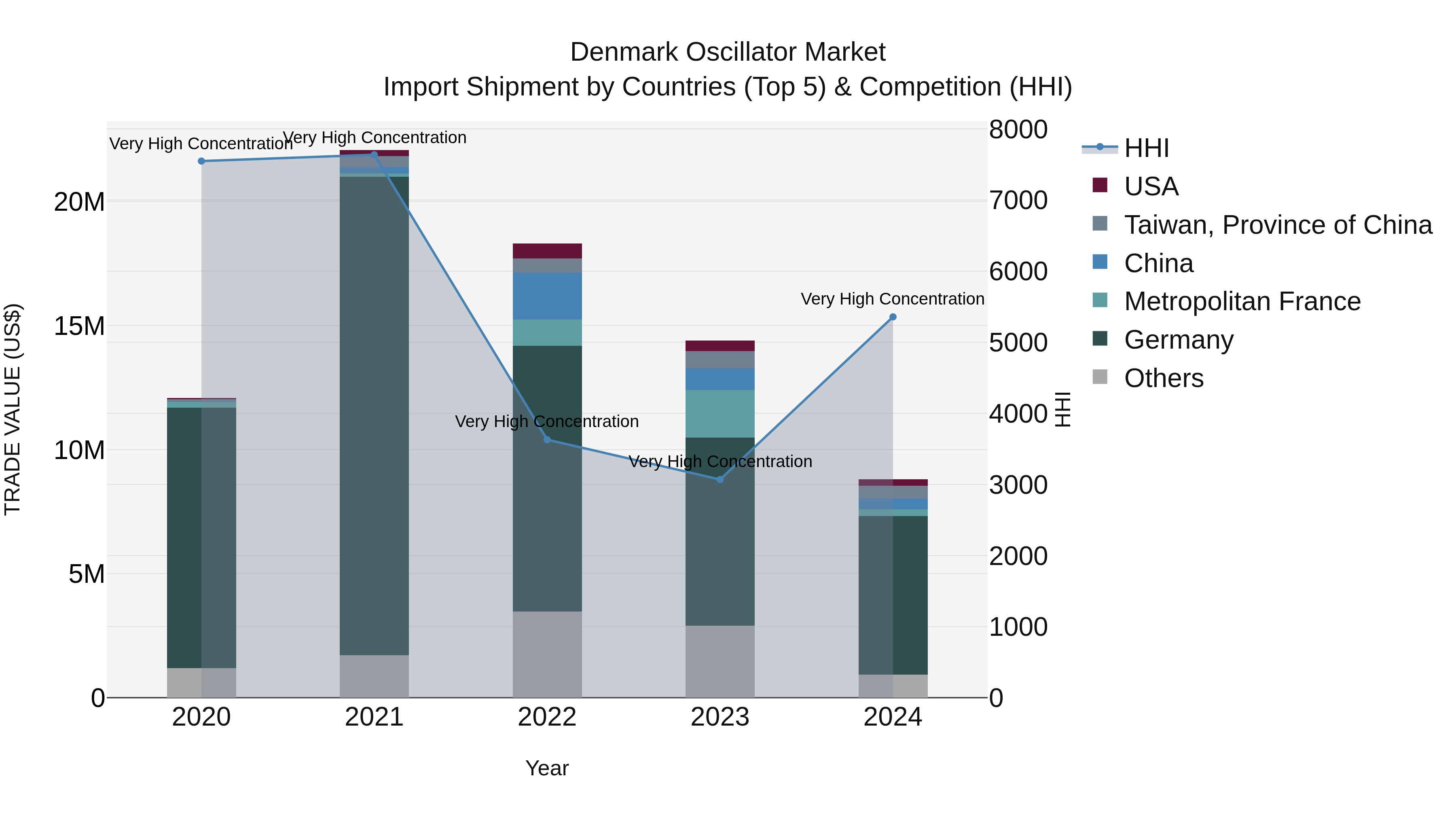
Denmark oscillator import market in 2024 saw significant contributions from top exporting countries such as Germany, Taiwan, China, Sweden, and Metropolitan France. Despite a high Herfindahl-Hirschman Index (HHI) indicating market concentration, the market experienced a negative compound annual growth rate (CAGR) of -7.6% from 2020 to 2024. The growth rate in 2024 further declined by -38.78%, signaling potential challenges and shifts in the market dynamics for oscillator imports in Denmark. Stakeholders should closely monitor these trends for strategic decision-making.
Denmark Oscillator Market Overview
The Denmark Oscillator Market is witnessing steady growth driven by increasing demand in various industries such as telecommunications, electronics, and healthcare. The market is characterized by the presence of both domestic and international players offering a wide range of oscillators including quartz, MEMS, and SAW oscillators. Key trends driving market growth include the growing adoption of wireless communication technologies, the rise in IoT devices, and the increasing need for precision timing in various applications. Market players are focusing on product innovation, strategic partnerships, and mergers and acquisitions to enhance their market presence and cater to evolving customer requirements. With technological advancements and the increasing use of oscillators in diverse applications, the Denmark Oscillator Market is expected to continue its growth trajectory in the coming years.
Denmark Oscillator Market Trends and Opportunities
The Denmark Oscillator Market is experiencing a growing demand for advanced oscillators in various industries such as telecommunications, healthcare, and automotive. The increasing adoption of 5G technology and IoT devices is driving the need for high-frequency oscillators with improved performance and stability. Additionally, the emphasis on precision timing and frequency control in industrial automation and aerospace applications is creating opportunities for innovative oscillator solutions. Key trends in the market include the development of compact and energy-efficient oscillators, as well as the integration of advanced features like temperature compensation and remote monitoring capabilities. Companies operating in the Denmark Oscillator Market have the opportunity to capitalize on these trends by investing in research and development to deliver cutting-edge products that meet the evolving needs of customers in a range of industries.
Denmark Oscillator Market Challenges
In the Denmark Oscillator Market, some of the challenges faced include increasing competition from international manufacturers, fluctuating raw material prices impacting product costs, and the need to continuously innovate to meet evolving technological requirements. Additionally, regulatory changes related to product standards and certifications can pose challenges for companies operating in the market. Ensuring reliable supply chains and managing inventory levels effectively are also key challenges, especially in the context of global economic uncertainties and geopolitical factors. Furthermore, the market`s sensitivity to macroeconomic conditions and consumer preferences adds complexity to forecasting demand and staying ahead of market trends. Overall, companies in the Denmark Oscillator Market need to navigate these challenges strategically to maintain competitiveness and drive sustainable growth.
Denmark Oscillator Market Drivers
The Denmark Oscillator Market is primarily driven by increasing demand for electronic devices across various industries such as telecommunications, healthcare, and automotive. The growing adoption of advanced technologies like 5G networks and Internet of Things (IoT) is fueling the need for precision oscillators for accurate frequency control. Additionally, the rising trend of miniaturization in electronic devices is boosting the demand for compact and high-performance oscillators. Furthermore, the emphasis on research and development activities in the electronics sector to enhance product efficiency and performance is driving the market growth. The increasing focus on renewable energy sources and the expansion of the industrial automation sector are also contributing to the demand for oscillators in Denmark.
Denmark Oscillator Market Government Policies
In Denmark, the oscillator market is subject to government regulations aimed at ensuring product safety, quality, and environmental sustainability. The Danish government has implemented strict standards and certification requirements for oscillators to be sold in the market, with a focus on compliance with EU regulations. Additionally, there are policies promoting innovation and research in the field of oscillators, with funding opportunities available for companies engaged in developing new technologies. The government also encourages the use of oscillators in renewable energy projects to support the country`s transition towards a greener economy. Overall, Denmark`s policies towards the oscillator market prioritize consumer protection, technological advancement, and environmental responsibility.
Denmark Oscillator Market Future Outlook
The Denmark Oscillator Market is expected to witness steady growth in the coming years, driven by increasing demand for oscillators in various applications such as telecommunications, consumer electronics, automotive, and healthcare. The market is likely to benefit from technological advancements, particularly in the development of compact and energy-efficient oscillators. Additionally, the growing adoption of IoT devices and the emergence of 5G technology are anticipated to further fuel the demand for oscillators in Denmark. However, challenges such as intense competition among key players and fluctuations in raw material prices may impact market growth. Overall, the Denmark Oscillator Market is projected to expand as industries continue to integrate advanced technologies, creating opportunities for innovation and market expansion.
Key Highlights of the Report:
- Denmark Oscillator Market Outlook
- Market Size of Denmark Oscillator Market, 2024
- Forecast of Denmark Oscillator Market, 2031
- Historical Data and Forecast of Denmark Oscillator Revenues & Volume for the Period 2021- 2031
- Denmark Oscillator Market Trend Evolution
- Denmark Oscillator Market Drivers and Challenges
- Denmark Oscillator Price Trends
- Denmark Oscillator Porter's Five Forces
- Denmark Oscillator Industry Life Cycle
- Historical Data and Forecast of Denmark Oscillator Market Revenues & Volume By Type for the Period 2021- 2031
- Historical Data and Forecast of Denmark Oscillator Market Revenues & Volume By Temperature Compensated Crystal Oscillator (TCXO) for the Period 2021- 2031
- Historical Data and Forecast of Denmark Oscillator Market Revenues & Volume By Voltage-controlled Crystal Oscillator (VCXO) for the Period 2021- 2031
- Historical Data and Forecast of Denmark Oscillator Market Revenues & Volume By Oven-controlled Crystal Oscillator (OCXO) for the Period 2021- 2031
- Historical Data and Forecast of Denmark Oscillator Market Revenues & Volume By MEMS Oscillators for the Period 2021- 2031
- Historical Data and Forecast of Denmark Oscillator Market Revenues & Volume By Mounting Type for the Period 2021- 2031
- Historical Data and Forecast of Denmark Oscillator Market Revenues & Volume By Surface Mount for the Period 2021- 2031
- Historical Data and Forecast of Denmark Oscillator Market Revenues & Volume By Thru-hole for the Period 2021- 2031
- Historical Data and Forecast of Denmark Oscillator Market Revenues & Volume By Others for the Period 2021- 2031
- Historical Data and Forecast of Denmark Oscillator Market Revenues & Volume By End-user Industry for the Period 2021- 2031
- Historical Data and Forecast of Denmark Oscillator Market Revenues & Volume By Consumer Electronics for the Period 2021- 2031
- Historical Data and Forecast of Denmark Oscillator Market Revenues & Volume By Automotive for the Period 2021- 2031
- Historical Data and Forecast of Denmark Oscillator Market Revenues & Volume By Telecom and Networking for the Period 2021- 2031
- Historical Data and Forecast of Denmark Oscillator Market Revenues & Volume By Aerospace and Defense for the Period 2021- 2031
- Historical Data and Forecast of Denmark Oscillator Market Revenues & Volume By Research and Medical for the Period 2021- 2031
- Historical Data and Forecast of Denmark Oscillator Market Revenues & Volume By Industrial for the Period 2021- 2031
- Denmark Oscillator Import Export Trade Statistics
- Market Opportunity Assessment By Type
- Market Opportunity Assessment By Mounting Type
- Market Opportunity Assessment By End-user Industry
- Denmark Oscillator Top Companies Market Share
- Denmark Oscillator Competitive Benchmarking By Technical and Operational Parameters
- Denmark Oscillator Company Profiles
- Denmark Oscillator Key Strategic Recommendations






































