Denmark Recordable Optical Disc Market Top 5 Importing Countries and Market Competition (HHI) Analysis
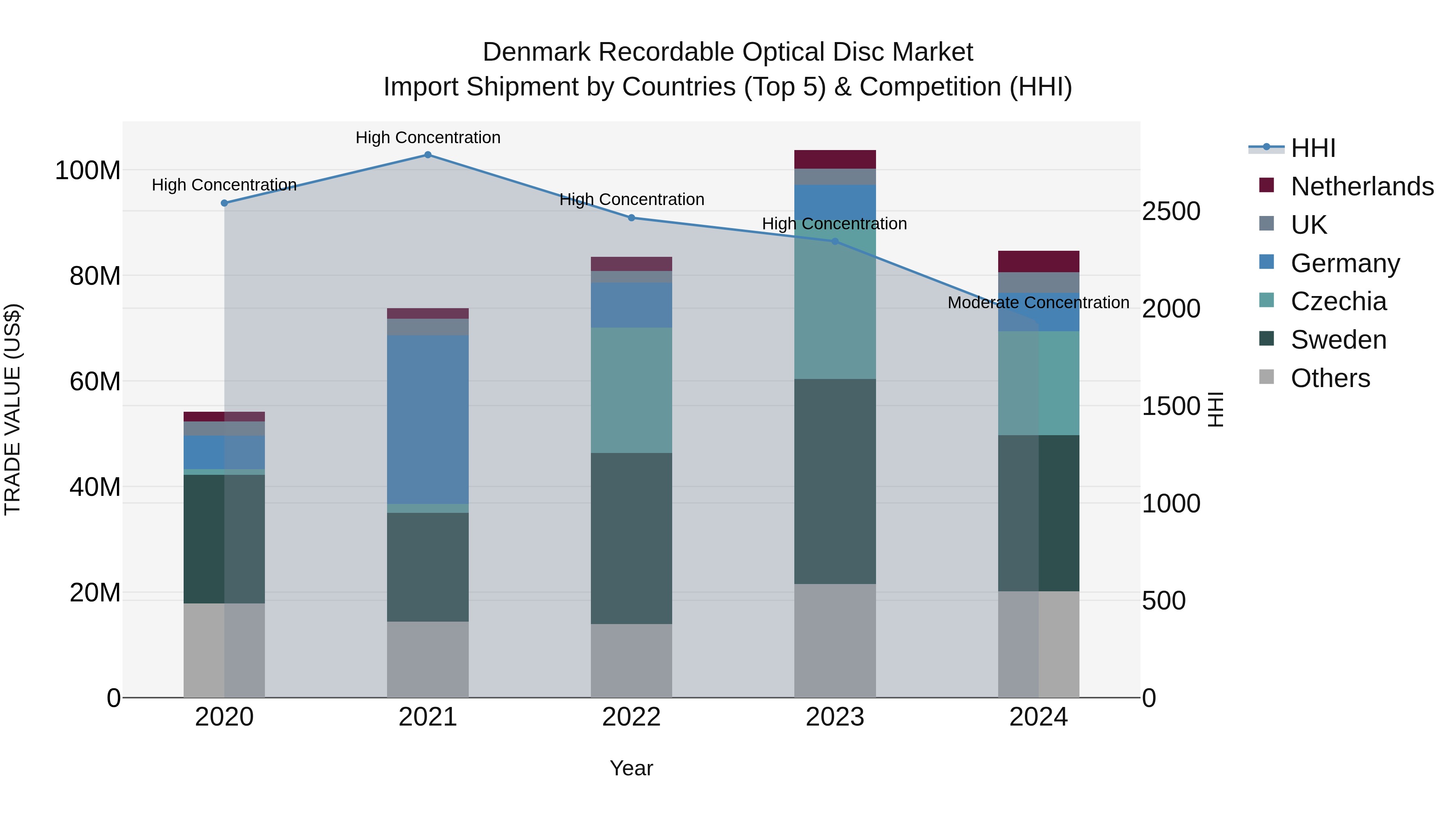
Denmark recordable optical disc import market saw a shift in concentration levels in 2024, moving from high to moderate concentration. The top exporting countries to Denmark in 2024 were Sweden, Czechia, Germany, China, and the Netherlands, indicating a diverse source of supply. Despite a slight decline in growth rate from 2023 to 2024, the compound annual growth rate for the period 2020-2024 was a strong 11.8%, highlighting a steady expansion in the market. This data suggests a competitive market landscape with opportunities for continued growth and innovation in the recordable optical disc industry in Denmark.
Denmark Recordable Optical Disc Market Overview
The recordable optical disc market in Denmark is facing significant transformation as digital alternatives gain prominence. While traditional formats such as CDs, DVDs, and Blu-ray discs are still in use for specific applications, the shift towards cloud storage and streaming services is reshaping consumer behavior. Despite this, there remains a niche market for recordable optical discs in sectors like data archiving, media production, and personal storage. The market is supported by advancements in disc technology, providing higher storage capacities and improved durability. As consumers continue to seek reliable data storage solutions, the recordable optical disc market is expected to find its place amid evolving technology trends.
Drivers of the market
Despite a global decline in the demand for physical media, the recordable optical disc market in Denmark still finds niche applications in data storage and archival purposes. The need for long-term data preservation, especially in industries like healthcare and legal services, is driving demand for optical discs due to their durability and reliability. Additionally, the cost-effectiveness of optical media for bulk data storage, combined with concerns about cybersecurity in digital storage systems, continues to maintain a modest demand for recordable optical discs in Denmark.
Challenges of the market
The recordable optical disc market in Denmark is struggling with declining demand as digital storage solutions gain dominance. Many consumers and businesses are shifting towards cloud storage and USB drives, which offer greater convenience and higher storage capacities. This trend has led to a decrease in production volumes, making it difficult for manufacturers to sustain profitability. Furthermore, the market faces challenges related to innovation, as advancements in technology create an environment where traditional optical discs are increasingly seen as outdated. As a result, companies in this sector must explore new applications and adapt their product offerings to remain relevant in a rapidly changing landscape.
Government Policy of the market
With Denmark focusing on digitalization and cloud-based data storage, the recordable optical disc market is witnessing shifts due to government-driven initiatives that encourage digital transformations across various sectors. The Danish government`s policies promoting sustainable practices and reducing electronic waste also influence this market, as optical discs are increasingly viewed as outdated technology with environmental downsides. Recycling programs and environmental regulations push companies and consumers to transition to more eco-friendly, digital solutions.
Key Highlights of the Report:
- Denmark Recordable Optical Disc Market Outlook
- Market Size of Denmark Recordable Optical Disc Market, 2024
- Forecast of Denmark Recordable Optical Disc Market, 2031
- Historical Data and Forecast of Denmark Recordable Optical Disc Revenues & Volume for the Period 2021-2031
- Denmark Recordable Optical Disc Market Trend Evolution
- Denmark Recordable Optical Disc Market Drivers and Challenges
- Denmark Recordable Optical Disc Price Trends
- Denmark Recordable Optical Disc Porter`s Five Forces
- Denmark Recordable Optical Disc Industry Life Cycle
- Historical Data and Forecast of Denmark Recordable Optical Disc Market Revenues & Volume By Product Type for the Period 2021-2031
- Historical Data and Forecast of Denmark Recordable Optical Disc Market Revenues & Volume By Compact Discs (CD) for the Period 2021-2031
- Historical Data and Forecast of Denmark Recordable Optical Disc Market Revenues & Volume By Digital Versatile Discs (DVD) for the Period 2021-2031
- Historical Data and Forecast of Denmark Recordable Optical Disc Market Revenues & Volume By Sales Channel for the Period 2021-2031
- Historical Data and Forecast of Denmark Recordable Optical Disc Market Revenues & Volume By Online Sales of Recordable Optical Discs for the Period 2021-2031
- Historical Data and Forecast of Denmark Recordable Optical Disc Market Revenues & Volume By Offline Sales of Recordable Optical Discs for the Period 2021-2031
- Historical Data and Forecast of Denmark Recordable Optical Disc Market Revenues & Volume By Sales of Recordable Optical Discs by Distributors for the Period 2021-2031
- Historical Data and Forecast of Denmark Recordable Optical Disc Market Revenues & Volume By Sales of Recordable Optical Discs by Resellers for the Period 2021-2031
- Historical Data and Forecast of Denmark Recordable Optical Disc Market Revenues & Volume By Direct Sales of Sales of Recordable Optical Discs for the Period 2021-2031
- Historical Data and Forecast of Denmark Recordable Optical Disc Market Revenues & Volume By End Use for the Period 2021-2031
- Historical Data and Forecast of Denmark Recordable Optical Disc Market Revenues & Volume By Consumers for the Period 2021-2031
- Historical Data and Forecast of Denmark Recordable Optical Disc Market Revenues & Volume By Professionals for the Period 2021-2031
- Historical Data and Forecast of Denmark Recordable Optical Disc Market Revenues & Volume By Storage Capacity for the Period 2021-2031
- Historical Data and Forecast of Denmark Recordable Optical Disc Market Revenues & Volume By Below 5GB Recordable Optical Discs for the Period 2021-2031
- Historical Data and Forecast of Denmark Recordable Optical Disc Market Revenues & Volume By 5-10 GB Recordable Optical Discs for the Period 2021-2031
- Historical Data and Forecast of Denmark Recordable Optical Disc Market Revenues & Volume By Above 10 GB Recordable Optical Discs for the Period 2021-2031
- Denmark Recordable Optical Disc Import Export Trade Statistics
- Market Opportunity Assessment By Product Type
- Market Opportunity Assessment By Sales Channel
- Market Opportunity Assessment By End Use
- Market Opportunity Assessment By Storage Capacity
- Denmark Recordable Optical Disc Top Companies Market Share
- Denmark Recordable Optical Disc Competitive Benchmarking By Technical and Operational Parameters
- Denmark Recordable Optical Disc Company Profiles
- Denmark Recordable Optical Disc Key Strategic Recommendations






































