Denmark Sensor Market Top 5 Importing Countries and Market Competition (HHI) Analysis
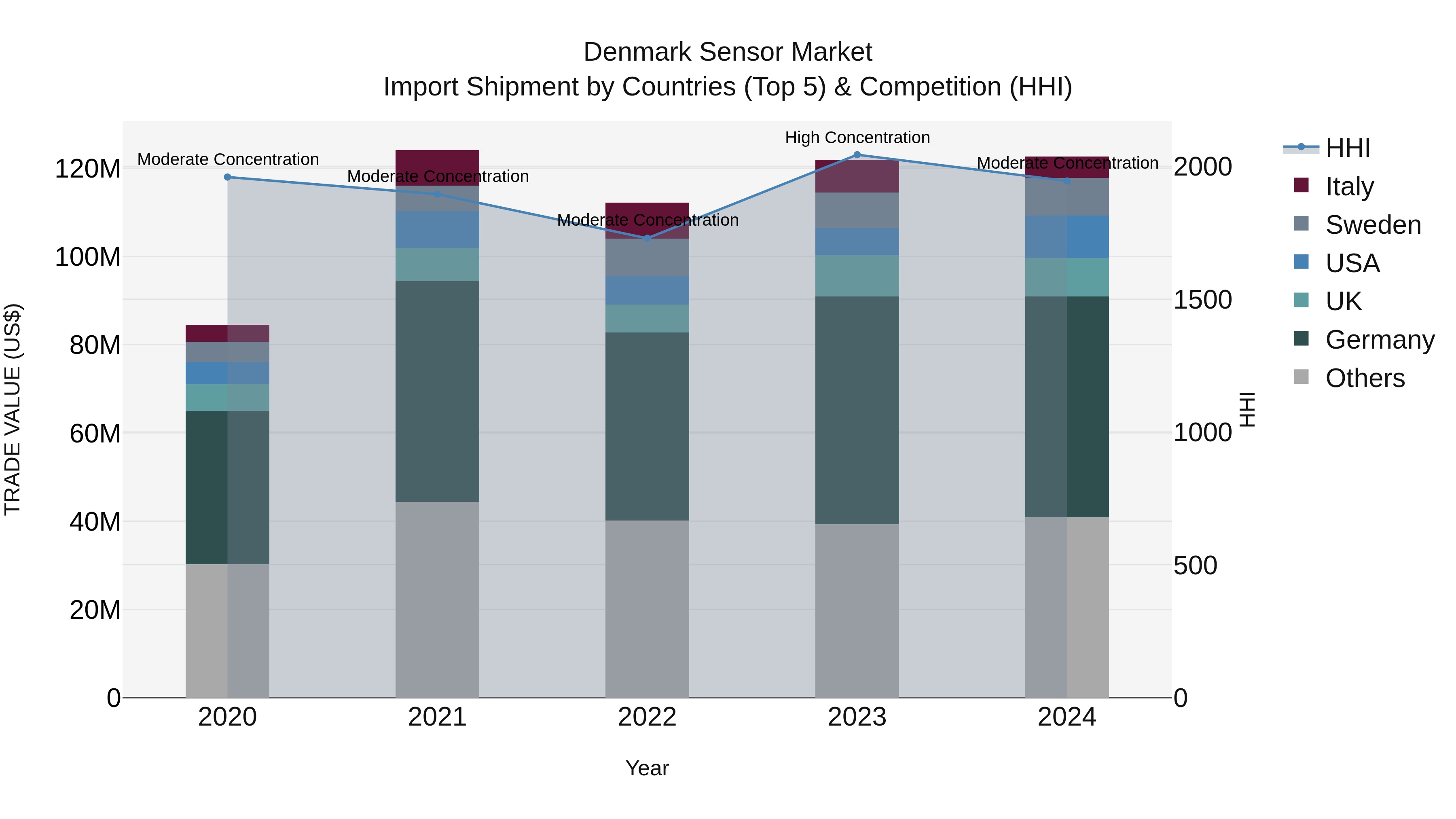
Denmark sensor import market in 2024 continues to thrive, with top suppliers including Germany, USA, UK, Sweden, and Netherlands. The market concentration, as measured by the Herfindahl-Hirschman Index (HHI), has shifted from high to moderate in 2024, indicating a more balanced competitive landscape. The compound annual growth rate (CAGR) from 2020 to 2024 stands at an impressive 9.74%, showcasing sustained market expansion. Additionally, the growth rate from 2023 to 2024 is 0.55%, reflecting a stable upward trend in sensor imports. This data suggests a positive outlook for the sensor market in Denmark.
Denmark Sensor Market Overview
The Denmark Sensor Market is experiencing significant growth driven by the increasing adoption of IoT technology across various industries such as automotive, healthcare, and manufacturing. The market is witnessing a surge in demand for sensors due to their crucial role in enabling data collection and analysis for smart devices and systems. Key sensor types in high demand include temperature sensors, pressure sensors, motion sensors, and image sensors. Furthermore, the market is also benefiting from the rising focus on environmental monitoring and sustainability initiatives. Key players in the Denmark Sensor Market include Danfoss, Sensata Technologies, and Infineon Technologies. The market is expected to continue its growth trajectory supported by ongoing technological advancements and the expanding application of sensors in diverse sectors.
Denmark Sensor Market Trends and Opportunities
The Denmark Sensor Market is experiencing significant growth driven by increasing adoption of IoT technology across various industries such as healthcare, automotive, and manufacturing. Key trends in the market include the rising demand for smart sensors for monitoring and control purposes, as well as the integration of sensors with artificial intelligence and machine learning capabilities. Opportunities in the Denmark Sensor Market lie in the development of advanced sensor technologies for applications like environmental monitoring, smart cities, and precision agriculture. Additionally, the increasing focus on sustainability and energy efficiency is driving demand for sensors that can enable more efficient resource utilization. Overall, the Denmark Sensor Market presents promising prospects for companies involved in sensor manufacturing and technology development.
Denmark Sensor Market Challenges
In the Denmark Sensor Market, challenges include increasing competition from global players, rapid technological advancements leading to shorter product life cycles, and the need for innovation to stay ahead in the market. Additionally, strict regulations and standards related to data privacy and security pose challenges for sensor manufacturers in terms of compliance and increased costs. The demand for sensors with higher accuracy, reliability, and efficiency also puts pressure on companies to continuously improve their products and invest in research and development. Furthermore, fluctuations in raw material prices and supply chain disruptions can impact the overall manufacturing process and lead to uncertainties in the market. Overall, companies operating in the Denmark Sensor Market need to navigate these challenges effectively to maintain their competitive edge and drive growth.
Denmark Sensor Market Drivers
The Denmark Sensor Market is primarily driven by the increasing demand for automation and smart technologies across various industries such as automotive, healthcare, and manufacturing. The adoption of Internet of Things (IoT) devices and the need for efficient monitoring and control systems are also fueling the growth of the sensor market in Denmark. Additionally, the government`s focus on sustainability and energy efficiency is driving the demand for sensors used in environmental monitoring and smart city applications. Technological advancements in sensor technologies, such as the development of miniaturized sensors and advancements in wireless communication protocols, are further propelling market growth. Overall, the Denmark Sensor Market is expected to continue expanding due to the growing trend towards digitalization and the integration of sensors in various applications to improve operational efficiency and enhance overall performance.
Denmark Sensor Market Government Policies
In Denmark, the sensor market is influenced by government policies promoting sustainable development and innovation. The government has implemented regulations encouraging the adoption of sensor technologies to improve energy efficiency, reduce emissions, and enhance overall environmental performance. Denmark`s strong focus on renewable energy and smart city initiatives also drives the demand for sensors in various applications such as smart grids, transportation, and building automation. Additionally, the government offers support through funding programs and incentives to boost research and development activities in the sensor industry. Overall, Denmark`s progressive policies and commitment to sustainability create a favorable environment for the growth of the sensor market in the country.
Denmark Sensor Market Future Outlook
The Denmark Sensor Market is poised for significant growth in the coming years, driven by increasing adoption of IoT technology, smart devices, and automation across various industries such as manufacturing, healthcare, and automotive. The demand for sensors in applications like environmental monitoring, connected devices, and industrial automation is expected to surge, fueling market expansion. Additionally, the rise in government initiatives promoting sustainable development and energy efficiency will further boost the sensor market in Denmark. Technological advancements in sensor technologies, such as MEMS sensors and wireless sensors, will also play a crucial role in shaping the future of the market. Overall, the Denmark Sensor Market is forecasted to experience steady growth and innovation opportunities in the foreseeable future.
Key Highlights of the Report:
- Denmark Sensor Market Outlook
- Market Size of Denmark Sensor Market, 2024
- Forecast of Denmark Sensor Market, 2031
- Historical Data and Forecast of Denmark Sensor Revenues & Volume for the Period 2021- 2031
- Denmark Sensor Market Trend Evolution
- Denmark Sensor Market Drivers and Challenges
- Denmark Sensor Price Trends
- Denmark Sensor Porter's Five Forces
- Denmark Sensor Industry Life Cycle
- Historical Data and Forecast of Denmark Sensor Market Revenues & Volume By Type for the Period 2021- 2031
- Historical Data and Forecast of Denmark Sensor Market Revenues & Volume By Pressure for the Period 2021- 2031
- Historical Data and Forecast of Denmark Sensor Market Revenues & Volume By Level for the Period 2021- 2031
- Historical Data and Forecast of Denmark Sensor Market Revenues & Volume By Flow for the Period 2021- 2031
- Historical Data and Forecast of Denmark Sensor Market Revenues & Volume By Chemical for the Period 2021- 2031
- Historical Data and Forecast of Denmark Sensor Market Revenues & Volume By Inertial for the Period 2021- 2031
- Historical Data and Forecast of Denmark Sensor Market Revenues & Volume By Magnetic for the Period 2021- 2031
- Historical Data and Forecast of Denmark Sensor Market Revenues & Volume By Others for the Period 2021- 2031
- Historical Data and Forecast of Denmark Sensor Market Revenues & Volume By Mode of Operation for the Period 2021- 2031
- Historical Data and Forecast of Denmark Sensor Market Revenues & Volume By Optical for the Period 2021- 2031
- Historical Data and Forecast of Denmark Sensor Market Revenues & Volume By Biosensor for the Period 2021- 2031
- Historical Data and Forecast of Denmark Sensor Market Revenues & Volume By Image for the Period 2021- 2031
- Historical Data and Forecast of Denmark Sensor Market Revenues & Volume By Capacitive for the Period 2021- 2031
- Historical Data and Forecast of Denmark Sensor Market Revenues & Volume By Lidar for the Period 2021- 2031
- Historical Data and Forecast of Denmark Sensor Market Revenues & Volume By Radar for the Period 2021- 2031
- Historical Data and Forecast of Denmark Sensor Market Revenues & Volume By Others for the Period 2021- 2031
- Historical Data and Forecast of Denmark Sensor Market Revenues & Volume By End-User Industry for the Period 2021- 2031
- Historical Data and Forecast of Denmark Sensor Market Revenues & Volume By Automotive for the Period 2021- 2031
- Historical Data and Forecast of Denmark Sensor Market Revenues & Volume By Industrial for the Period 2021- 2031
- Historical Data and Forecast of Denmark Sensor Market Revenues & Volume By Construction for the Period 2021- 2031
- Historical Data and Forecast of Denmark Sensor Market Revenues & Volume By Agriculture for the Period 2021- 2031
- Historical Data and Forecast of Denmark Sensor Market Revenues & Volume By Mining for the Period 2021- 2031
- Historical Data and Forecast of Denmark Sensor Market Revenues & Volume By Aerospace for the Period 2021- 2031
- Historical Data and Forecast of Denmark Sensor Market Revenues & Volume By Others for the Period 2021- 2031
- Denmark Sensor Import Export Trade Statistics
- Market Opportunity Assessment By Type
- Market Opportunity Assessment By Mode of Operation
- Market Opportunity Assessment By End-User Industry
- Denmark Sensor Top Companies Market Share
- Denmark Sensor Competitive Benchmarking By Technical and Operational Parameters
- Denmark Sensor Company Profiles
- Denmark Sensor Key Strategic Recommendations






































