Denmark Urea Market Size (2020-2030)
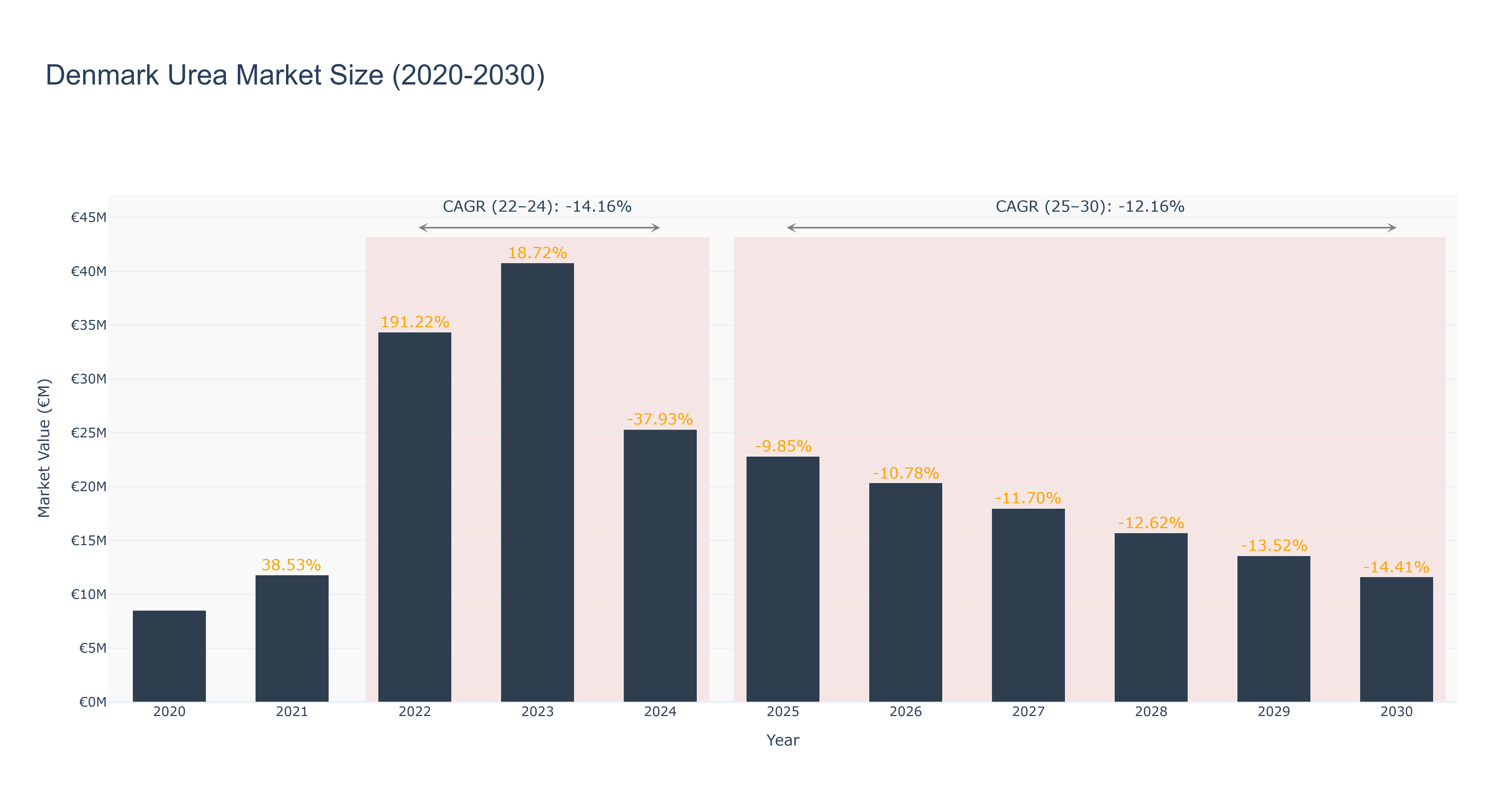
Denmark Urea Market has shown a fluctuating trend over the past decade. The peak market size of €40.79 million was recorded in 2023, followed by a significant decline to €25.31 million in 2024. The market continued to shrink, reaching €20.36 million in 2026. The CAGR from 2022 to 2024 was -14.16%, while from 2025 to 2030, it is projected at -12.16%. The market's downturn can be attributed to factors such as changing agricultural practices, global economic conditions, and environmental concerns. However, recent developments indicate a shift towards sustainable urea production methods and increased focus on organic farming in Denmark, which could potentially drive market growth in the future. Additionally, upcoming government initiatives aimed at promoting green technologies in agriculture are expected to positively impact the urea market in the country.
Denmark Urea Market: Production & Trade Performance (2019-2025)
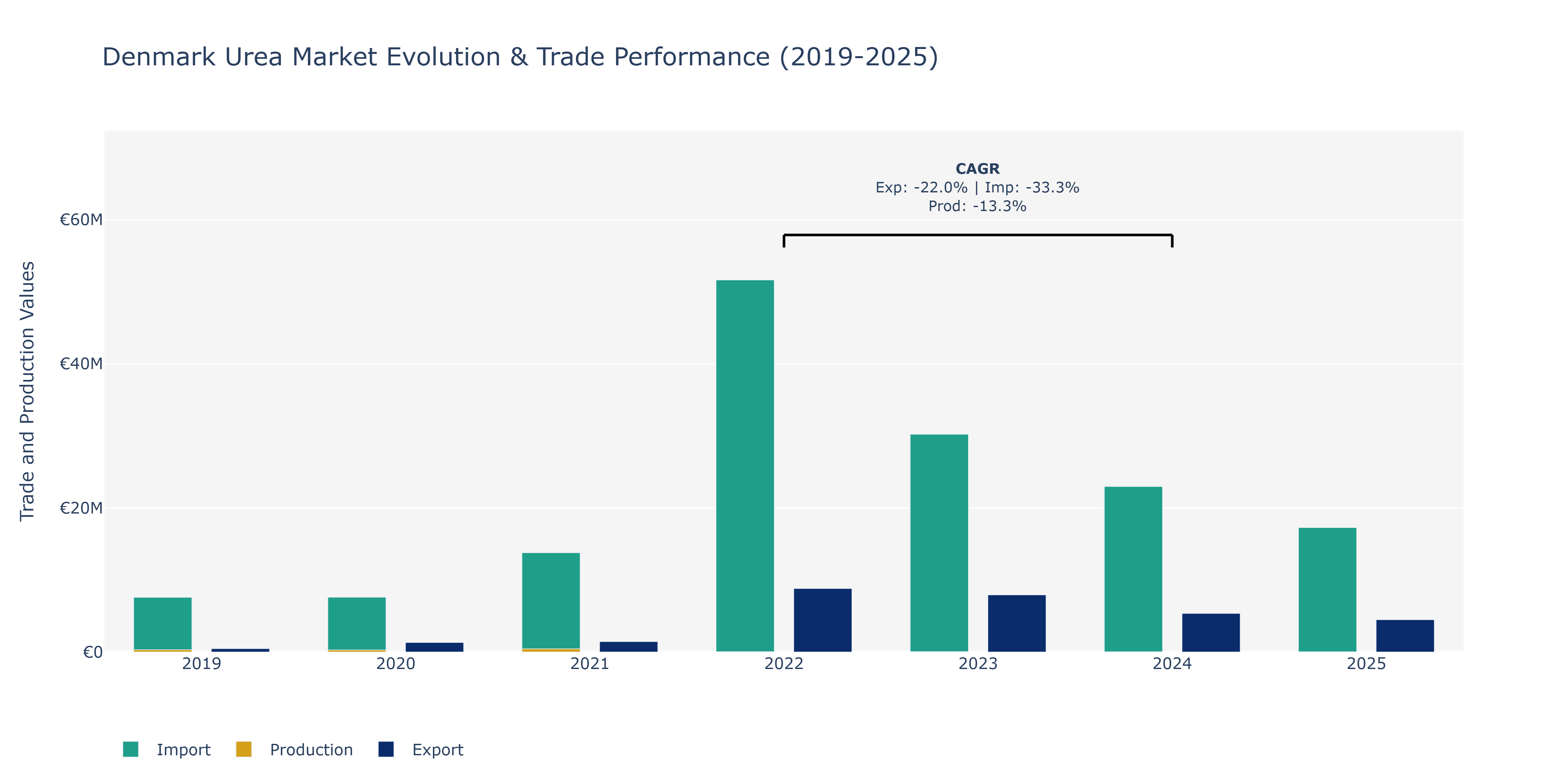
In the Denmark Urea Market, from 2019 to 2025, exports experienced fluctuations, reaching a peak in 2022 at €8.82 million before declining to €4.49 million in 2025. Imports followed a similar trend, peaking in 2022 at €51.63 million and then decreasing to €17.27 million in 2025. Production levels fluctuated as well, with a peak of €436.47 million in 2021 and a decline to €33.86 million in 2025. These fluctuations could be attributed to various factors such as changes in global demand for urea fertilizers, shifts in pricing dynamics, and possibly regulatory changes impacting trade patterns. The significant decrease in imports from 2022 to 2025 could be influenced by local production capacity ramp-up or changes in domestic consumption patterns. To maintain market competitiveness, companies operating in this sector may need to adapt to these changing market dynamics, possibly by focusing on enhancing production efficiency or exploring new export markets to mitigate the impact of fluctuating import levels.
Denmark Urea Market Overview
The urea market in Denmark primarily serves the agricultural sector as a key fertilizer component. While demand is stable due to its efficiency in boosting crop yields, the market is subject to environmental policies aimed at reducing the carbon footprint of fertilizers, encouraging the adoption of more sustainable agricultural practices.
Drivers of the market
The urea market in Denmark is driven by the agricultural sector`s need for nitrogen fertilizers to enhance crop yields. As global food demand continues to rise, the emphasis on agricultural productivity is pushing up the demand for urea as a cost-effective fertilizer. Additionally, the increasing adoption of precision farming techniques is leading to more targeted and efficient fertilizer use, thereby stimulating the urea market. The growth of the animal feed industry and the trend towards sustainable agricultural practices also play significant roles in driving the urea market.
Challenges of the market
The urea market in Denmark faces challenges stemming from environmental concerns, particularly with its use in fertilizers. Excessive use of urea-based fertilizers has been linked to soil degradation and water pollution due to nitrogen runoff, prompting stricter regulations and shifts toward more sustainable agricultural practices. Additionally, the market is influenced by volatile global prices for natural gas, a key raw material in urea production, which can affect the cost structure and profitability.
Government Policy of the market
The urea market in Denmark is closely linked to agricultural policies, particularly those promoting sustainable farming practices. The Danish government encourages the efficient use of fertilizers through regulations and best practices aimed at reducing nitrogen runoff and environmental impact. Policies aimed at supporting organic farming and minimizing chemical inputs can affect the demand and pricing dynamics of urea in the agricultural sector. Furthermore, Denmarks focus on reducing greenhouse gas emissions also influences the urea market, particularly regarding its use in nitrogen fertilizers.
Key Highlights of the Report:
- Denmark Urea Market Outlook
- Market Size of Denmark Urea Market, 2024
- Forecast of Denmark Urea Market, 2031
- Historical Data and Forecast of Denmark Urea Revenues & Volume for the Period 2021-2031
- Denmark Urea Market Trend Evolution
- Denmark Urea Market Drivers and Challenges
- Denmark Urea Price Trends
- Denmark Urea Porter`s Five Forces
- Denmark Urea Industry Life Cycle
- Historical Data and Forecast of Denmark Urea Market Revenues & Volume By Grade for the Period 2021-2031
- Historical Data and Forecast of Denmark Urea Market Revenues & Volume By Fertilizer for the Period 2021-2031
- Historical Data and Forecast of Denmark Urea Market Revenues & Volume By Feed for the Period 2021-2031
- Historical Data and Forecast of Denmark Urea Market Revenues & Volume By Technical for the Period 2021-2031
- Historical Data and Forecast of Denmark Urea Market Revenues & Volume By End-user Industry for the Period 2021-2031
- Historical Data and Forecast of Denmark Urea Market Revenues & Volume By Agriculture for the Period 2021-2031
- Historical Data and Forecast of Denmark Urea Market Revenues & Volume By Chemical for the Period 2021-2031
- Historical Data and Forecast of Denmark Urea Market Revenues & Volume By Automotive for the Period 2021-2031
- Historical Data and Forecast of Denmark Urea Market Revenues & Volume By Medical for the Period 2021-2031
- Historical Data and Forecast of Denmark Urea Market Revenues & Volume By Others for the Period 2021-2031
- Denmark Urea Import Export Trade Statistics
- Market Opportunity Assessment By Grade
- Market Opportunity Assessment By End-user Industry
- Denmark Urea Top Companies Market Share
- Denmark Urea Competitive Benchmarking By Technical and Operational Parameters
- Denmark Urea Company Profiles
- Denmark Urea Key Strategic Recommendations






































