Denmark Wine Production Machinery Market Size (2020-2030)
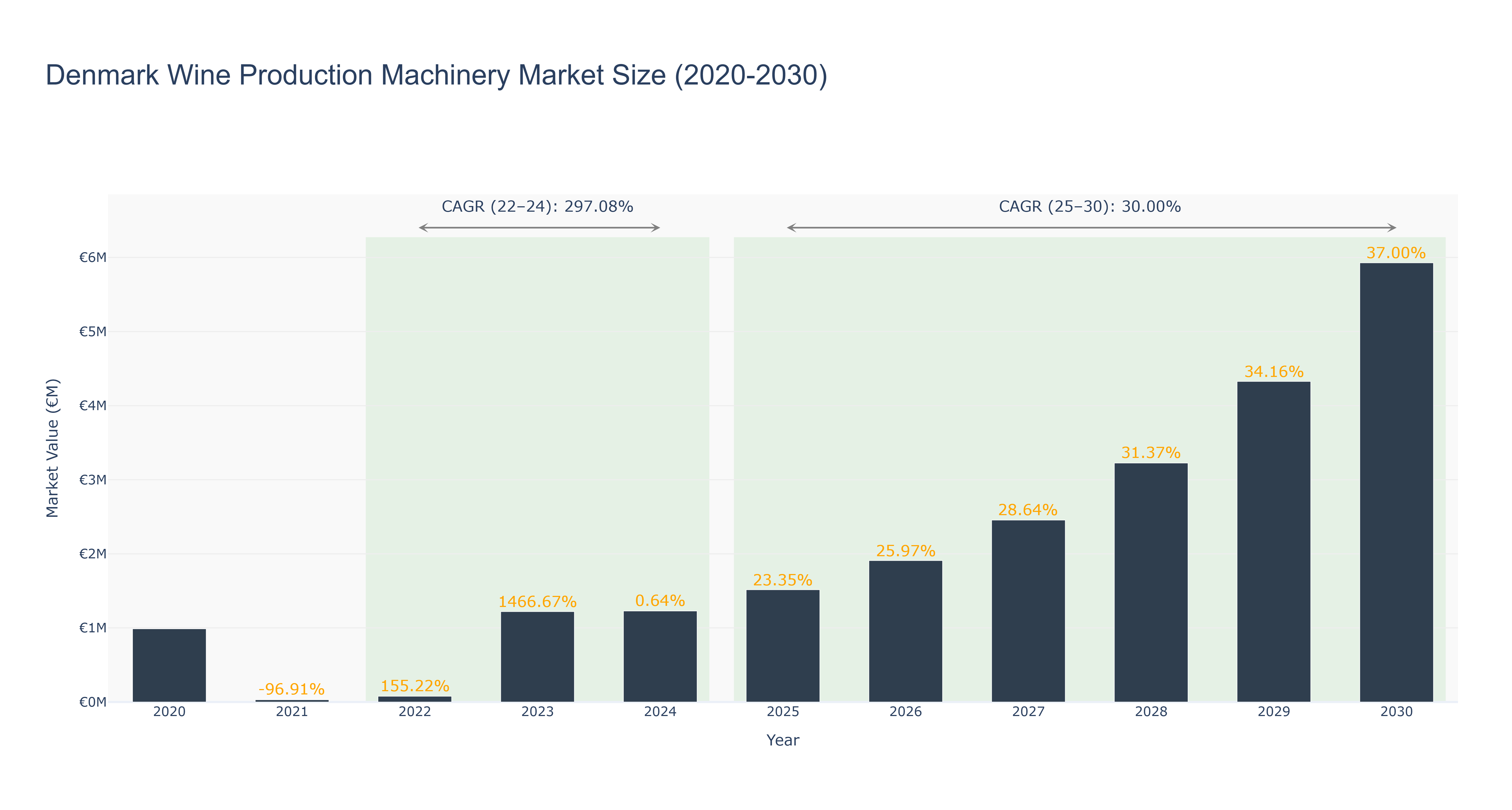
The Denmark Wine Production Machinery Market has exhibited significant volatility and growth in recent years. After reaching a peak market size of €987.41 thousand in 2020, the market experienced a dramatic decline to €30.52 thousand in 2021, reflecting a growth rate of -96.91%. However, it rebounded strongly, achieving €1.23 million in 2024, with an impressive CAGR of 297.08% from 2022 to 2024. Looking forward, the market is projected to maintain a robust growth trajectory, with an expected market size of €5.93 million by 2030, reflecting a CAGR of 30.00% from 2025 to 2030. This anticipated growth is driven by increasing consumer demand for high-quality wine production, advancements in technology, and investment in modern production facilities. As Denmark continues to enhance its wine industry, the focus on sustainable practices and innovation in machinery will further bolster market expansion.
Denmark Wine Production Machinery Market: Production & Trade Performance (2019-2025)
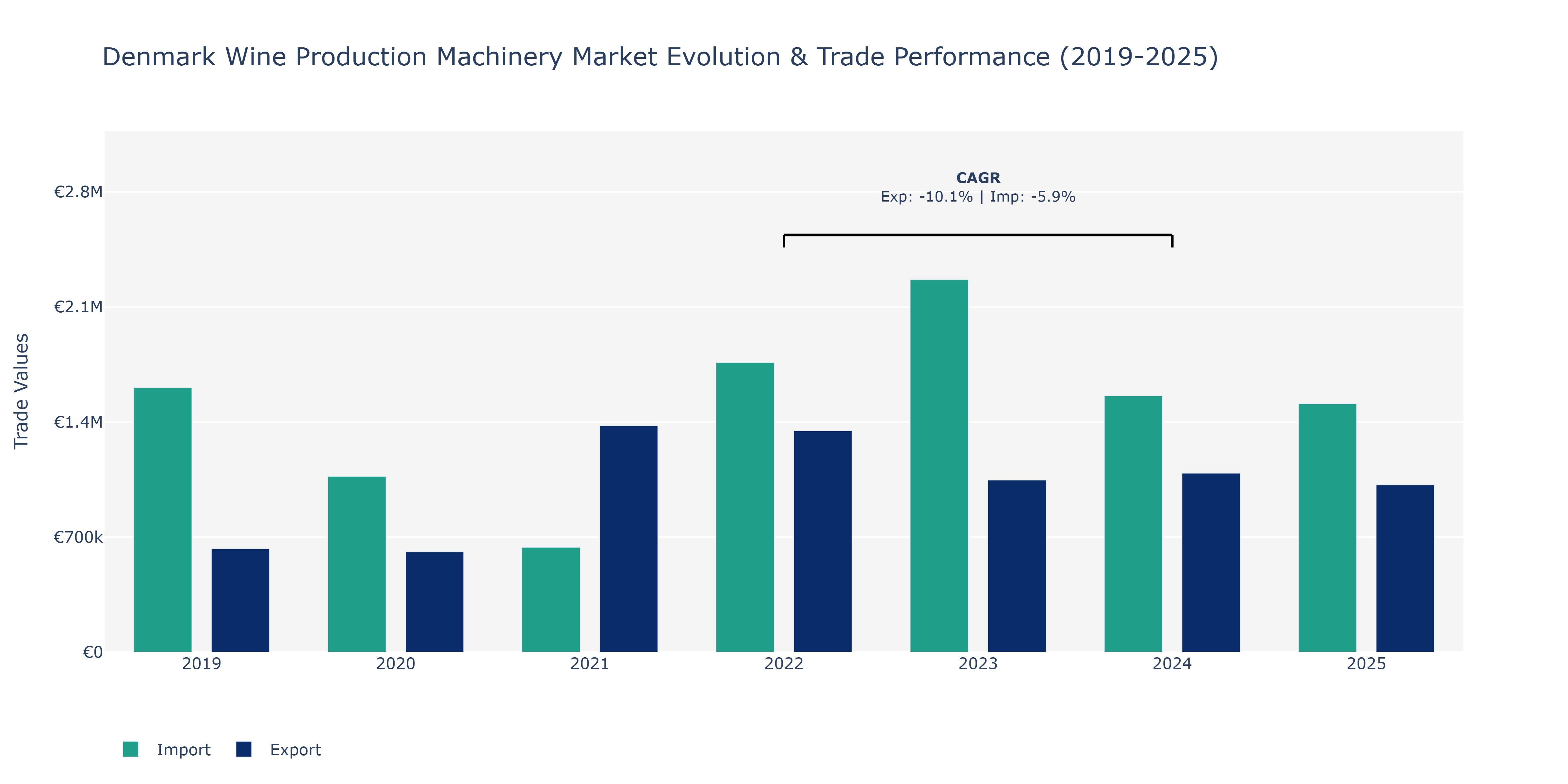
In the Denmark Wine Production Machinery Market, exports experienced a steady decline from 2019 to 2025, with a peak in 2021 at €1.38 million before decreasing to around €1.02 million in 2025. This decline may be attributed to external factors such as changes in global demand for wine production machinery, competition from other manufacturing countries, or shifts in trade agreements impacting export volumes. In contrast, imports fluctuated notably, starting at €1.61 million in 2019, dropping to around €1.07 million in 2020, and then rising to approximately €2.27 million in 2023 before slightly decreasing in 2025. The fluctuations in imports could be influenced by factors like changes in domestic consumption patterns, technological advancements affecting the need for imported machinery, or currency exchange rates impacting import costs. These trends suggest a dynamic market landscape for wine production machinery in Denmark, emphasizing the market's sensitivity to both domestic and international factors impacting trade flows.
Key Highlights of the Report:
- Denmark Wine production Machinery Market Outlook
- Market Size of Denmark Wine production Machinery Market, 2025
- Forecast of Denmark Wine production Machinery Market, 2032
- Historical Data and Forecast of Denmark Wine production Machinery Revenues & Volume for the Period 2022 - 2032F
- Denmark Wine production Machinery Market Trend Evolution
- Denmark Wine production Machinery Market Drivers and Challenges
- Denmark Wine production Machinery Price Trends
- Denmark Wine production Machinery Porter`s Five Forces
- Denmark Wine production Machinery Industry Life Cycle
- Historical Data and Forecast of Denmark Wine production Machinery Market Revenues & Volume By Type for the Period 2022 - 2032F
- Historical Data and Forecast of Denmark Wine production Machinery Market Revenues & Volume By Tanks & fermenters for the Period 2022 - 2032F
- Historical Data and Forecast of Denmark Wine production Machinery Market Revenues & Volume By Crushing & Pressing Equipment for the Period 2022 - 2032F
- Historical Data and Forecast of Denmark Wine production Machinery Market Revenues & Volume By Temperature Control Equipment for the Period 2022 - 2032F
- Historical Data and Forecast of Denmark Wine production Machinery Market Revenues & Volume By Filtration Equipment for the Period 2022 - 2032F
- Historical Data and Forecast of Denmark Wine production Machinery Market Revenues & Volume By Others for the Period 2022 - 2032F
- Denmark Wine production Machinery Import Export Trade Statistics
- Market Opportunity Assessment By Type
- Denmark Wine production Machinery Top Companies Market Share
- Denmark Wine production Machinery Competitive Benchmarking By Technical and Operational Parameters
- Denmark Wine production Machinery Company Profiles
- Denmark Wine production Machinery Key Strategic Recommendations






































