Ecuador Bearings Market Year-wise Growth Rate (2021-2031F)
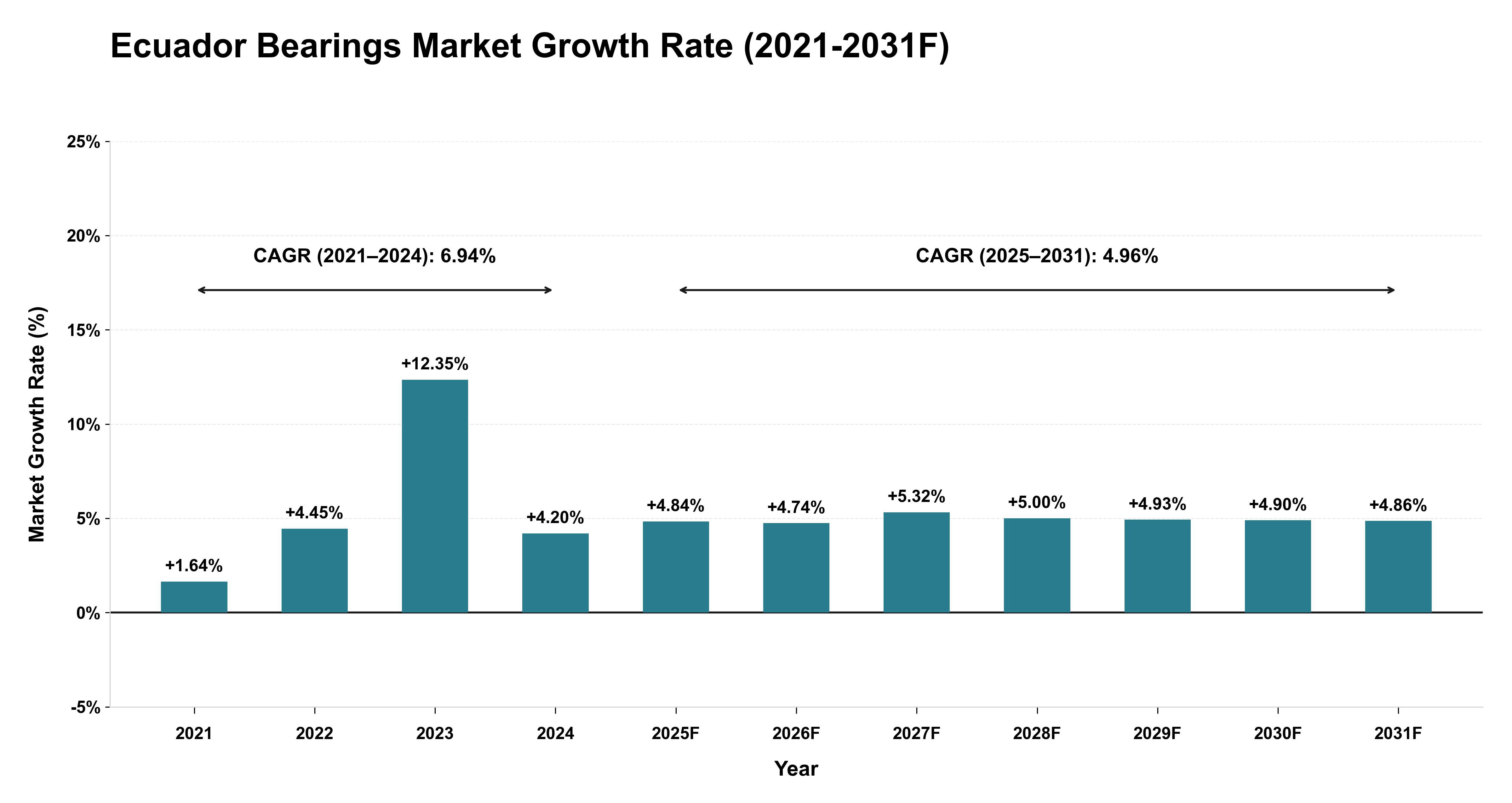
Over the historical period of 2021-2024, the Ecuador Bearings Market demonstrated a robust growth trajectory with varying annual growth rates, starting at 1.64% in 2021, experiencing a notable acceleration in 2023 with a growth rate of 12.35%, and maintaining a positive trend overall with a CAGR of 6.94%. These developments were likely driven by increasing industrial activities and infrastructure projects in Ecuador during this period. Looking ahead to the forecast period of 2025-2031, the market is expected to continue growing at a slightly slower pace with a forecasted CAGR of 4.96%. The consistent positive growth rates between 2025-2031 indicate sustained demand for bearings, possibly supported by ongoing infrastructure investments and technological advancements in various industries requiring machinery and equipment fitted with bearings for optimal performance.
Key Highlights of the Report:
- Ecuador Bearings Market Outlook
- Market Size of Ecuador Bearings Market, 2024
- Forecast of Ecuador Bearings Market, 2031
- Historical Data and Forecast of Ecuador Bearings Revenues & Volume for the Period 2021-2031
- Ecuador Bearings Market Trend Evolution
- Ecuador Bearings Market Drivers and Challenges
- Ecuador Bearings Price Trends
- Ecuador Bearings Porter`s Five Forces
- Ecuador Bearings Industry Life Cycle
- Historical Data and Forecast of Ecuador Bearings Market Revenues & Volume By Product for the Period 2021-2031
- Historical Data and Forecast of Ecuador Bearings Market Revenues & Volume By Ball Bearings for the Period 2021-2031
- Historical Data and Forecast of Ecuador Bearings Market Revenues & Volume By Roller Bearings for the Period 2021-2031
- Historical Data and Forecast of Ecuador Bearings Market Revenues & Volume By Application for the Period 2021-2031
- Historical Data and Forecast of Ecuador Bearings Market Revenues & Volume By Automotive for the Period 2021-2031
- Historical Data and Forecast of Ecuador Bearings Market Revenues & Volume By Agriculture for the Period 2021-2031
- Historical Data and Forecast of Ecuador Bearings Market Revenues & Volume By Electrical for the Period 2021-2031
- Historical Data and Forecast of Ecuador Bearings Market Revenues & Volume By Mining & Construction for the Period 2021-2031
- Historical Data and Forecast of Ecuador Bearings Market Revenues & Volume By Railway & Aerospace for the Period 2021-2031
- Historical Data and Forecast of Ecuador Bearings Market Revenues & Volume By Automotive Aftermarket for the Period 2021-2031
- Historical Data and Forecast of Ecuador Bearings Market Revenues & Volume By Others for the Period 2021-2031
- Ecuador Bearings Import Export Trade Statistics
- Market Opportunity Assessment By Product
- Market Opportunity Assessment By Application
- Ecuador Bearings Top Companies Market Share
- Ecuador Bearings Competitive Benchmarking By Technical and Operational Parameters
- Ecuador Bearings Company Profiles
- Ecuador Bearings Key Strategic Recommendations






































