Ecuador Biodiesel Market Growth Rate Analysis (2025 - 2031)
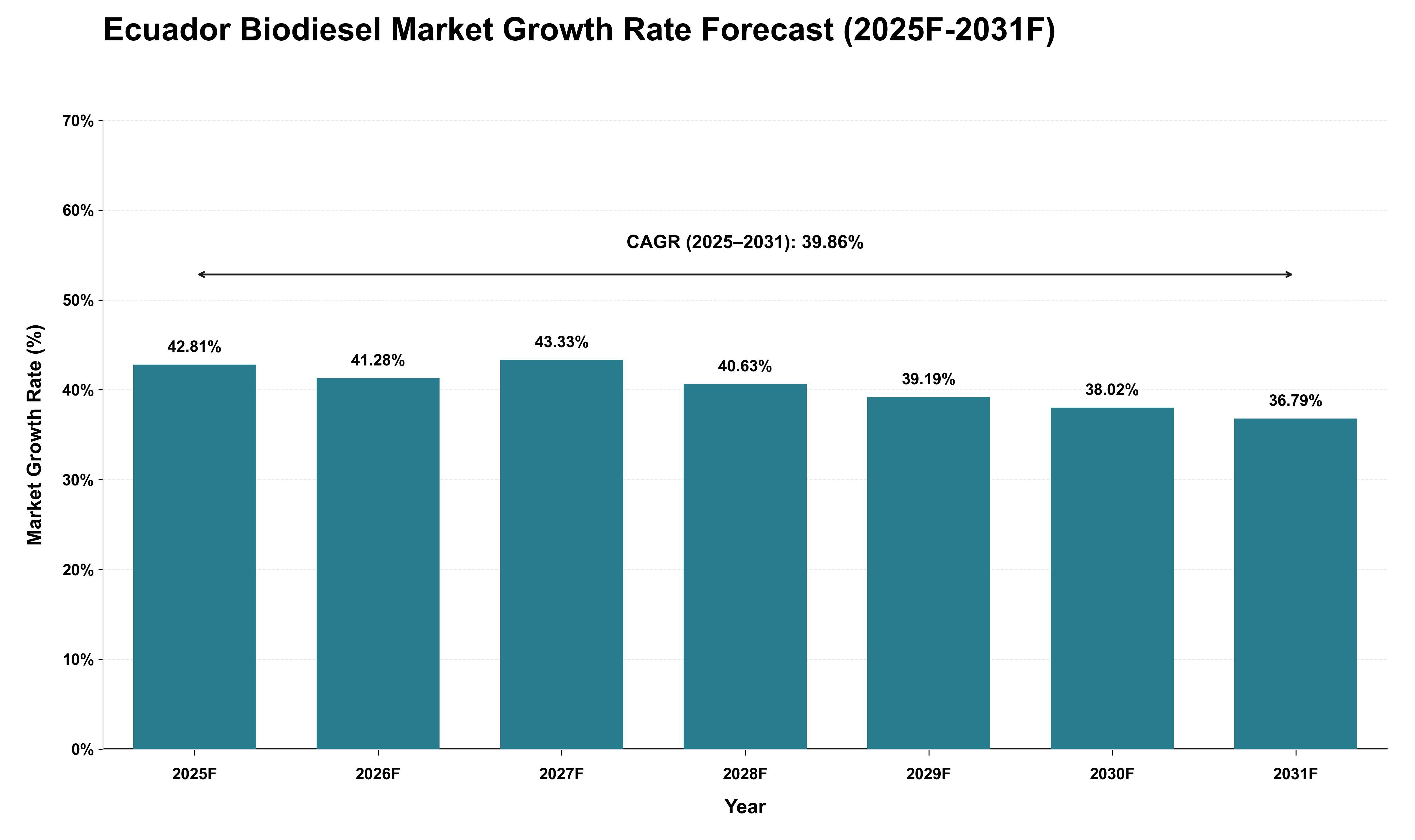
The forecasted growth trajectory for the Ecuador biodiesel market will exhibit a notable deceleration from 2025 to 2031, with annual growth rates starting at 42.81% and tapering to 36.79%. This trend reflects underlying macroeconomic factors, particularly the anticipated fluctuations in raw material availability and pricing, which are critical for biodiesel production. As demand surges, driven by both domestic consumption and international export opportunities, the reliance on imported feedstocks may intensify, potentially leading to price volatility. The projected CAGR of 39.86% underscores a robust expansion phase; however, as local production capabilities scale up and supply chains adapt, the market will likely experience cyclical adjustments influenced by global commodity prices and regulatory frameworks aimed at promoting renewable energy sources. Consequently, while growth remains strong, it will be tempered by these structural dynamics in the biodiesel sector.
Key Highlights of the Report:
- Ecuador Biodiesel Market Outlook
- Market Size of Ecuador Biodiesel Market, 2024
- Forecast of Ecuador Biodiesel Market, 2031
- Historical Data and Forecast of Ecuador Biodiesel Revenues & Volume for the Period 2021-2031
- Ecuador Biodiesel Market Trend Evolution
- Ecuador Biodiesel Market Drivers and Challenges
- Ecuador Biodiesel Price Trends
- Ecuador Biodiesel Porter`s Five Forces
- Ecuador Biodiesel Industry Life Cycle
- Historical Data and Forecast of Ecuador Biodiesel Market Revenues & Volume By Feedstock for the Period 2021-2031
- Historical Data and Forecast of Ecuador Biodiesel Market Revenues & Volume By Vegetable Oils for the Period 2021-2031
- Historical Data and Forecast of Ecuador Biodiesel Market Revenues & Volume By Animal Fats for the Period 2021-2031
- Historical Data and Forecast of Ecuador Biodiesel Market Revenues & Volume By Applications for the Period 2021-2031
- Historical Data and Forecast of Ecuador Biodiesel Market Revenues & Volume By Power Generation for the Period 2021-2031
- Historical Data and Forecast of Ecuador Biodiesel Market Revenues & Volume By Fuel for the Period 2021-2031
- Historical Data and Forecast of Ecuador Biodiesel Market Revenues & Volume By Others for the Period 2021-2031
- Ecuador Biodiesel Import Export Trade Statistics
- Market Opportunity Assessment By Feedstock
- Market Opportunity Assessment By Applications
- Ecuador Biodiesel Top Companies Market Share
- Ecuador Biodiesel Competitive Benchmarking By Technical and Operational Parameters
- Ecuador Biodiesel Company Profiles
- Ecuador Biodiesel Key Strategic Recommendations






































