Ecuador Camphor Market Growth Rate Analysis (2025 - 2031)
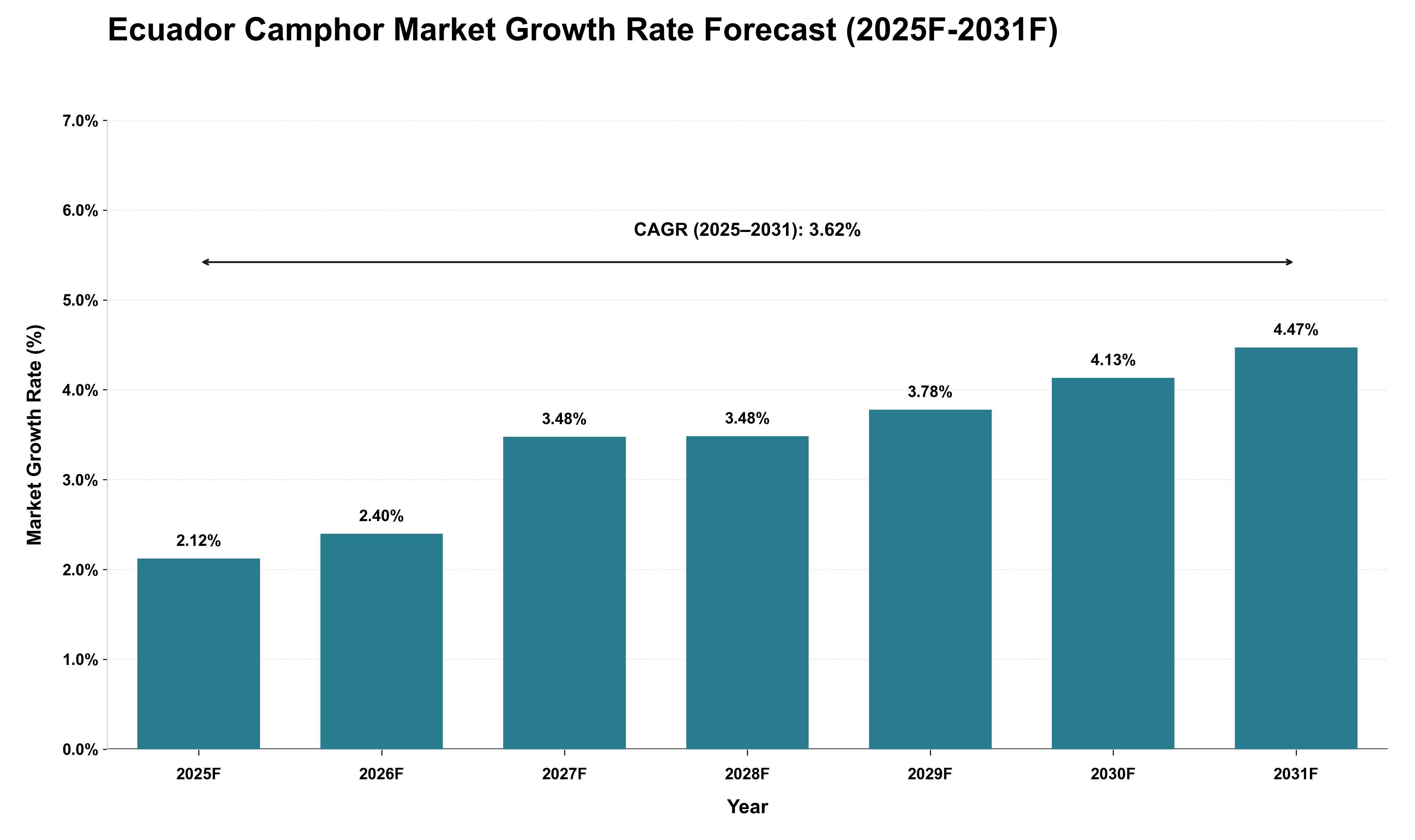
The Ecuador camphor market will experience a steady growth trajectory driven by several macroeconomic factors, including increasing demand in pharmaceuticals and cosmetics, which will enhance import dependencies. As global health trends emphasize natural ingredients, the market is projected to grow at a CAGR of 3.62% from 2025 to 2031. Initial growth rates will be modest, with 2.12% in 2025, reflecting cautious consumer spending and potential supply chain adjustments. However, as economic conditions stabilize and production efficiencies improve, growth rates are expected to accelerate significantly; by 2031, the market could see an increase of up to 4.47%. This upward trend will likely be supported by favorable trade policies and enhanced export opportunities for Ecuadorian camphor products, aligning with broader cyclical trends in the global natural product sector that favor sustainable sourcing and increased consumer awareness.
Key Highlights of the Report:
- Ecuador Camphor Market Outlook
- Market Size of Ecuador Camphor Market, 2024
- Forecast of Ecuador Camphor Market, 2031
- Historical Data and Forecast of Ecuador Camphor Revenues & Volume for the Period 2021-2031
- Ecuador Camphor Market Trend Evolution
- Ecuador Camphor Market Drivers and Challenges
- Ecuador Camphor Price Trends
- Ecuador Camphor Porter's Five Forces
- Ecuador Camphor Industry Life Cycle
- Historical Data and Forecast of Ecuador Camphor Market Revenues & Volume By Product Type for the Period 2021-2031
- Historical Data and Forecast of Ecuador Camphor Market Revenues & Volume By Tablets for the Period 2021-2031
- Historical Data and Forecast of Ecuador Camphor Market Revenues & Volume By Oil for the Period 2021-2031
- Historical Data and Forecast of Ecuador Camphor Market Revenues & Volume By Application for the Period 2021-2031
- Historical Data and Forecast of Ecuador Camphor Market Revenues & Volume By Pharmaceuticals for the Period 2021-2031
- Historical Data and Forecast of Ecuador Camphor Market Revenues & Volume By Religious Rituals for the Period 2021-2031
- Historical Data and Forecast of Ecuador Camphor Market Revenues & Volume By End User for the Period 2021-2031
- Historical Data and Forecast of Ecuador Camphor Market Revenues & Volume By Healthcare for the Period 2021-2031
- Historical Data and Forecast of Ecuador Camphor Market Revenues & Volume By Households for the Period 2021-2031
- Historical Data and Forecast of Ecuador Camphor Market Revenues & Volume By Source for the Period 2021-2031
- Historical Data and Forecast of Ecuador Camphor Market Revenues & Volume By Natural (Plant-Based) for the Period 2021-2031
- Historical Data and Forecast of Ecuador Camphor Market Revenues & Volume By Synthetic for the Period 2021-2031
- Ecuador Camphor Import Export Trade Statistics
- Market Opportunity Assessment By Product Type
- Market Opportunity Assessment By Application
- Market Opportunity Assessment By End User
- Market Opportunity Assessment By Source
- Ecuador Camphor Top Companies Market Share
- Ecuador Camphor Competitive Benchmarking By Technical and Operational Parameters
- Ecuador Camphor Company Profiles
- Ecuador Camphor Key Strategic Recommendations






































