Ecuador Concrete Vibrator Market Growth Rate Analysis (2025 - 2031)
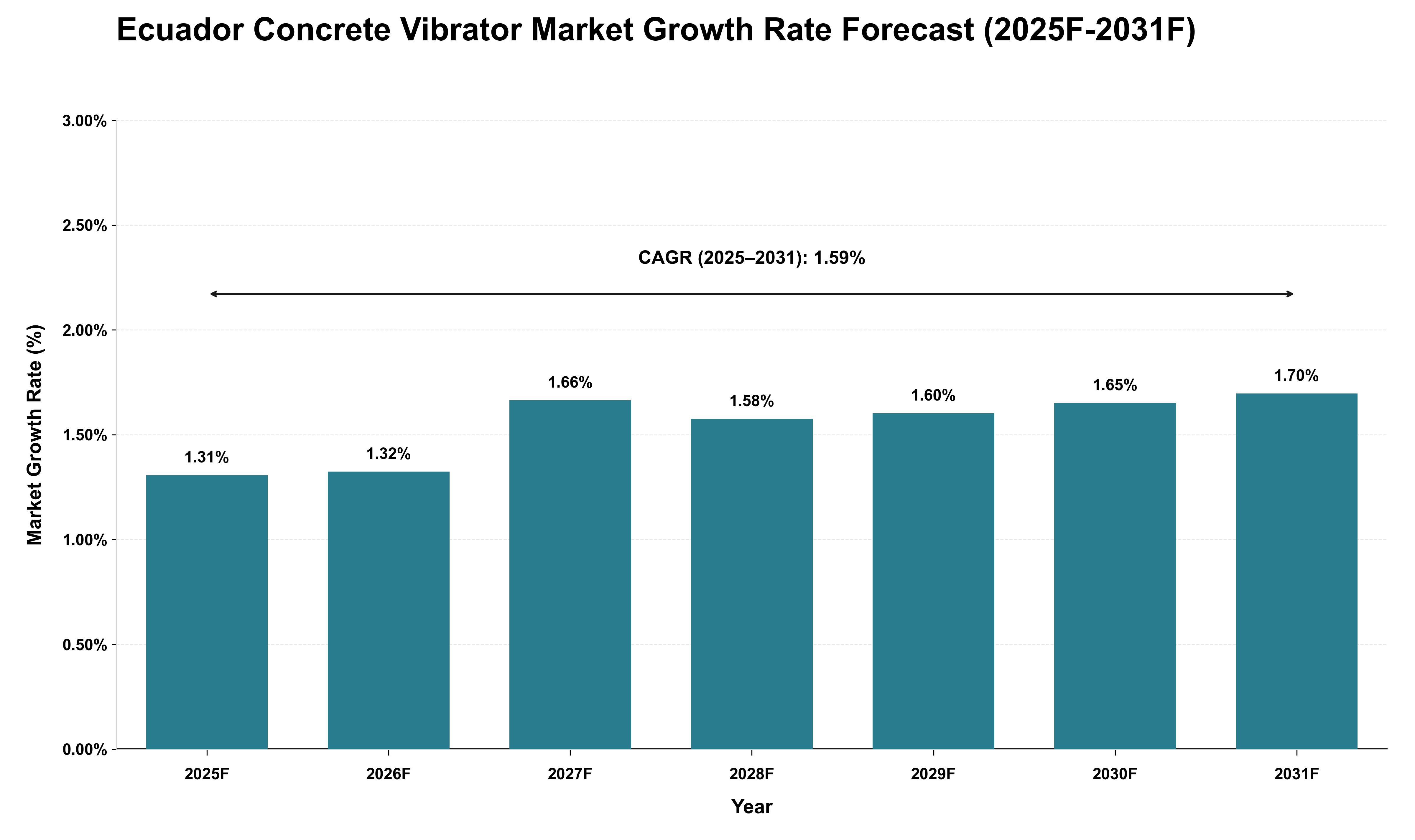
From 2025 onward, the Ecuador concrete vibrator market will likely experience a gradual growth trajectory, with an anticipated compound annual growth rate (CAGR) of 1.59%. This modest increase reflects underlying macroeconomic factors such as infrastructure development and construction activity, which are expected to drive demand for concrete vibrators. The annual growth rates will fluctuate slightly, starting at 1.31% in 2025 and reaching 1.70% by 2031, indicating a steady but cautious recovery in construction investments influenced by global economic conditions and local policy frameworks. Import dependencies may also play a critical role; as Ecuador continues to rely on foreign technology and equipment, fluctuations in trade policies or currency valuations could impact pricing and availability. Overall, the market's performance will be shaped by cyclical trends in construction demand and broader economic health, suggesting a stable yet incremental expansion phase ahead.
Key Highlights of the Report:
- Ecuador Concrete Vibrator Market Outlook
- Market Size of Ecuador Concrete Vibrator Market, 2024
- Forecast of Ecuador Concrete Vibrator Market, 2031
- Historical Data and Forecast of Ecuador Concrete Vibrator Revenues & Volume for the Period 2021-2031
- Ecuador Concrete Vibrator Market Trend Evolution
- Ecuador Concrete Vibrator Market Drivers and Challenges
- Ecuador Concrete Vibrator Price Trends
- Ecuador Concrete Vibrator Porter`s Five Forces
- Ecuador Concrete Vibrator Industry Life Cycle
- Historical Data and Forecast of Ecuador Concrete Vibrator Market Revenues & Volume By Type for the Period 2021-2031
- Historical Data and Forecast of Ecuador Concrete Vibrator Market Revenues & Volume By External Vibrator for the Period 2021-2031
- Historical Data and Forecast of Ecuador Concrete Vibrator Market Revenues & Volume By Internal Vibrator for the Period 2021-2031
- Historical Data and Forecast of Ecuador Concrete Vibrator Market Revenues & Volume By Others for the Period 2021-2031
- Historical Data and Forecast of Ecuador Concrete Vibrator Market Revenues & Volume By Application for the Period 2021-2031
- Historical Data and Forecast of Ecuador Concrete Vibrator Market Revenues & Volume By Architectural Engineering for the Period 2021-2031
- Historical Data and Forecast of Ecuador Concrete Vibrator Market Revenues & Volume By Dam Engineering for the Period 2021-2031
- Historical Data and Forecast of Ecuador Concrete Vibrator Market Revenues & Volume By Mine and Well Engineering for the Period 2021-2031
- Historical Data and Forecast of Ecuador Concrete Vibrator Market Revenues & Volume By Others for the Period 2021-2031
- Ecuador Concrete Vibrator Import Export Trade Statistics
- Market Opportunity Assessment By Type
- Market Opportunity Assessment By Application
- Ecuador Concrete Vibrator Top Companies Market Share
- Ecuador Concrete Vibrator Competitive Benchmarking By Technical and Operational Parameters
- Ecuador Concrete Vibrator Company Profiles
- Ecuador Concrete Vibrator Key Strategic Recommendations






































