Ecuador Cyclohexanone Market Top 5 Importing Countries and Market Competition (HHI) Analysis
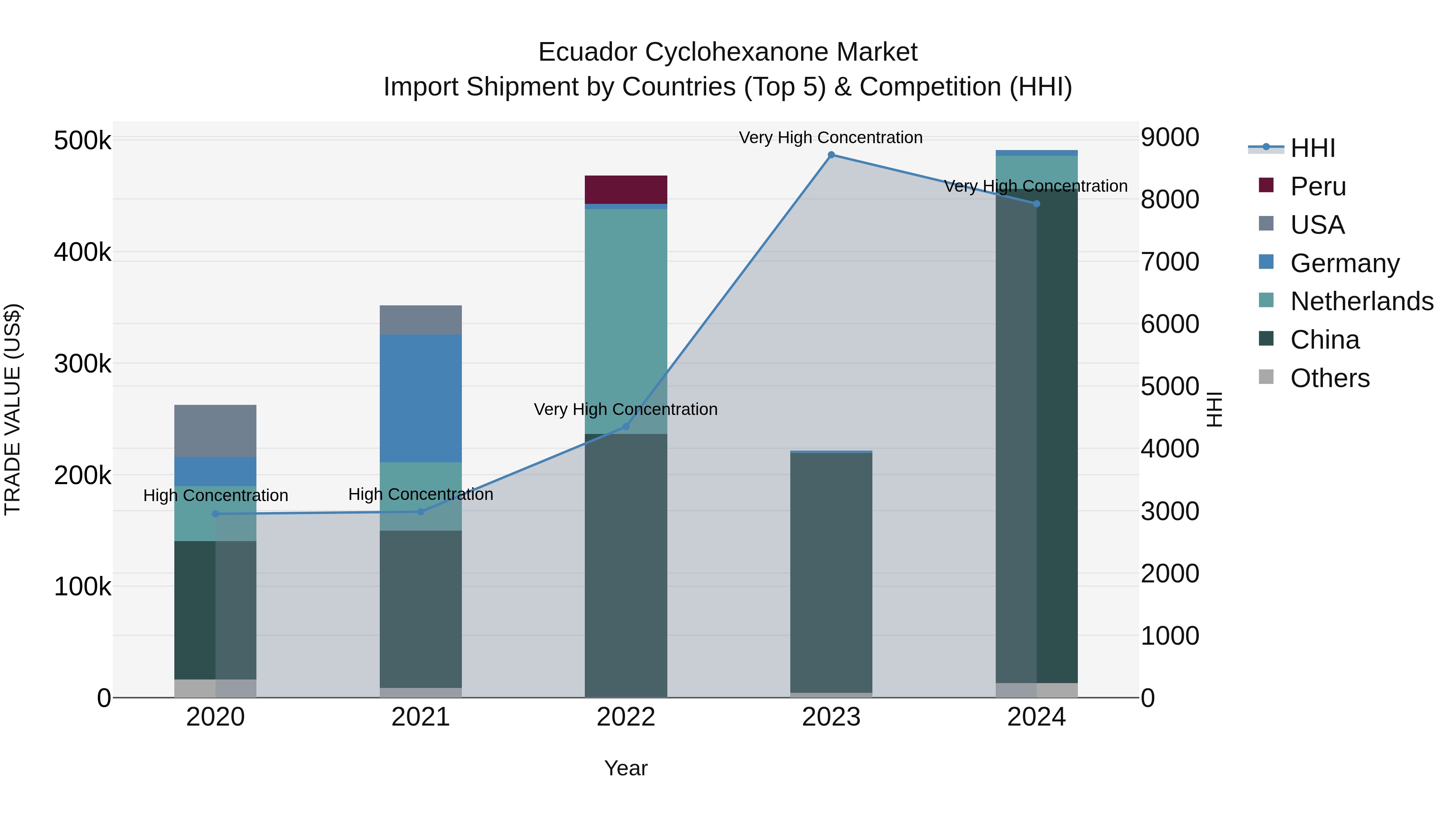
Ecuador`s cyclohexanone import Market Top 5 Importing Countries and Market Competition (HHI) Analysis saw significant growth in 2024, with top exporters being China, Netherlands, Colombia, Germany, and India. The high Herfindahl-Hirschman Index (HHI) indicates a concentrated Market Top 5 Importing Countries and Market Competition (HHI) Analysis. The compound annual growth rate (CAGR) from 2020 to 2024 was strong at 16.94%, with a remarkable growth rate of 121.74% from 2023 to 2024. This data suggests a competitive landscape with increasing demand for cyclohexanone in Ecuador, driven by imports from key global suppliers.
Ecuador Cyclohexanone Market Overview
Cyclohexanone is used as a solvent and in the production of nylon intermediates. The Ecuador Cyclohexanone Market supports the chemical industry, which relies on cyclohexanone for applications in plastics, resins, and coatings.
Drivers of the market
The Ecuador Cyclohexanone Market is driven by the rising demand for cyclohexanone in the manufacturing of adhesives, paints, and coatings. As industries focus on improving product performance and sustainability, the adoption of cyclohexanone as a solvent and intermediate is growing. This market is also supported by advancements in production processes.
Challenges of the market
The cyclohexanone market in Ecuador encounters challenges related to the volatility of raw material prices, which can impact production costs and profitability. Manufacturers must navigate intense competition from both local and international suppliers, necessitating effective differentiation through product quality and performance. Additionally, regulatory compliance concerning environmental impacts and safety standards complicates operations, requiring ongoing investments in testing and quality assurance. The market is influenced by fluctuating demand from key sectors such as paints and coatings, creating uncertainty in sales projections. Furthermore, ensuring effective distribution channels to reach target customers presents a significant challenge.
Government Policy of the market
Ecuadorian policies regarding the cyclohexanone market emphasize safety and environmental compliance due to its role as a solvent and intermediate in various chemical processes. The government enforces strict regulations on emissions and waste management associated with cyclohexanone production. Additionally, initiatives are in place to promote research into safer alternatives and green chemistry practices that can reduce reliance on traditional cyclohexanone production methods.
Key Highlights of the Report:
- Ecuador Cyclohexanone Market Outlook
- Market Size of Ecuador Cyclohexanone Market, 2024
- Forecast of Ecuador Cyclohexanone Market, 2031
- Historical Data and Forecast of Ecuador Cyclohexanone Revenues & Volume for the Period 2021-2031
- Ecuador Cyclohexanone Market Trend Evolution
- Ecuador Cyclohexanone Market Drivers and Challenges
- Ecuador Cyclohexanone Price Trends
- Ecuador Cyclohexanone Porter`s Five Forces
- Ecuador Cyclohexanone Industry Life Cycle
- Historical Data and Forecast of Ecuador Cyclohexanone Market Revenues & Volume By Type for the Period 2021-2031
- Historical Data and Forecast of Ecuador Cyclohexanone Market Revenues & Volume By Nylon 6 for the Period 2021-2031
- Historical Data and Forecast of Ecuador Cyclohexanone Market Revenues & Volume By Nylon 66 for the Period 2021-2031
- Historical Data and Forecast of Ecuador Cyclohexanone Market Revenues & Volume By Polyester Polyol for the Period 2021-2031
- Historical Data and Forecast of Ecuador Cyclohexanone Market Revenues & Volume By Others for the Period 2021-2031
- Historical Data and Forecast of Ecuador Cyclohexanone Market Revenues & Volume By End-use for the Period 2021-2031
- Historical Data and Forecast of Ecuador Cyclohexanone Market Revenues & Volume By Construction for the Period 2021-2031
- Historical Data and Forecast of Ecuador Cyclohexanone Market Revenues & Volume By Aerospace and Defence for the Period 2021-2031
- Historical Data and Forecast of Ecuador Cyclohexanone Market Revenues & Volume By Textiles for the Period 2021-2031
- Historical Data and Forecast of Ecuador Cyclohexanone Market Revenues & Volume By Automotive for the Period 2021-2031
- Historical Data and Forecast of Ecuador Cyclohexanone Market Revenues & Volume By Electrical and Electronics for the Period 2021-2031
- Historical Data and Forecast of Ecuador Cyclohexanone Market Revenues & Volume By Others for the Period 2021-2031
- Historical Data and Forecast of Ecuador Cyclohexanone Market Revenues & Volume By Application for the Period 2021-2031
- Historical Data and Forecast of Ecuador Cyclohexanone Market Revenues & Volume By Paint and Dyes for the Period 2021-2031
- Historical Data and Forecast of Ecuador Cyclohexanone Market Revenues & Volume By Soaps for the Period 2021-2031
- Historical Data and Forecast of Ecuador Cyclohexanone Market Revenues & Volume By Fertilizers for the Period 2021-2031
- Historical Data and Forecast of Ecuador Cyclohexanone Market Revenues & Volume By Films for the Period 2021-2031
- Historical Data and Forecast of Ecuador Cyclohexanone Market Revenues & Volume By Pharmaceutical for the Period 2021-2031
- Historical Data and Forecast of Ecuador Cyclohexanone Market Revenues & Volume By Caprolactam for the Period 2021-2031
- Historical Data and Forecast of Ecuador Cyclohexanone Market Revenues & Volume By Adipic Acid for the Period 2021-2031
- Historical Data and Forecast of Ecuador Cyclohexanone Market Revenues & Volume By Others for the Period 2021-2031
- Ecuador Cyclohexanone Import Export Trade Statistics
- Market Opportunity Assessment By Type
- Market Opportunity Assessment By End-use
- Market Opportunity Assessment By Application
- Ecuador Cyclohexanone Top Companies Market Share
- Ecuador Cyclohexanone Competitive Benchmarking By Technical and Operational Parameters
- Ecuador Cyclohexanone Company Profiles
- Ecuador Cyclohexanone Key Strategic Recommendations






































