Ecuador Dairy Products Market Growth Rate Analysis (2025 - 2031)
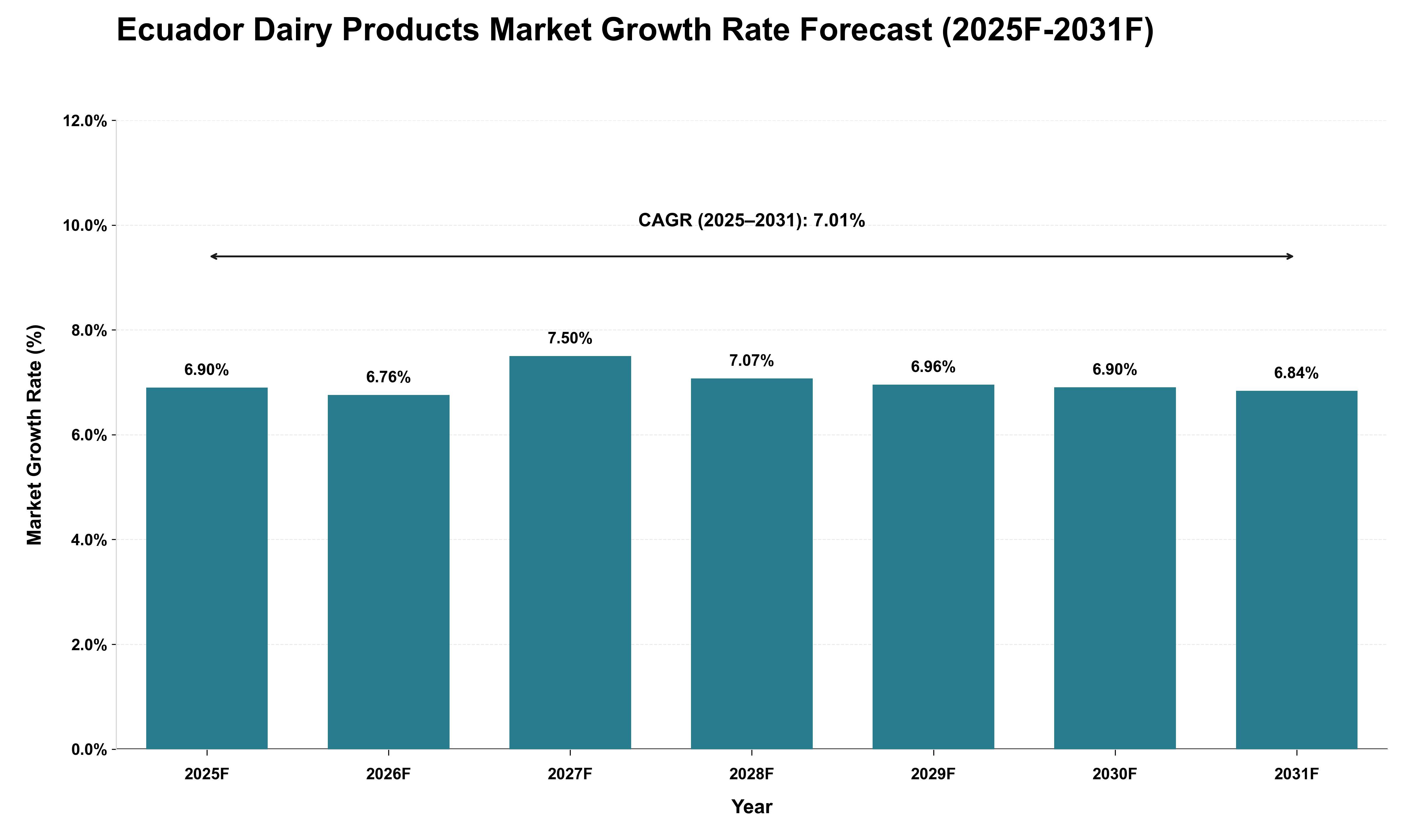
The forecasted growth trajectory for Ecuador's dairy products market will exhibit a nuanced pattern, characterized by an initial acceleration in 2027, where growth is projected at 7.50%, before transitioning into a slight deceleration through the subsequent years. This fluctuation reflects underlying macroeconomic factors such as evolving consumer preferences and potential shifts in import dependencies, which may influence domestic production capabilities and trade flows. The overall CAGR of 7.01% suggests robust demand dynamics, likely driven by increasing health consciousness and dietary diversification among consumers. As Ecuador navigates its trade relationships, particularly with dairy-importing nations, the interplay between local production enhancements and international supply chain adjustments will be critical in shaping export opportunities. Consequently, while annual growth rates fluctuate slightly from year to year, the overarching trend indicates a resilient dairy sector poised for sustained expansion within the global marketplace.
Key Highlights of the Report:
- Ecuador Dairy products Market Outlook
- Market Size of Ecuador Dairy products Market, 2024
- Forecast of Ecuador Dairy products Market, 2031
- Historical Data and Forecast of Ecuador Dairy products Revenues & Volume for the Period 2021-2031
- Ecuador Dairy products Market Trend Evolution
- Ecuador Dairy products Market Drivers and Challenges
- Ecuador Dairy products Price Trends
- Ecuador Dairy products Porter`s Five Forces
- Ecuador Dairy products Industry Life Cycle
- Historical Data and Forecast of Ecuador Dairy products Market Revenues & Volume By Product Type for the Period 2021-2031
- Historical Data and Forecast of Ecuador Dairy products Market Revenues & Volume By Butter for the Period 2021-2031
- Historical Data and Forecast of Ecuador Dairy products Market Revenues & Volume By Cheese for the Period 2021-2031
- Historical Data and Forecast of Ecuador Dairy products Market Revenues & Volume By Milk for the Period 2021-2031
- Historical Data and Forecast of Ecuador Dairy products Market Revenues & Volume By Cream for the Period 2021-2031
- Historical Data and Forecast of Ecuador Dairy products Market Revenues & Volume By Yoghurt for the Period 2021-2031
- Historical Data and Forecast of Ecuador Dairy products Market Revenues & Volume By Buttermilk for the Period 2021-2031
- Historical Data and Forecast of Ecuador Dairy products Market Revenues & Volume By Ice Cream for the Period 2021-2031
- Historical Data and Forecast of Ecuador Butter Dairy products Market Revenues & Volume By Lactose-Free Dairy Products for the Period 2021-2031
- Historical Data and Forecast of Ecuador Dairy products Market Revenues & Volume By Distribution Channel for the Period 2021-2031
- Historical Data and Forecast of Ecuador Dairy products Market Revenues & Volume By Supermarkets & Hypermarkets for the Period 2021-2031
- Historical Data and Forecast of Ecuador Dairy products Market Revenues & Volume By Convenience Store for the Period 2021-2031
- Historical Data and Forecast of Ecuador Dairy products Market Revenues & Volume By Online for the Period 2021-2031
- Ecuador Dairy products Import Export Trade Statistics
- Market Opportunity Assessment By Product Type
- Market Opportunity Assessment By Distribution Channel
- Ecuador Dairy products Top Companies Market Share
- Ecuador Dairy products Competitive Benchmarking By Technical and Operational Parameters
- Ecuador Dairy products Company Profiles
- Ecuador Dairy products Key Strategic Recommendations






































