Ecuador Food Products Machinery Market Year-wise Growth Rate (2021-2031F)
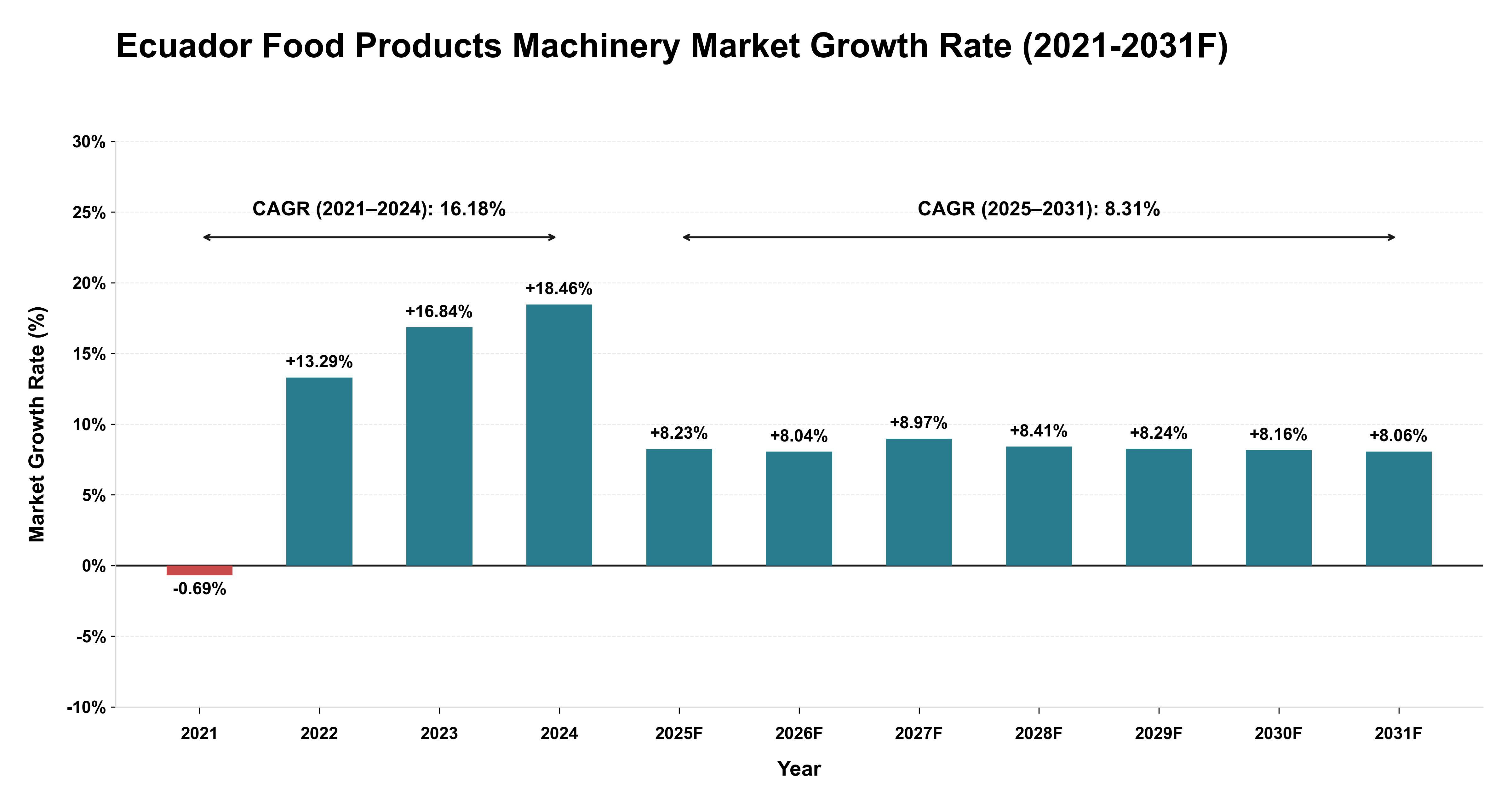
In the Ecuador Food Products Machinery Market, the period from 2021 to 2024 saw a fluctuating trajectory with a notable downturn in 2021 followed by strong growth rates of 13.29%, 16.84%, and 18.46% in the subsequent years, resulting in a high historical CAGR of 16.18%. These fluctuations can be attributed to shifts in consumer preferences, technological advancements, and possibly regulatory changes impacting the food processing industry in Ecuador. Looking ahead to 2025-2031, the growth rate stabilizes around 8%, indicating a more sustainable pace driven by steady demand for food processing machinery, potential market maturity, and evolving supply chain efficiencies. This forecasted deceleration aligns with the market reaching a new equilibrium after the rapid expansion observed in the previous years.
Key Highlights of the Report:
- Ecuador Food products machinery Market Outlook
- Market Size of Ecuador Food products machinery Market, 2024
- Forecast of Ecuador Food products machinery Market, 2031
- Historical Data and Forecast of Ecuador Food products machinery Revenues & Volume for the Period 2021-2031
- Ecuador Food products machinery Market Trend Evolution
- Ecuador Food products machinery Market Drivers and Challenges
- Ecuador Food products machinery Price Trends
- Ecuador Food products machinery Porter`s Five Forces
- Ecuador Food products machinery Industry Life Cycle
- Historical Data and Forecast of Ecuador Food products machinery Market Revenues & Volume By Type for the Period 2021-2031
- Historical Data and Forecast of Ecuador Food products machinery Market Revenues & Volume By Dairy Product Plant Machinery and Equipment for the Period 2021-2031
- Historical Data and Forecast of Ecuador Food products machinery Market Revenues & Volume By Bakery Machinery and Equipment for the Period 2021-2031
- Historical Data and Forecast of Ecuador Food products machinery Market Revenues & Volume By Meat and Poultry Processing And Preparation Machinery for the Period 2021-2031
- Historical Data and Forecast of Ecuador Food products machinery Market Revenues & Volume By Other Commercial Food Products Machinery for the Period 2021-2031
- Historical Data and Forecast of Ecuador Food products machinery Market Revenues & Volume By Applications for the Period 2021-2031
- Historical Data and Forecast of Ecuador Food products machinery Market Revenues & Volume By Bakery & Confectionery for the Period 2021-2031
- Historical Data and Forecast of Ecuador Food products machinery Market Revenues & Volume By Meat, Poultry, and Seafood for the Period 2021-2031
- Historical Data and Forecast of Ecuador Food products machinery Market Revenues & Volume By Dairy for the Period 2021-2031
- Historical Data and Forecast of Ecuador Food products machinery Market Revenues & Volume By Beverages for the Period 2021-2031
- Historical Data and Forecast of Ecuador Food products machinery Market Revenues & Volume By Others for the Period 2021-2031
- Ecuador Food products machinery Import Export Trade Statistics
- Market Opportunity Assessment By Type
- Market Opportunity Assessment By Applications
- Ecuador Food products machinery Top Companies Market Share
- Ecuador Food products machinery Competitive Benchmarking By Technical and Operational Parameters
- Ecuador Food products machinery Company Profiles
- Ecuador Food products machinery Key Strategic Recommendations






































