Ecuador Galvanized Steel Market Growth Rate Analysis (2025 - 2031)
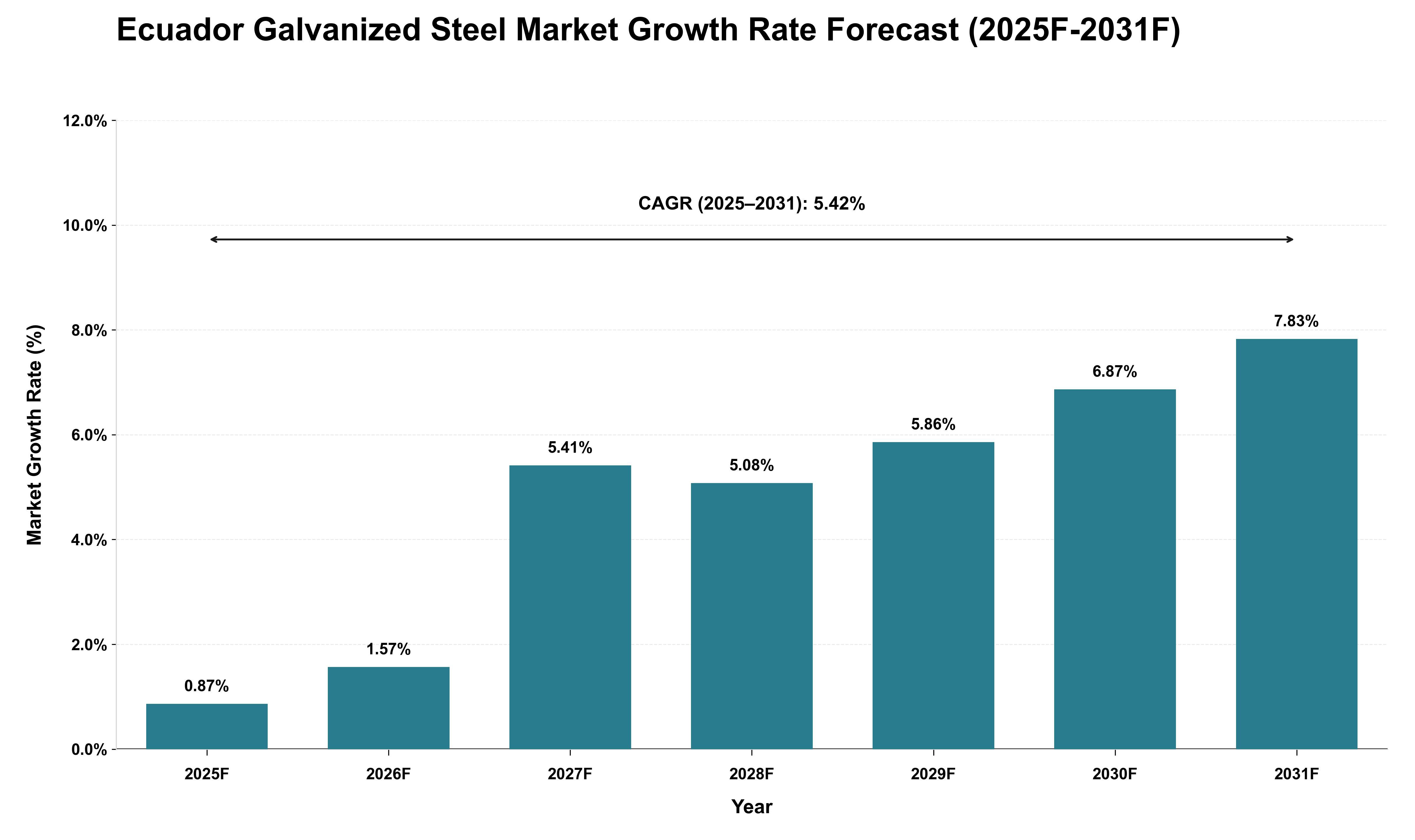
The projected growth trajectory for the Ecuador galvanized steel market will exhibit a notable acceleration, particularly from 2029 onward, where annual growth rates will rise from 5.86% to 7.83%. This upward trend can be attributed to anticipated improvements in supply chain efficiencies and a potential reduction in input costs as global steel production stabilizes and logistics networks adapt post-pandemic. As demand for construction and infrastructure projects increases, driven by urbanization and economic recovery efforts, Ecuador's reliance on imported raw materials may create volatility in pricing; however, local production capabilities are expected to enhance resilience against external shocks. The forecasted CAGR of 5.42% reflects these dynamics, suggesting that while initial years may show modest growth due to transitional adjustments, the latter part of the forecast period will likely benefit from robust demand and improved operational efficiencies within the sector.
Key Highlights of the Report:
- Ecuador Galvanized Steel Market Outlook
- Market Size of Ecuador Galvanized Steel Market, 2024
- Forecast of Ecuador Galvanized Steel Market, 2031
- Historical Data and Forecast of Ecuador Galvanized Steel Revenues & Volume for the Period 2021-2031
- Ecuador Galvanized Steel Market Trend Evolution
- Ecuador Galvanized Steel Market Drivers and Challenges
- Ecuador Galvanized Steel Price Trends
- Ecuador Galvanized Steel Porter`s Five Forces
- Ecuador Galvanized Steel Industry Life Cycle
- Historical Data and Forecast of Ecuador Galvanized Steel Market Revenues & Volume By Product Type for the Period 2021-2031
- Historical Data and Forecast of Ecuador Galvanized Steel Market Revenues & Volume By Galvanized Steel Coils for the Period 2021-2031
- Historical Data and Forecast of Ecuador Galvanized Steel Market Revenues & Volume By Galvanized Steel Strips for the Period 2021-2031
- Historical Data and Forecast of Ecuador Galvanized Steel Market Revenues & Volume By Others for the Period 2021-2031
- Historical Data and Forecast of Ecuador Galvanized Steel Market Revenues & Volume By Application for the Period 2021-2031
- Historical Data and Forecast of Ecuador Galvanized Steel Market Revenues & Volume By Construction for the Period 2021-2031
- Historical Data and Forecast of Ecuador Galvanized Steel Market Revenues & Volume By Automobile for the Period 2021-2031
- Historical Data and Forecast of Ecuador Galvanized Steel Market Revenues & Volume By Home Appliances for the Period 2021-2031
- Historical Data and Forecast of Ecuador Galvanized Steel Market Revenues & Volume By Others for the Period 2021-2031
- Ecuador Galvanized Steel Import Export Trade Statistics
- Market Opportunity Assessment By Product Type
- Market Opportunity Assessment By Application
- Ecuador Galvanized Steel Top Companies Market Share
- Ecuador Galvanized Steel Competitive Benchmarking By Technical and Operational Parameters
- Ecuador Galvanized Steel Company Profiles
- Ecuador Galvanized Steel Key Strategic Recommendations






































