Ecuador Robotic Welding Market Top 5 Importing Countries and Market Competition (HHI) Analysis
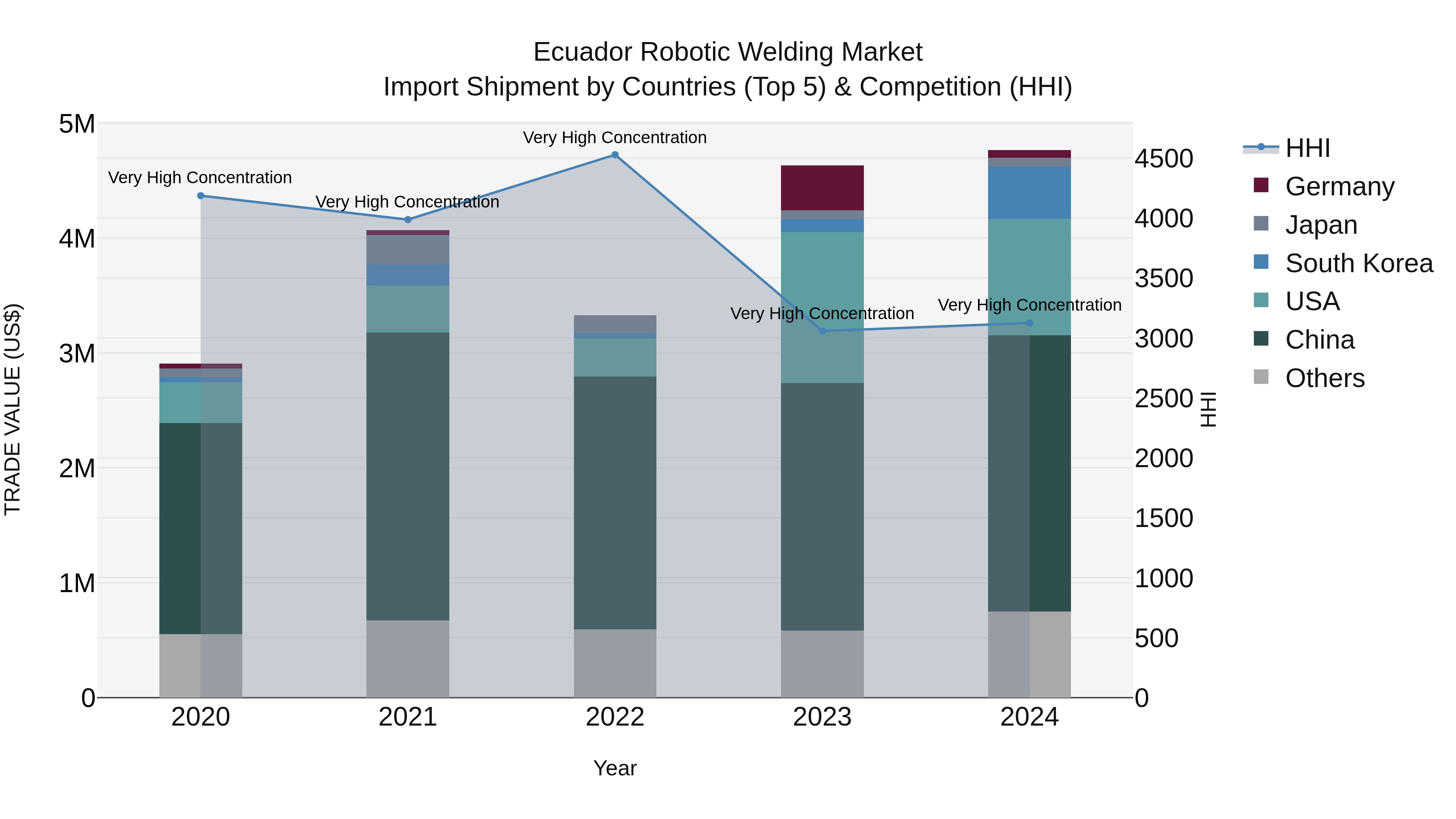
Ecuador continues to rely on imports for robotic welding equipment, with top exporting countries such as China, USA, and South Korea dominating the Market Top 5 Importing Countries and Market Competition (HHI) Analysis in 2024. The high Herfindahl-Hirschman Index (HHI) indicates a concentrated Market Top 5 Importing Countries and Market Competition (HHI) Analysis, while the impressive compound annual growth rate (CAGR) of 13.15% from 2020 to 2024 demonstrates strong demand. Despite a slightly lower growth rate of 2.89% from 2023 to 2024, the Market Top 5 Importing Countries and Market Competition (HHI) Analysis for robotic welding imports in Ecuador remains robust and shows potential for continued expansion in the coming years.
Ecuador Robotic Welding Market Overview
The robotic welding market in Ecuador is witnessing significant advancements as industries seek to enhance productivity, efficiency, and quality in manufacturing processes. With the rise of automation and Industry 4.0, robotic welding systems are being increasingly adopted in sectors such as automotive, construction, and metal fabrication. These systems provide consistent quality, reduce labor costs, and improve safety in welding operations. Furthermore, the governments initiatives to promote technological adoption in manufacturing are expected to fuel market growth, paving the way for increased investment in robotic solutions.
Drivers of the market
The robotic welding market in Ecuador is primarily driven by the need for automation in manufacturing processes. As industries strive to improve efficiency and reduce labor costs, the adoption of robotic welding solutions is on the rise. The increasing demand for high-quality welds and precision in the automotive and metal fabrication sectors further supports this trend. Additionally, the growing emphasis on safety and reducing workplace hazards is pushing manufacturers to invest in robotic solutions, contributing to the market`s expansion.
Challenges of the market
Ecuador`s Robotic Welding market faces several obstacles, including high initial investment costs and a lack of affordable financing options for businesses looking to adopt this technology. Many small and medium enterprises (SMEs) in the country find it difficult to justify the capital expenditure required for robotic welding systems. Another challenge is the insufficient technical expertise available for maintenance and operation of robotic systems, leading to increased downtime and operational inefficiencies. Furthermore, local industries are often slow to adopt automation due to the perception that traditional welding methods are more cost-effective in the short term.
Government Policy of the market
Ecuador`s robotic welding market is growing as industries seek automation solutions to increase production efficiency and reduce labor costs. The government has recognized the importance of automation and robotics in improving industrial competitiveness, and it has implemented various initiatives to support this sector. These include programs to incentivize the adoption of advanced manufacturing technologies, including robotic welding systems, through tax credits and grants for businesses. Additionally, government policies focusing on enhancing industrial workforce skills through training programs ensure that local industries are prepared for technological advancements in robotics.
Key Highlights of the Report:
- Ecuador Robotic Welding Market Outlook
- Market Size of Ecuador Robotic Welding Market, 2024
- Forecast of Ecuador Robotic Welding Market, 2031
- Historical Data and Forecast of Ecuador Robotic Welding Revenues & Volume for the Period 2021-2031
- Ecuador Robotic Welding Market Trend Evolution
- Ecuador Robotic Welding Market Drivers and Challenges
- Ecuador Robotic Welding Price Trends
- Ecuador Robotic Welding Porter`s Five Forces
- Ecuador Robotic Welding Industry Life Cycle
- Historical Data and Forecast of Ecuador Robotic Welding Market Revenues & Volume By Type for the Period 2021-2031
- Historical Data and Forecast of Ecuador Robotic Welding Market Revenues & Volume By Spot Welding Robots for the Period 2021-2031
- Historical Data and Forecast of Ecuador Robotic Welding Market Revenues & Volume By Arc Welding Robots for the Period 2021-2031
- Historical Data and Forecast of Ecuador Robotic Welding Market Revenues & Volume By Payload for the Period 2021-2031
- Historical Data and Forecast of Ecuador Robotic Welding Market Revenues & Volume By >150 kilograms for the Period 2021-2031
- Historical Data and Forecast of Ecuador Robotic Welding Market Revenues & Volume By 50-150 kilograms for the Period 2021-2031
- Historical Data and Forecast of Ecuador Robotic Welding Market Revenues & Volume By End User for the Period 2021-2031
- Historical Data and Forecast of Ecuador Robotic Welding Market Revenues & Volume By Automotive for the Period 2021-2031
- Historical Data and Forecast of Ecuador Robotic Welding Market Revenues & Volume By Transportation for the Period 2021-2031
- Historical Data and Forecast of Ecuador Robotic Welding Market Revenues & Volume By Electrical for the Period 2021-2031
- Historical Data and Forecast of Ecuador Robotic Welding Market Revenues & Volume By Electronics for the Period 2021-2031
- Ecuador Robotic Welding Import Export Trade Statistics
- Market Opportunity Assessment By Type
- Market Opportunity Assessment By Payload
- Market Opportunity Assessment By End User
- Ecuador Robotic Welding Top Companies Market Share
- Ecuador Robotic Welding Competitive Benchmarking By Technical and Operational Parameters
- Ecuador Robotic Welding Company Profiles
- Ecuador Robotic Welding Key Strategic Recommendations






































