Ecuador Steam Turbine Market Growth Rate Analysis (2025 - 2031)
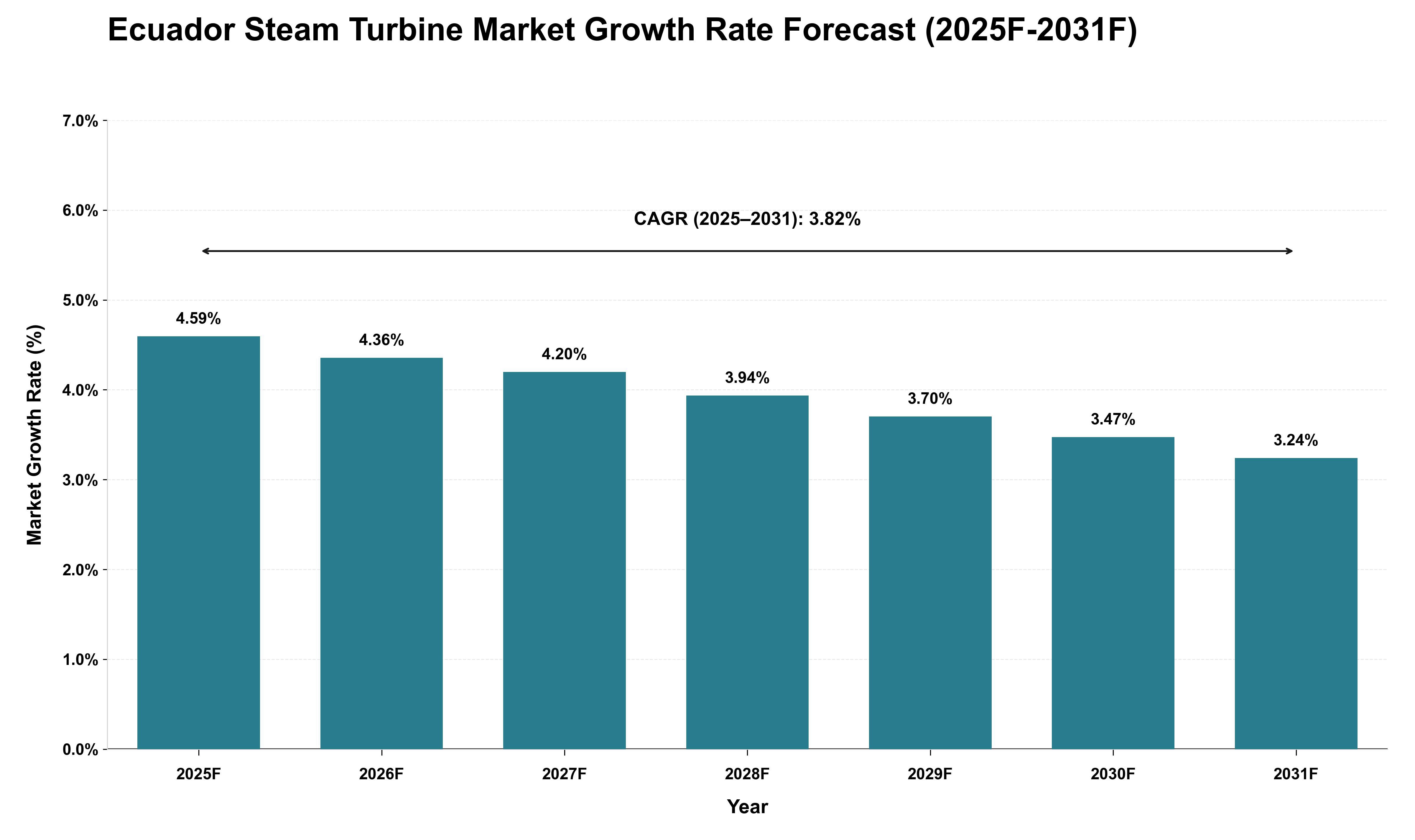
The Ecuador steam turbine market will experience a compound annual growth rate (CAGR) of 3.82% from 2025 to 2031, driven primarily by evolving energy demands and infrastructure investments. As global supply chains stabilize post-pandemic, input costs for manufacturing steam turbines are expected to fluctuate, influenced by raw material availability and transportation expenses. The initial growth rates of 4.59% in 2025 will gradually taper off, reflecting anticipated adjustments in import dependencies as local production capabilities improve and energy policies evolve. Additionally, cyclical trends in the energy sector will play a crucial role; as renewable energy sources gain traction, the demand for efficient steam turbines will shift towards more specialized applications. By 2031, the market growth is projected to decelerate to 3.24%, indicating a transition phase where technological advancements may redefine operational efficiencies within the sector.
Key Highlights of the Report:
- Ecuador Steam Turbine Market Outlook
- Market Size of Ecuador Steam Turbine Market, 2024
- Forecast of Ecuador Steam Turbine Market, 2031
- Historical Data and Forecast of Ecuador Steam Turbine Revenues & Volume for the Period 2021-2031
- Ecuador Steam Turbine Market Trend Evolution
- Ecuador Steam Turbine Market Drivers and Challenges
- Ecuador Steam Turbine Price Trends
- Ecuador Steam Turbine Porter`s Five Forces
- Ecuador Steam Turbine Industry Life Cycle
- Historical Data and Forecast of Ecuador Steam Turbine Market Revenues & Volume By Design for the Period 2021-2031
- Historical Data and Forecast of Ecuador Steam Turbine Market Revenues & Volume By Reaction for the Period 2021-2031
- Historical Data and Forecast of Ecuador Steam Turbine Market Revenues & Volume By Impulse for the Period 2021-2031
- Historical Data and Forecast of Ecuador Steam Turbine Market Revenues & Volume By End Use Industry for the Period 2021-2031
- Historical Data and Forecast of Ecuador Steam Turbine Market Revenues & Volume By Others for the Period 2021-2031
- Historical Data and Forecast of Ecuador Steam Turbine Market Revenues & Volume By Power Generation for the Period 2021-2031
- Historical Data and Forecast of Ecuador Steam Turbine Market Revenues & Volume By Petrochemical for the Period 2021-2031
- Historical Data and Forecast of Ecuador Steam Turbine Market Revenues & Volume By Oil And Gas for the Period 2021-2031
- Ecuador Steam Turbine Import Export Trade Statistics
- Market Opportunity Assessment By Design
- Market Opportunity Assessment By End Use Industry
- Ecuador Steam Turbine Top Companies Market Share
- Ecuador Steam Turbine Competitive Benchmarking By Technical and Operational Parameters
- Ecuador Steam Turbine Company Profiles
- Ecuador Steam Turbine Key Strategic Recommendations






































