Egypt Algorithmic Trading Market Size & Growth Rate (2026-2032)
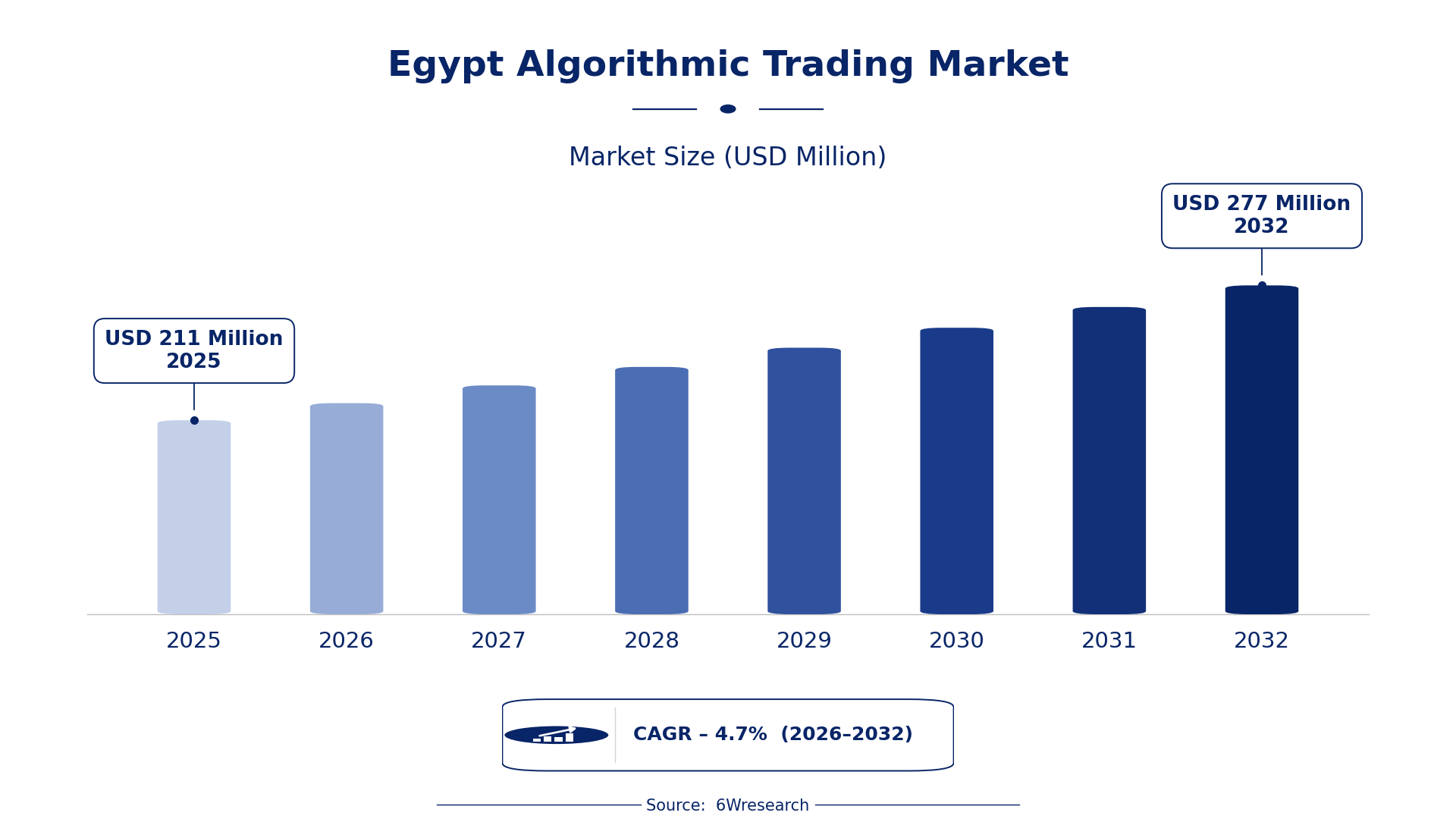
The Egypt Algorithmic Trading Market was estimated at USD 211 Million in 2025 and is projected to reach USD 277 Million by 2032, growing at a CAGR of 4.7% from 2026 to 2032.
Egypt Algorithmic Trading Market Synopsis
The primary force driving the Egypt Algorithmic Trading Market is the rapid adoption of automation in trading practices. Financial institutions and individual investors alike are increasingly recognizing the benefits of algorithmic trading, which offers speed and efficiency that traditional trading methods cannot match.
Technological advancements play a crucial role in this market's evolution. Enhanced connectivity, sophisticated algorithms, and growing interest in data-driven trading strategies are significantly impacting how trades are executed and managed in Egypt's financial sector.
Egypt Algorithmic Trading Market Year-wise Growth Rate and Key Drivers
This graph illustrates the annual growth rates of the Egypt Algorithmic Trading Market from 2021 to 2032, highlighting a steady upward trajectory and projected expansion over the forecast period.
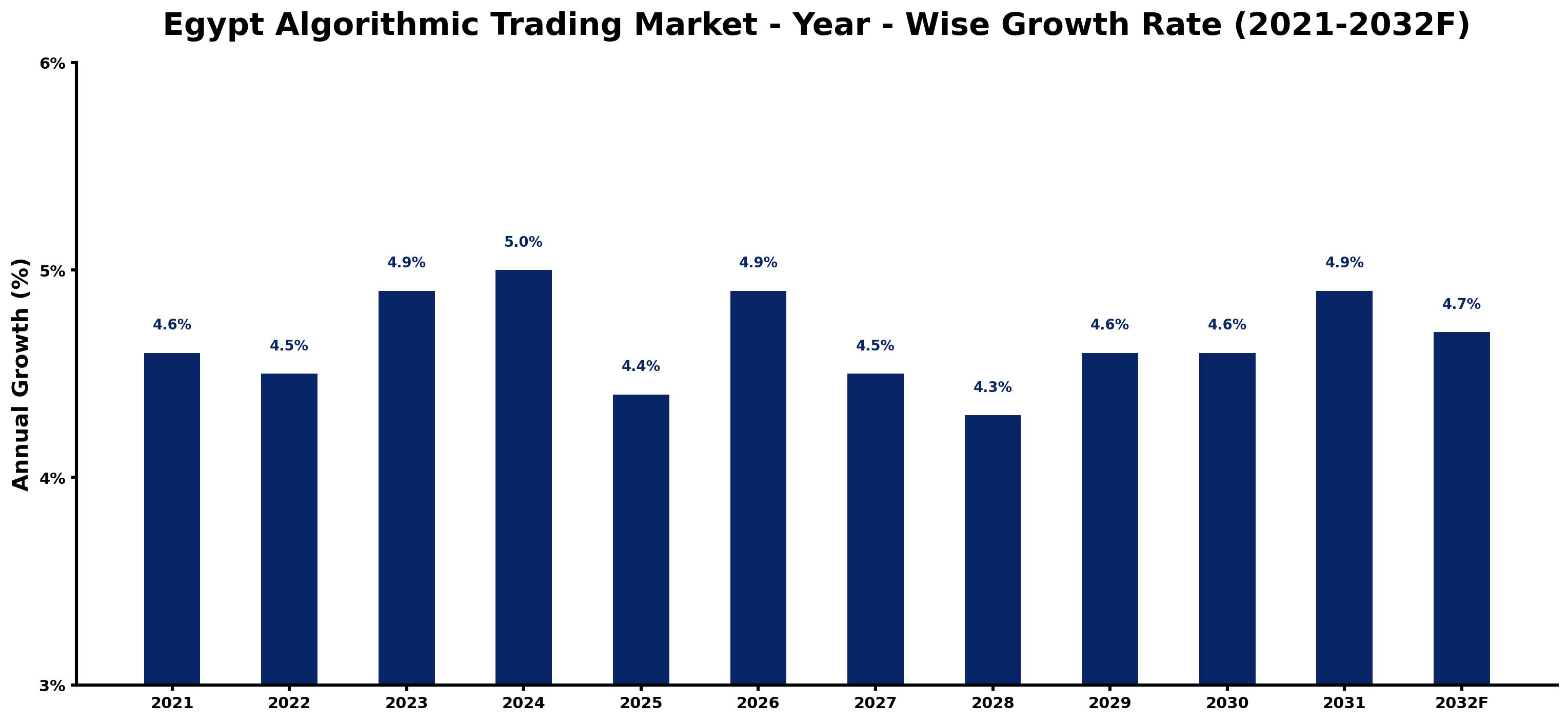
The table below presents the year‑wise growth rates along with the key drivers influencing the market
| Year | Growth Rate | Major Drivers |
| 2021 | 4.6% | Central Bank's support for fintech innovation initiatives |
| 2022 | 4.5% | Growing participation of retail investors in stock market |
| 2023 | 4.9% | Regulatory encouragement for algorithm-based trading strategies |
| 2024 | 5.0% | Increased digital infrastructure in Cairo fostering trading tech |
| 2025 | 4.4% | Young population driving demand for online trading platforms |
| 2026 | 4.9% | Emergence of local fintech firms enhancing trading solutions |
| 2027 | 4.5% | Government initiatives promoting financial literacy among millennials |
| 2028 | 4.3% | Rising institutional investments in Egyptian equities |
| 2029 | 4.6% | Development of advanced analytics tools by local startups |
| 2030 | 4.6% | Collaboration between banks and tech firms on algorithms |
| 2031 | 4.9% | Increased foreign investment in Egyptian financial markets |
| 2032 | 4.7% | Enhanced regulatory framework supporting innovative trading methods |
Note: Market size estimations and growth projections presented in this report are based on 6Wresearch's proprietary forecasting methodology, utilizing the latest available industry data, government publications, and primary research inputs.
Egypt Algorithmic Trading Market Key Takeaways
Below are some of the specific key takeaways from the market, including:
- The market is witnessing a shift towards automated trading solutions among both retail and institutional investors.
- Technological infrastructure improvements are crucial to support high-frequency trading operations.
- Regulatory reforms are fostering a more transparent trading environment, which benefits algorithmic trading strategies.
- The demand for predictive analytics and machine learning applications is on the rise.
- Investment opportunities are emerging as collaboration between tech providers and financial institutions increases.
Evaluation of Restraints in Egypt Algorithmic Trading Market
The growth of the Egypt Algorithmic Trading Market faces real limitations. A significant barrier is the lack of a well-defined regulatory framework specifically for algorithmic trading, which creates uncertainty for market participants. on top of that, access to high-quality market data remains limited, hindering the development of effective trading strategies. A shortage of skilled professionals in algorithmic trading is another pressing issue. Addressing these challenges will require concerted efforts among stakeholders to build a more conducive environment for algorithmic trading.
Egypt Algorithmic Trading Market Trends
Current trends indicate a growing emphasis on advanced trading algorithms that utilize artificial intelligence and machine learning. This technological integration is enhancing predictive analytics, which is increasingly being adopted by traders seeking competitive advantages. Additionally, there is a noticeable shift toward more efficient trading practices, driven by the desire to reduce transaction costs and improve execution speeds.
Egypt Algorithmic Trading Market Opportunities
Opportunities abound in the Egypt Algorithmic Trading Market, particularly for service providers catering to institutional investors and asset managers. As these entities seek to optimize their trading strategies, there is potential for innovation in algorithmic solutions tailored to local market needs. Partnerships between technology firms and financial institutions are likely to spur further advancements, enabling more sophisticated trading approaches that align with evolving regulatory standards.
Government Initiatives in the Egypt Algorithmic Trading Market
Government policies significantly influence the Egypt Algorithmic Trading Market, as they aim to promote transparency and efficiency within financial trading. The Egyptian Financial Supervisory Authority (EFSA) oversees regulations that ensure market integrity and protect investors, which is crucial for fostering an environment conducive to algorithmic trading.
- A regulatory framework implemented in 2025 aims to enhance transparency in trading practices, laying the groundwork for algorithmic trading compliance.
- Current initiatives by the EFSA focus on developing cybersecurity measures for market participants to safeguard against data breaches.
- Ongoing efforts to upgrade digital infrastructure are underway, enhancing connectivity for trading operations.
- Planned initiatives include workshops aimed at educating financial professionals about algorithmic trading best practices scheduled for 2026.
Future Insights of the Egypt Algorithmic Trading Market
Looking ahead, the Egypt Algorithmic Trading Market is expected to expand as automation in trading becomes increasingly mainstream. Continued technological advancements will enhance trading efficiency, while evolving regulatory frameworks will support the market's growth. As more investors recognize the advantages of algorithmic trading, such as improved execution speed and reduced costs, the market will likely see sustained interest and innovation in trading strategies through 2032.
Egypt Algorithmic Trading Market Latest Developments
In the past year, activity in the Egypt Algorithmic Trading Market has intensified, with a clear trend toward modernization and automation. Financial institutions are seeking innovative solutions to improve trading efficiency while addressing regulatory compliance challenges.
- A major technology vendor launched a new algorithmic trading platform in Q1 2025, aimed at enhancing execution speeds for institutional clients.
- An ongoing initiative began in early 2025 to improve market data accessibility, facilitating better-informed trading decisions.
- Plans for a collaborative project between financial institutions and tech providers are set to commence in mid-2026, focusing on predictive analytics integration.
- In late 2025, a regional operator announced an upgrade to its trading infrastructure, enhancing support for high-frequency trading operations.
Egypt Algorithmic Trading Market - Key Attractiveness of the Report
- 10 Years of Market Numbers
- Historical Data Starting from 2022 to 2025
- Base Year: 2025
- Forecast Data until 2032
- Key Performance Indicators Impacting the Market
- Major Upcoming Developments and Projects
Key Highlights of the Report:
- Egypt Algorithmic Trading Market Outlook
- Market Size of Egypt Algorithmic Trading Market, 2025
- Forecast of Egypt Algorithmic Trading Market, 2032
- Historical Data and Forecast of Egypt Algorithmic Trading Revenues & Volume for the Period 2022-2032F
- Egypt Algorithmic Trading Market Trend Evolution
- Egypt Algorithmic Trading Market Drivers and Challenges
- Egypt Algorithmic Trading Price Trends
- Egypt Algorithmic Trading Porter's Five Forces
- Egypt Algorithmic Trading Industry Life Cycle
- Historical Data and Forecast of Egypt Algorithmic Trading Market Revenues & Volume By Trading Type for the Period 2022-2032F
- Historical Data and Forecast of Egypt Algorithmic Trading Market Revenues & Volume By Foreign Exchange (FOREX) for the Period 2022-2032F
- Historical Data and Forecast of Egypt Algorithmic Trading Market Revenues & Volume By Stock Markets for the Period 2022-2032F
- Historical Data and Forecast of Egypt Algorithmic Trading Market Revenues & Volume By Exchange-Traded Fund (ETF) for the Period 2022-2032F
- Historical Data and Forecast of Egypt Algorithmic Trading Market Revenues & Volume By Bonds for the Period 2022-2032F
- Historical Data and Forecast of Egypt Algorithmic Trading Market Revenues & Volume By Cryptocurrencies for the Period 2022-2032F
- Historical Data and Forecast of Egypt Algorithmic Trading Market Revenues & Volume By Others for the Period 2022-2032F
- Historical Data and Forecast of Egypt Algorithmic Trading Market Revenues & Volume By Deployment Mode for the Period 2022-2032F
- Historical Data and Forecast of Egypt Algorithmic Trading Market Revenues & Volume By Cloud for the Period 2022-2032F
- Historical Data and Forecast of Egypt Algorithmic Trading Market Revenues & Volume By On-premises for the Period 2022-2032F
- Historical Data and Forecast of Egypt Algorithmic Trading Market Revenues & Volume By Component for the Period 2022-2032F
- Historical Data and Forecast of Egypt Algorithmic Trading Market Revenues & Volume By Solutions for the Period 2022-2032F
- Historical Data and Forecast of Egypt Algorithmic Trading Market Revenues & Volume By Services for the Period 2022-2032F
- Historical Data and Forecast of Egypt Algorithmic Trading Market Revenues & Volume By Enterprise Size for the Period 2022-2032F
- Historical Data and Forecast of Egypt Algorithmic Trading Market Revenues & Volume By Small and Medium-sized Enterprises (SMEs) for the Period 2022-2032F
- Historical Data and Forecast of Egypt Algorithmic Trading Market Revenues & Volume By Large Enterprises for the Period 2022-2032F
- Egypt Algorithmic Trading Import Export Trade Statistics
- Market Opportunity Assessment By Trading Type
- Market Opportunity Assessment By Deployment Mode
- Market Opportunity Assessment By Component
- Market Opportunity Assessment By Enterprise Size
- Egypt Algorithmic Trading Top Companies Market Share
- Egypt Algorithmic Trading Competitive Benchmarking By Technical and Operational Parameters
- Egypt Algorithmic Trading Company Profiles
- Egypt Algorithmic Trading Key Strategic Recommendations






































