Egypt Anti Reflective Glass Market Size, Share & Growth Rate
The Egypt Anti Reflective Glass Market was estimated at USD 344 Million in 2025 and is projected to reach USD 494 Million by 2032, growing at a CAGR of 5.3% from 2026 to 2032. This growth trajectory is primarily driven by the increasing adoption of anti-reflective glass in the construction and automotive sectors, where both aesthetic appeal and energy efficiency are paramount. Additionally, the burgeoning demand for high-performance glass products in electronics is further propelling market expansion.
Egypt Anti Reflective Glass Market Year-wise Growth Rate and Key Drivers
This graph highlights how the Egypt Anti Reflective Glass Market has steadily grown over the years, supported by major growth factors.
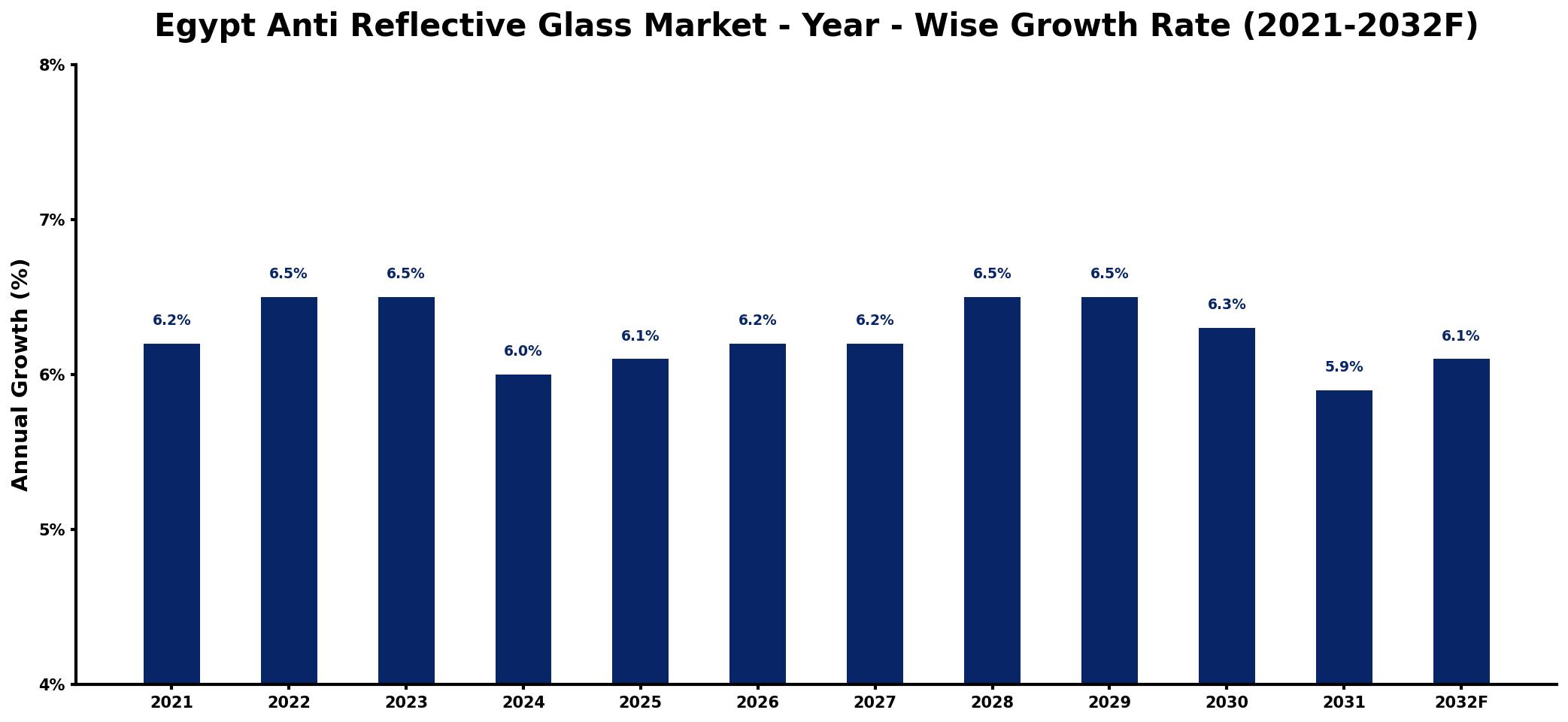
The table below presents the year‑wise growth rates along with the key drivers influencing the market
| Year | Growth Rate | Major Drivers |
| 2021 | 6.2% | Growing construction sector investments |
| 2022 | 6.5% | Rising demand for energy efficiency |
| 2023 | 6.5% | Increased focus on sustainability practices |
| 2024 | 6.0% | Expansion of renewable energy projects |
| 2025 | 6.1% | Surge in architectural design innovations |
| 2026 | 6.2% | Growing automotive industry requirements |
| 2027 | 6.2% | Strengthening regulations for energy standards |
| 2028 | 6.5% | Increased urbanization and infrastructure projects |
| 2029 | 6.5% | improved raw material availability |
| 2030 | 6.3% | rising procurement volume requirements |
| 2031 | 5.9% | Shifts towards eco-friendly materials |
| 2032 | 6.1% | increased domestic production output |
Note: Market size estimations and growth projections presented in this report are based on 6Wresearch's proprietary forecasting methodology, utilizing the latest available industry data, government publications, and primary research inputs.
Egypt Anti Reflective Glass Market Synopsis
Currently, the Egypt Anti Reflective Glass Market is witnessing a significant upswing, fueled by the rising need for superior glass solutions across various industries. Architectural applications, in particular, are turning to anti-reflective glass to enhance building aesthetics while minimizing glare and improving light transmission.
Moreover, the growing emphasis on sustainability is pushing sectors such as solar energy to incorporate anti-reflective glass in photovoltaic systems. This is not just a trend; its a shift towards smarter materials that aid in energy conservation and environmental responsibility.
Egypt Anti Reflective Glass Market Key Takeaways
- The market is buoyed by a surge in demand for energy-efficient solutions in construction and electronics.
- Technological advancements are leading to superior anti-reflective coatings, enhancing product performance.
- Increasing urbanization and infrastructure development in Egypt are critical growth drivers.
- Government initiatives are supporting local manufacturers through tariffs and incentives.
- Consumer awareness regarding the benefits of anti-reflective glass is on the rise, promoting market growth.
Evaluation of Restraints in Egypt Anti Reflective Glass Market
Despite the promising growth prospects, the Egypt Anti Reflective Glass Market faces several constraints. Intense competition from both domestic and international manufacturers poses a challenge for local players to maintain market share. Additionally, fluctuations in raw material prices can affect production costs and, subsequently, pricing strategies. Continuous innovation is crucial, yet often resource-intensive, to keep up with ever-evolving consumer preferences. Political and economic uncertainties in the region further complicate investment decisions, impacting overall market stability. Companies must strategize effectively to navigate these challenges while ensuring product quality and consumer trust.
Egypt Anti Reflective Glass Market Trends
A multitude of trends is currently shaping the Egypt Anti Reflective Glass Market. Firstly, there is a robust increase in the construction sector's demand for anti-reflective glass, with architects leveraging its properties to improve both aesthetics and functionality. Secondly, the solar energy sector is becoming an increasingly significant consumer of anti-reflective glass, driven by the need for improved energy efficiency. Technological enhancements are also noteworthy; advances in coating techniques are leading to better light transmission and reduced glare. Furthermore, the rising awareness regarding the impact of screen glare on electronic device users is driving demand in the electronics sector as well.
Egypt Anti Reflective Glass Market Opportunities
The Egypt Anti Reflective Glass Market offers substantial investment opportunities, particularly in sectors focusing on sustainability and energy efficiency. As urbanization accelerates, the demand for high-quality glass products in construction projects is set to rise. Companies that innovate within this space, especially those developing eco-friendly solutions or improving manufacturing processes, stand to benefit significantly. The continued growth in the automotive and electronics markets also presents avenues for expansion, particularly for firms that can offer specialized anti-reflective products tailored to these industries.
Government Initiatives in the Egypt Anti Reflective Glass Market
The Egyptian government has implemented several supportive policies to bolster the anti-reflective glass market. These initiatives include imposing import tariffs on foreign anti-reflective glass products to shield local manufacturers from international competition. Additionally, tax incentives and subsidies are available for companies that invest in domestic production. Regulatory frameworks are also in place to ensure that anti-reflective glass products meet stringent quality and safety standards, which helps foster consumer confidence and encourages market growth.
Future Insights of the Egypt Anti Reflective Glass Market
Looking ahead to 2026-2032, the Egypt Anti Reflective Glass Market is set for continuous growth. The anticipated expansion across various sectors, particularly construction and electronics, coupled with the government's commitment to infrastructure development, lays a solid foundation for this market. The focus on sustainability and energy efficiency will likely foster ongoing innovations in anti-reflective glass products, further enhancing their appeal. As consumer preferences evolve and technology advances, the market will undoubtedly adapt, ensuring a promising trajectory.
Egypt Anti Reflective Glass Market Latest Developments (2025 - 2026)
Recent industry developments indicate a strategic shift towards enhanced product offerings in the Egypt Anti Reflective Glass Market. Companies are increasingly investing in advanced coating technologies to improve functionality and performance. Additionally, there is a growing trend of collaboration between glass manufacturers and architectural firms to create tailored solutions for specific projects, emphasizing aesthetic and functional requirements. As consumer awareness rises, the market is expected to see a more pronounced integration of anti-reflective glass in innovative designs across various applications.
Egypt Anti Reflective Glass Market - Key Attractiveness of the Report
- 10 Years of Market Numbers
- Historical Data Starting from 2022 to 2025
- Base Year: 2025
- Forecast Data until 2032
- Key Performance Indicators Impacting the Market
- Major Upcoming Developments and Projects
Key Highlights of the Report:
- Egypt Anti Reflective Glass Market Outlook
- Market Size of Egypt Anti Reflective Glass Market, 2025
- Forecast of Egypt Anti Reflective Glass Market, 2032
- Historical Data and Forecast of Egypt Anti Reflective Glass Revenues & Volume for the Period 2022-2032F
- Egypt Anti Reflective Glass Market Trend Evolution
- Egypt Anti Reflective Glass Market Drivers and Challenges
- Egypt Anti Reflective Glass Price Trends
- Egypt Anti Reflective Glass Porter's Five Forces
- Egypt Anti Reflective Glass Industry Life Cycle
- Historical Data and Forecast of Egypt Anti Reflective Glass Market Revenues & Volume By Type for the Period 2022-2032F
- Historical Data and Forecast of Egypt Anti Reflective Glass Market Revenues & Volume By Double Layers for the Period 2022-2032F
- Historical Data and Forecast of Egypt Anti Reflective Glass Market Revenues & Volume By Four Layers for the Period 2022-2032F
- Historical Data and Forecast of Egypt Anti Reflective Glass Market Revenues & Volume By Others for the Period 2022-2032F
- Historical Data and Forecast of Egypt Anti Reflective Glass Market Revenues & Volume By Application for the Period 2022-2032F
- Historical Data and Forecast of Egypt Anti Reflective Glass Market Revenues & Volume By Architectural Windows for the Period 2022-2032F
- Historical Data and Forecast of Egypt Anti Reflective Glass Market Revenues & Volume By Instrumentation Windows for the Period 2022-2032F
- Historical Data and Forecast of Egypt Anti Reflective Glass Market Revenues & Volume By Electronic Displays for the Period 2022-2032F
- Historical Data and Forecast of Egypt Anti Reflective Glass Market Revenues & Volume By Picture Framing Glass for the Period 2022-2032F
- Historical Data and Forecast of Egypt Anti Reflective Glass Market Revenues & Volume By Showcase Glass for the Period 2022-2032F
- Historical Data and Forecast of Egypt Anti Reflective Glass Market Revenues & Volume By Cold Storage Displays for the Period 2022-2032F
- Historical Data and Forecast of Egypt Anti Reflective Glass Market Revenues & Volume By Lamps Glass for the Period 2022-2032F
- Historical Data and Forecast of Egypt Anti Reflective Glass Market Revenues & Volume By Others for the Period 2022-2032F
- Egypt Anti Reflective Glass Import Export Trade Statistics
- Market Opportunity Assessment By Type
- Market Opportunity Assessment By Application
- Egypt Anti Reflective Glass Top Companies Market Share
- Egypt Anti Reflective Glass Competitive Benchmarking By Technical and Operational Parameters
- Egypt Anti Reflective Glass Company Profiles
- Egypt Anti Reflective Glass Key Strategic Recommendations






































