Egypt Blenders Market Summary
The egypt blenders market was estimated at USD 258 Million in 2025 and is projected to reach USD 340 Million by 2032, growing at a CAGR of 4.7% from 2026 to 2032.
Egypt Blenders Market Year-wise Growth Rate and Key Drivers
This graph highlights how the Egypt Blenders Market has steadily grown over the past five years, supported by major growth factors.
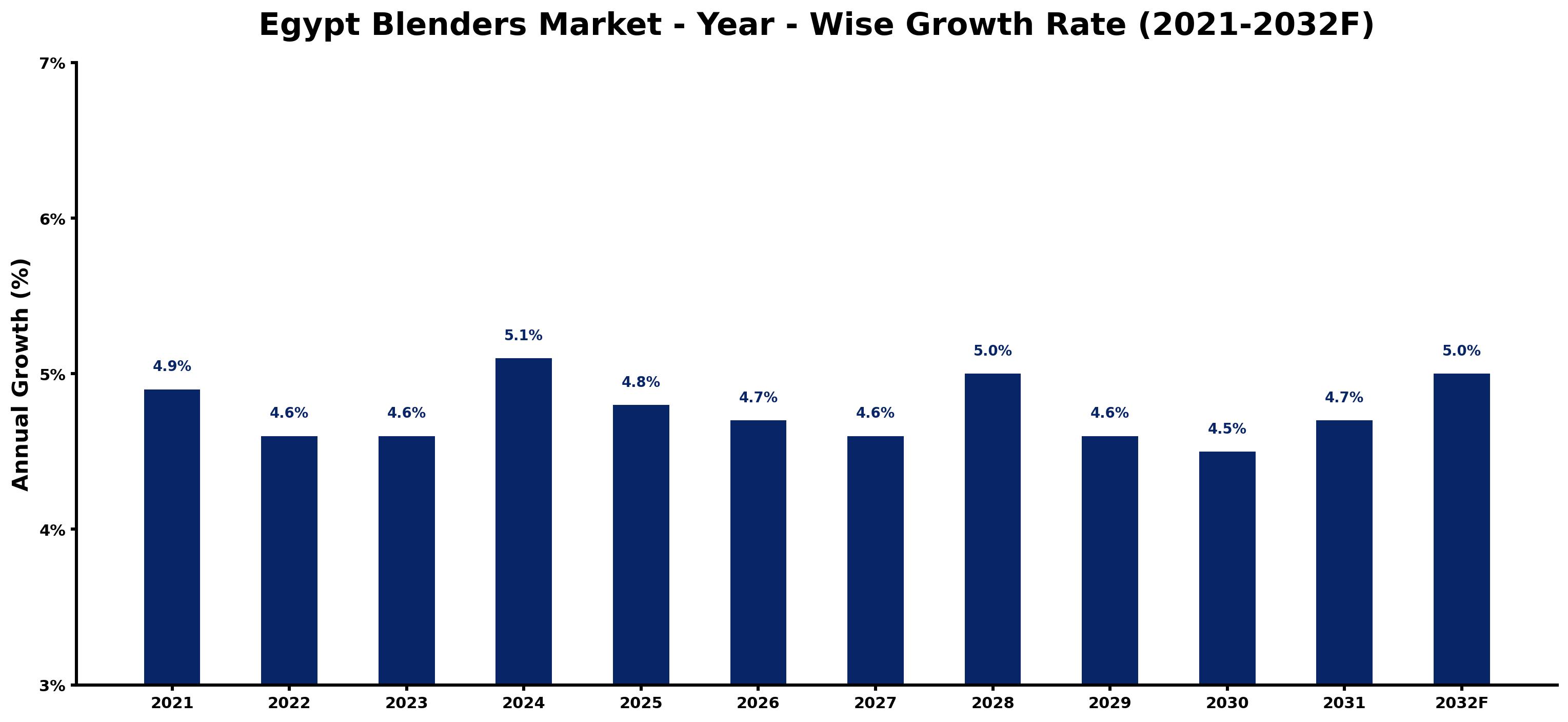
The table below presents the year wise growth rates along with the key drivers influencing the market
| Year | Growth Rate | Major Drivers |
| 2021 | 4.9% | Consumer preference for kitchen appliances surged, enhancing blender sales across households. |
| 2022 | 4.6% | Health-conscious lifestyles prompted increased interest in nutritional smoothies and blending options. |
| 2023 | 4.6% | Local manufacturers introduced innovative designs tailored to Egyptian culinary practices and recipes. |
| 2024 | 5.1% | Retail expansion into urban and suburban areas facilitated easier access to blenders. |
| 2025 | 4.8% | Rising disposable incomes among middle-class families led to higher kitchen appliance spending. |
| 2026 | 4.7% | Growing interest in home cooking encouraged investment in versatile multifunctional blenders. |
| 2027 | 4.6% | Social media influencers showcased blender recipes, captivating younger demographics and their preferences. |
| 2028 | 5.0% | Online shopping trends prompted retailers to enhance e-commerce platforms for blender sales. |
| 2029 | 4.6% | Local partnerships with health food brands boosted visibility and demand for premium blenders. |
| 2030 | 4.5% | Consumer education on sustainability favored eco-friendly blenders with reduced environmental impact. |
| 2031 | 4.7% | Collaborations with culinary schools fueled interest in high-performance blenders for aspiring chefs. |
| 2032 | 5.0% | Automated smart home technology integration introduced new functionalities, appealing to tech-savvy users. |
Note - Market size estimations and growth projections presented in this report are based on 6Wresearch's advanced forecasting approach, validated with industry datasets as of June 2026.
Egypt Blenders Market Synopsis
The Egypt Blenders Market is projected to reach 4.7% and witness significant growth during the forecast period (2026-2032). This growth is primarily influenced by urbanization trends, rising disposable incomes, and a notable shift towards healthier lifestyles among consumers. As Egyptian households increasingly prioritize convenience in food preparation, the demand for blenders has surged, with applications spanning smoothies, soups, and sauces. The market showcases a diverse array of products, including traditional countertop blenders, personal blenders, and immersion models, catering to varying consumer needs.
Egypt Blenders Market Growth Drivers
The growth of the Egypt Blenders Market is underpinned by several key drivers:
- Urbanization is transforming lifestyles, prompting consumers to seek modern kitchen appliances that facilitate quicker meal preparation.
- Growing disposable incomes are allowing consumers to invest in higher-quality kitchen gadgets, including advanced blenders.
- An increasing interest in health and wellness is motivating consumers to prepare nutritious meals at home, boosting the demand for blenders designed for smoothies and juices.
- Innovation in blending technology, such as improved blending speeds and preset functions, is enhancing user experience and driving sales.
- Aesthetic considerations are leading consumers to prefer stylish and modern blender designs that complement contemporary kitchen decor.
Egypt Blenders Market Trends and Opportunities
Current trends in the Egypt Blenders Market reflect a significant shift towards multifunctional appliances. This shift is largely attributed to consumer preferences for blenders that offer:
- Enhanced functionalities, such as multiple blending speeds and specialized programs for different food types, catering to diverse culinary needs.
- Increased power capacities, allowing users to blend tougher ingredients efficiently, thereby expanding the potential uses of blenders in food preparation.
- Sleek, modern designs that appeal to consumers looking to enhance their kitchen aesthetic through attractive appliances.
- The rising health consciousness which drives demand for blenders capable of creating fresh juices and healthy smoothies, reflecting a broader shift towards nutrition-focused diets.
- A growing interest in eco-friendly products, with consumers gravitating towards blenders made from sustainable materials.
Egypt Blenders Market Challenges and Restraints
Despite its growth potential, the Egypt Blenders Market faces several challenges that could hinder progress:
- Intense competition between domestic and international brands is leading to price wars, which can erode profit margins.
- Fluctuations in currency exchange rates may affect import costs for international brands, complicating pricing strategies in the local market.
- The unpredictability of consumer preferences and purchasing power creates difficulties in demand forecasting and inventory management for manufacturers.
- Challenges related to infrastructure and logistics in Egypt can disrupt distribution channels and increase operational costs.
- Continued economic fluctuations could impact consumer spending, affecting overall demand for kitchen appliances.
Egypt Blenders Market Investment Opportunities
The Egypt Blenders Market presents appealing investment opportunities for both local and foreign stakeholders looking to capitalize on growing consumer demands:
- Investing in innovative technologies, such as smart blenders equipped with connectivity features, can attract tech-savvy consumers seeking advanced functionality.
- Opportunities exist for producing eco-friendly blenders that target environmentally conscious consumers, tapping into the green market trend.
- Collaborative efforts with local distributors may enhance market penetration and increase brand visibility among Egyptian consumers.
- Utilizing digital marketing strategies could improve outreach and engagement with a broader audience, particularly in urban areas.
- Focusing on product differentiation and customization can create niche opportunities in an increasingly saturated market.
Egypt Blenders Market Government Investment and Initiatives
The government of Egypt has played a crucial role in shaping the blenders market through multiple initiatives and supportive policies. Policies include regulations on imports with tariffs designed to shield domestic manufacturers from foreign competition. Quality control standards are enforced to ensure consumer safety, fostering trust in local products. Furthermore, the government offers incentives and subsidies to encourage local production, thus enhancing market competitiveness. Environmental regulations are also implemented to spur sustainable practices within the industry. These initiatives aim to cultivate a conducive business environment for both local entities and foreign investors in the Egypt Blenders Market.
Egypt Blenders Market Latest Developments (May 2025 - June 2026)
The Egypt Blenders Market has seen notable developments between May 2025 and June 2026. Manufacturers have increasingly turned their attention to product innovation, focusing on incorporating advanced features that cater to tech-savvy consumers. Additionally, the trend towards sustainability has gained traction, with brands exploring eco-friendly manufacturing processes and materials. Marketing strategies have evolved to emphasize health and wellness messaging, resonating with the growing consumer focus on nutritious home-cooked meals. As competition intensifies, companies are also placing greater emphasis on customer engagement through social media and digital platforms, aiming to strengthen brand loyalty and capture a larger market share.
Egypt Blenders Market - Key Attractiveness of the Report
- 10 Years of Market Numbers
- Historical Data Starting from 2022 to 2025
- Base Year: 2025
- Forecast Data until 2032
- Key Performance Indicators Impacting the Market
- Major Upcoming Developments and Projects
Key Highlights of the Report:
- Egypt Blenders Market Outlook
- Market Size of Egypt Blenders Market, 2025
- Forecast of Egypt Blenders Market, 2032F
- Historical Data and Forecast of Egypt Blenders Revenues & Volume for the Period 2022-2032F
- Egypt Blenders Market Trend Evolution
- Egypt Blenders Market Drivers and Challenges
- Egypt Blenders Price Trends
- Egypt Blenders Porter's Five Forces
- Egypt Blenders Industry Life Cycle
- Historical Data and Forecast of Egypt Blenders Market Revenues & Volume By Types for the Period 2022-2032F
- Historical Data and Forecast of Egypt Blenders Market Revenues & Volume By Hand Blenders for the Period 2022-2032F
- Historical Data and Forecast of Egypt Blenders Market Revenues & Volume By Single-Serve Blenders for the Period 2022-2032F
- Historical Data and Forecast of Egypt Blenders Market Revenues & Volume By Full-Size Blenders for the Period 2022-2032F
- Historical Data and Forecast of Egypt Blenders Market Revenues & Volume By Applications for the Period 2022-2032F
- Historical Data and Forecast of Egypt Blenders Market Revenues & Volume By Commercial for the Period 2022-2032F
- Historical Data and Forecast of Egypt Blenders Market Revenues & Volume By Household for the Period 2022-2032F
- Egypt Blenders Import Export Trade Statistics
- Market Opportunity Assessment By Types
- Market Opportunity Assessment By Applications
- Egypt Blenders Top Companies Market Share
- Egypt Blenders Competitive Benchmarking By Technical and Operational Parameters
- Egypt Blenders Company Profiles
- Egypt Blenders Key Strategic Recommendations






































