Topics Covered in Egypt Composites Market Report
Egypt Composites Market Report thoroughly covers the market by by Fiber Type, Resin Type, and by End-Use Industry. Egypt Composites Market Outlook report provides an unbiased and detailed analysis of the ongoing Egypt Composites Market trends, opportunities/high growth areas, and market drivers. This would help stakeholders devise and align their market strategies according to the current and future market dynamics.
Egypt Composites Market Synopsis
Egypt Composite Market is experiencing steady structural expansion, driven by sustained growth across construction, infrastructure, urban development, and hospitality sectors. The construction industry continues to act as a key growth engine, supported by significant government-led investments focused on large-scale infrastructure and real estate development. Major national projects, including the New Administrative Capital, New Alamein City, and Ras El Hikma, are creating substantial demand for advanced composite materials across applications such as panels, facades, piping systems, and structural components. These developments are reinforcing the role of composites as essential materials due to their durability, lightweight properties, and resistance to corrosion.
In parallel, rising private sector participation, particularly in residential, commercial, and mixed-use developments, is further strengthening market demand. Increasing urbanization and population growth are also contributing to higher construction activity, thereby supporting consistent consumption of composite materials. Collectively, these factors are establishing a strong foundation for long-term growth, positioning composites as a critical material within Egypt’s evolving construction and infrastructure ecosystem.
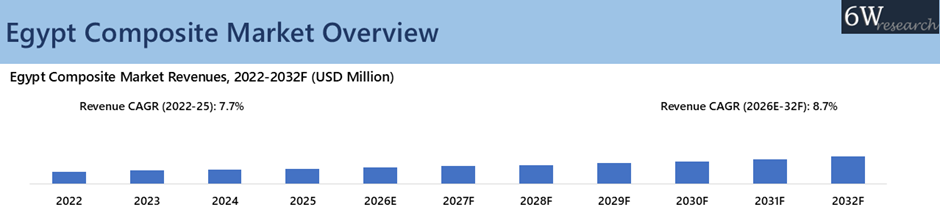
According to 6Wresearch, Egypt Composite Market revenue size is projected to grow at a CAGR of 8.7% during the forecast period 2026-2032F, driven by strong momentum in construction, real estate expansion, and large-scale infrastructure development. Growth is supported by government increasing investments and a project pipeline, creating sustained demand for advanced materials. Real estate activity is expected to rise by 2027, while construction activity is projected to grow, reflecting increased building and infrastructure development. Rapid urbanization, with the urban population projected to rise by 2050, is accelerating residential and mixed-use projects. Additionally, expansion in the hospitality sector, supported by initiatives such as the hotel financing scheme and rising hotel capacity, is further driving demand for lightweight, durable, and corrosion-resistant composite materials.
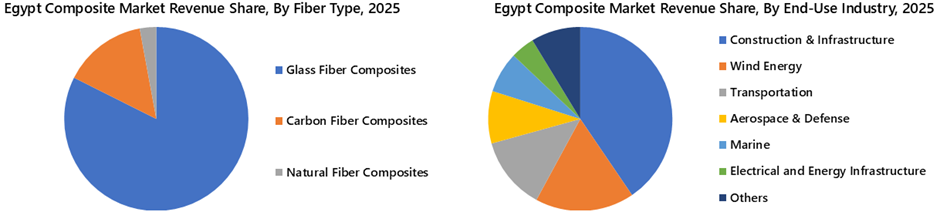
Market Segmentation By Fiber Type
By 2032, carbon fiber composites are expected to experience the strongest growth in Egypt’s composites market, driven by increasing industrial adoption and rising demand for lightweight, high-strength materials across transportation, construction, and renewable energy applications. The growing focus on performance efficiency, durability, and advanced material solutions is accelerating the uptake of carbon fiber composites, positioning them as a key high-growth segment in Egypt’s evolving composites landscape.
Market Segmentation By Resin Type
By 2032, the thermoplastic composites segment is expected to witness the highest growth in Egypt’s composites market, driven by increasing demand across transportation, construction, and industrial sectors. The need for lightweight, durable, and recyclable materials, along with faster processing and cost-efficient manufacturing, is accelerating adoption—particularly in transportation and infrastructure applications. With rising investments in advanced materials and sustainability initiatives, the segment is poised for strong growth, supported by innovation and expanding end-use applications.
Market Segmentation By End-Use Industry
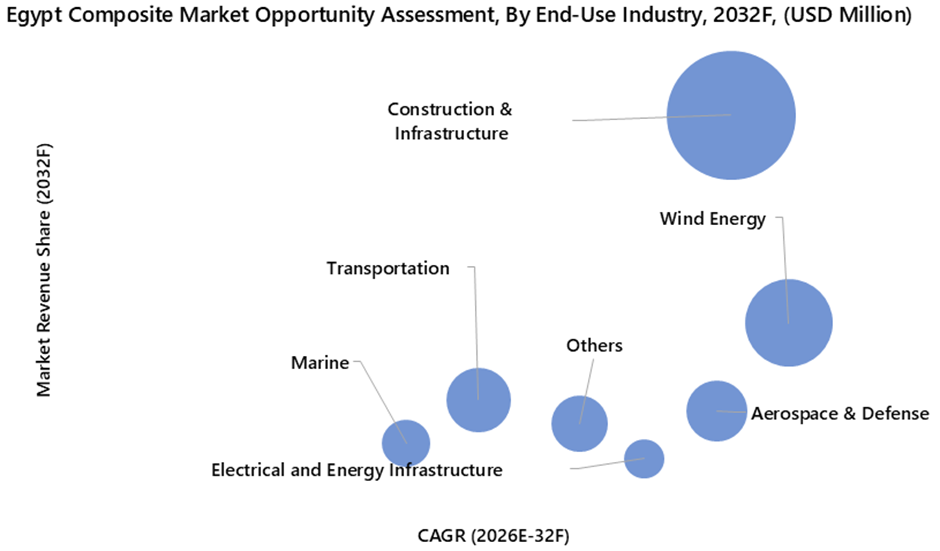
By 2032, wind energy is expected to witness the highest growth within Egypt’s composites market, driven by increasing demand for lightweight, high-strength materials in wind turbine blades and structural components. Rising investments in renewable energy projects, particularly wind power capacity expansion, are fueling the segment’s growth. Enhanced performance requirements, durability needs, and the growing adoption of advanced composite materials in large-scale turbine manufacturing are further supporting expansion, positioning wind energy as a key sector driving value in Egypt’s composites market.
Key Attractiveness of the Report
- 10 Years Market Numbers.
- Historical Data Starting from 2022 to 2025
- Base Year: 2025
- Forecast Data until 2032
- Key Performance Indicators Impacting the Market.
- Major Upcoming Developments and Projects.
Key Highlights of the Report:
- Egypt Composite Market Overview
- Egypt Composite Market Outlook
- Egypt Composite Market Forecast
- Historical Data and Forecast of Egypt Composite Market Revenues for the Period 2022-2032F
- Historical Data and Forecast of Egypt Composite Market Revenues, By Fiber Type, for the Period 2022-2032F
- Historical Data and Forecast of Egypt Composite Market Revenues, By Resin Type, for the Period 2022-2032F
- Historical Data and Forecast of Egypt Composite Market Revenues, By End-Use Industry, for the Period 2022-2032F
- Industry Life Cycle
- Porter’s Five Force Analysis
- Egypt Composite Market Drivers and Restraints
- Market Trends & Evolution
- Market Opportunity Assessment
- Egypt Composite Market Revenue Ranking, By Top 3 Companies
- Competitive Benchmarking
- Company Profiles
- Key Strategic Recommendations
Market Scope and Segmentation
The report provides a detailed analysis of the following market segments:
By Fiber Type
- Glass Fiber Composites
- Carbon Fiber Composites
- Others (Aramid, Natural, Basalt)
By Resin Type
- Thermoset Composites
- Thermoplastic Composites
By End-Use Industry
- Automotive & Transportation
- Wind Energy
- Construction & Infrastructure
- Aerospace & Defense
- Others (Medical Industry, Sports & Leisure, Consumer Goods, etc)






































