Egypt Enterprise AI Market Size & Growth Rate (2026-2032)
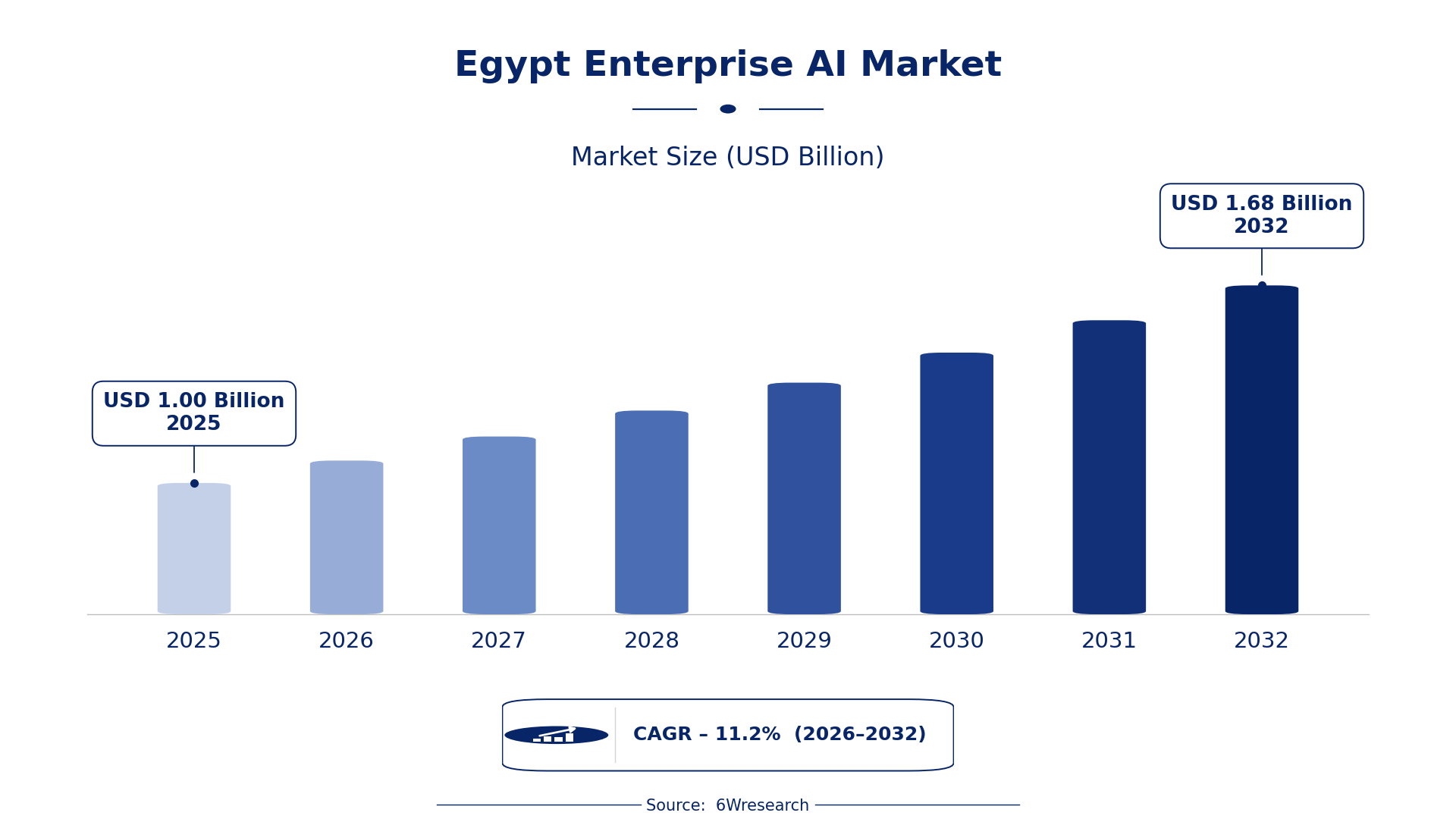
The Egypt Enterprise AI Market was estimated at USD 1000 Million in 2025 and is projected to reach USD 1677 Million by 2032, growing at a CAGR of 11.2% from 2026 to 2032.
Egypt Enterprise AI Market Synopsis
The Egypt Enterprise AI Market is on an upward trajectory, characterized by a surge in AI technology adoption across diverse sectors. Industries such as healthcare, finance, and retail are increasingly integrating AI solutions to enhance efficiency and customer satisfaction.
This growth is underpinned by a wave of investment from both local startups and international technology firms, all eager to tap into Egypt's burgeoning AI potential. Government initiatives aimed at fostering digital innovation are further solidifying the country's position as a key player in the regional AI market.
Egypt Enterprise AI Market Year-wise Growth Rate and Key Drivers
This graph illustrates the annual growth rates of the Egypt Enterprise AI Market from 2021 to 2032, highlighting a steady upward trajectory and projected expansion over the forecast period.
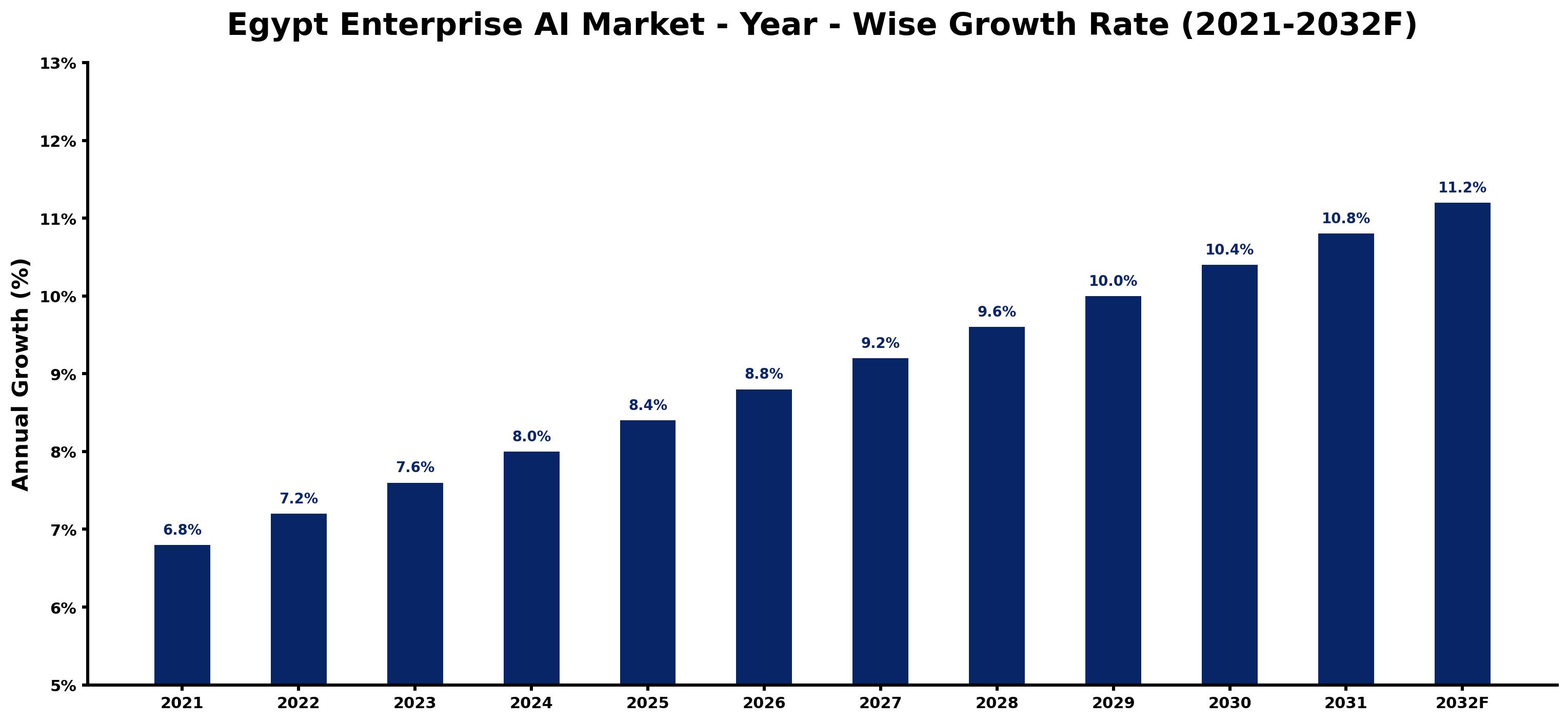
The table below presents the year‑wise growth rates along with the key drivers influencing the market
| Year | Growth Rate | Major Drivers |
| 2021 | 6.8% | National AI Strategy promoting digital transformation initiatives. |
| 2022 | 7.2% | Increased investment in AI research by Egyptian universities. |
| 2023 | 7.6% | Rise in startups focusing on AI-driven solutions. |
| 2024 | 8.0% | Government incentives for tech innovation and AI adoption. |
| 2025 | 8.4% | Growth in local AI talent due to training programs. |
| 2026 | 8.8% | Partnerships with global AI firms enhancing local capabilities. |
| 2027 | 9.2% | Strong demand in healthcare for AI analytics tools. |
| 2028 | 9.6% | Increased use of AI in agriculture for yield optimization. |
| 2029 | 10.0% | Regulatory support for AI-driven financial services innovation. |
| 2030 | 10.4% | Local businesses pivoting to AI for operational efficiency. |
| 2031 | 10.8% | Emergence of AI-focused venture capital funding in Egypt. |
| 2032 | 11.2% | Adoption of AI technologies by government services improving efficiency. |
Note: Market size estimations and growth projections presented in this report are based on 6Wresearch's proprietary forecasting methodology, utilizing the latest available industry data, government publications, and primary research inputs.
Egypt Enterprise AI Market Key Takeaways
Below are some of the specific key takeaways from the market, including:
- The Egypt Enterprise AI Market is driven by increasing adoption in sectors like healthcare and finance.
- Government policies are actively promoting digital transformation and AI integration.
- Partnerships between local enterprises and AI technology providers are on the rise.
- Investment in AI startups is significantly boosting innovation and development.
- Challenges such as skill shortages and data security concerns remain pertinent.
Evaluation of Restraints in Egypt Enterprise AI Market
Despite promising growth, the Egypt Enterprise AI Market faces several significant restraints. Limited awareness and understanding of AI technologies among businesses hinder widespread adoption. Additionally, the shortage of skilled professionals capable of implementing AI solutions creates a bottleneck in the market. Concerns regarding data privacy and security further complicate the landscape, as organizations weigh the risks associated with AI integration. on top of that, the initial costs of implementing AI solutions often deter smaller enterprises, leaving them at a competitive disadvantage.
Egypt Enterprise AI Market Trends
Several trends are currently shaping the Egypt Enterprise AI Market. The focus on enhancing customer experience through personalized AI applications is gaining traction, particularly in retail. Businesses are also leveraging AI for process optimization and data-driven decision-making, which is becoming a standard practice in competitive industries. on top of that, the integration of machine learning and natural language processing technologies is on the rise, signaling a shift towards more sophisticated AI applications.
Egypt Enterprise AI Market Opportunities
Opportunities abound in the Egypt Enterprise AI Market, particularly for vendors who can tailor solutions to meet the unique needs of local businesses. Collaborations between AI firms and Egyptian enterprises are essential for driving innovation and addressing specific market challenges. Additionally, there is a growing demand for AI-powered solutions in underserved sectors, presenting a clear pathway for investment and development.
Government Initiatives in the Egypt Enterprise AI Market
The Egyptian government is taking proactive measures to cultivate a favorable environment for the Enterprise AI Market. By prioritizing digital transformation, the government is establishing policies that support AI adoption across various sectors, making this a critical time for public policy in the AI domain.
- A National AI Strategy launched in early 2025 aims to enhance AI utilization across industries.
- Currently ongoing is a program to invest in AI education and training initiatives to build a skilled workforce.
- A regulatory framework introduced in 2025 ensures ethical AI use and addresses privacy concerns.
- There is a planned public-private initiative expected to foster innovation through AI collaborations by 2028.
- The government is supporting AI startups through funding opportunities and partnerships with industry stakeholders.
Future Insights of the Egypt Enterprise AI Market
Looking ahead to 2026-2032, the Egypt Enterprise AI Market is expected to experience robust growth driven by increasing technological adoption and supportive government initiatives. As businesses increasingly recognize the value of AI in driving efficiency and enhancing customer engagement, the demand for advanced AI solutions will rise. The ongoing investments in AI startups and innovation will further solidify Egypt's position as a regional leader in the AI space.
Egypt Enterprise AI Market Latest Developments
Over the past year, the Egypt Enterprise AI Market has witnessed notable activity, with various developments indicating a vibrant industry landscape. Companies are increasingly launching innovative AI solutions, while collaborations are forming to enhance technological capabilities.
- A leading regional operator launched a new AI-powered customer service platform in Q2 2025.
- An initiative that began in early 2025 aims to integrate AI solutions in the healthcare sector, enhancing diagnostic accuracy.
- A major technology vendor is currently underway with a project to develop AI applications focused on predictive analytics for retail.
- A partnership formed in late 2025 between an AI startup and a prominent financial institution is set to enhance fraud detection capabilities.
- Upcoming is a rollout expected to begin in the second half of 2026 for a national AI research and development hub.
Egypt Enterprise AI Market - Key Attractiveness of the Report
- 10 Years of Market Numbers
- Historical Data Starting from 2022 to 2025
- Base Year: 2025
- Forecast Data until 2032
- Key Performance Indicators Impacting the Market
- Major Upcoming Developments and Projects
Key Highlights of the Report:
- Egypt Enterprise AI Market Outlook
- Market Size of Egypt Enterprise AI Market, 2025
- Forecast of Egypt Enterprise AI Market, 2032
- Historical Data and Forecast of Egypt Enterprise AI Revenues & Volume for the Period 2022-2032F
- Egypt Enterprise AI Market Trend Evolution
- Egypt Enterprise AI Market Drivers and Challenges
- Egypt Enterprise AI Price Trends
- Egypt Enterprise AI Porter's Five Forces
- Egypt Enterprise AI Industry Life Cycle
- Historical Data and Forecast of Egypt Enterprise AI Market Revenues & Volume By Component for the Period 2022-2032F
- Historical Data and Forecast of Egypt Enterprise AI Market Revenues & Volume By Solution for the Period 2022-2032F
- Historical Data and Forecast of Egypt Enterprise AI Market Revenues & Volume By Services for the Period 2022-2032F
- Historical Data and Forecast of Egypt Enterprise AI Market Revenues & Volume By Technology for the Period 2022-2032F
- Historical Data and Forecast of Egypt Enterprise AI Market Revenues & Volume By Machine learning and deep learning for the Period 2022-2032F
- Historical Data and Forecast of Egypt Enterprise AI Market Revenues & Volume By Natural Language Processing (NLP) for the Period 2022-2032F
- Historical Data and Forecast of Egypt Enterprise AI Market Revenues & Volume By Application Area for the Period 2022-2032F
- Historical Data and Forecast of Egypt Enterprise AI Market Revenues & Volume By Security and risk management for the Period 2022-2032F
- Historical Data and Forecast of Egypt Enterprise AI Market Revenues & Volume By Marketing management for the Period 2022-2032F
- Historical Data and Forecast of Egypt Enterprise AI Market Revenues & Volume By Customer support and experience for the Period 2022-2032F
- Historical Data and Forecast of Egypt Enterprise AI Market Revenues & Volume By Human resource and recruitment management for the Period 2022-2032F
- Historical Data and Forecast of Egypt Enterprise AI Market Revenues & Volume By Analytics application for the Period 2022-2032F
- Historical Data and Forecast of Egypt Enterprise AI Market Revenues & Volume By Process automation for the Period 2022-2032F
- Historical Data and Forecast of Egypt Enterprise AI Market Revenues & Volume By Deployment Type for the Period 2022-2032F
- Historical Data and Forecast of Egypt Enterprise AI Market Revenues & Volume By Cloud for the Period 2022-2032F
- Historical Data and Forecast of Egypt Enterprise AI Market Revenues & Volume By On-premises for the Period 2022-2032F
- Historical Data and Forecast of Egypt Enterprise AI Market Revenues & Volume By Organization Size for the Period 2022-2032F
- Historical Data and Forecast of Egypt Enterprise AI Market Revenues & Volume By Small and Medium-sized Businesses (SMBs) for the Period 2022-2032F
- Historical Data and Forecast of Egypt Enterprise AI Market Revenues & Volume By Large enterprises for the Period 2022-2032F
- Egypt Enterprise AI Import Export Trade Statistics
- Market Opportunity Assessment By Component
- Market Opportunity Assessment By Technology
- Market Opportunity Assessment By Application Area
- Market Opportunity Assessment By Deployment Type
- Market Opportunity Assessment By Organization Size
- Egypt Enterprise AI Top Companies Market Share
- Egypt Enterprise AI Competitive Benchmarking By Technical and Operational Parameters
- Egypt Enterprise AI Company Profiles
- Egypt Enterprise AI Key Strategic Recommendations






































