Egypt Ethane Market Size, Share & Growth Rate
The Egypt Ethane Market was estimated at USD 416 Million in 2025 and is projected to reach USD 559 Million by 2032, growing at a CAGR of 4.3% from 2026 to 2032. This growth trajectory is largely fueled by the increasing demand from the petrochemical industry, which relies heavily on ethane as a primary feedstock for ethylene production. Furthermore, ongoing investments in production capabilities and government initiatives promoting the sector are key elements supporting this upward trend.
Egypt Ethane Market Year-wise Growth Rate and Key Drivers
This graph highlights how the Egypt Ethane Market has steadily grown over the years, supported by major growth factors.
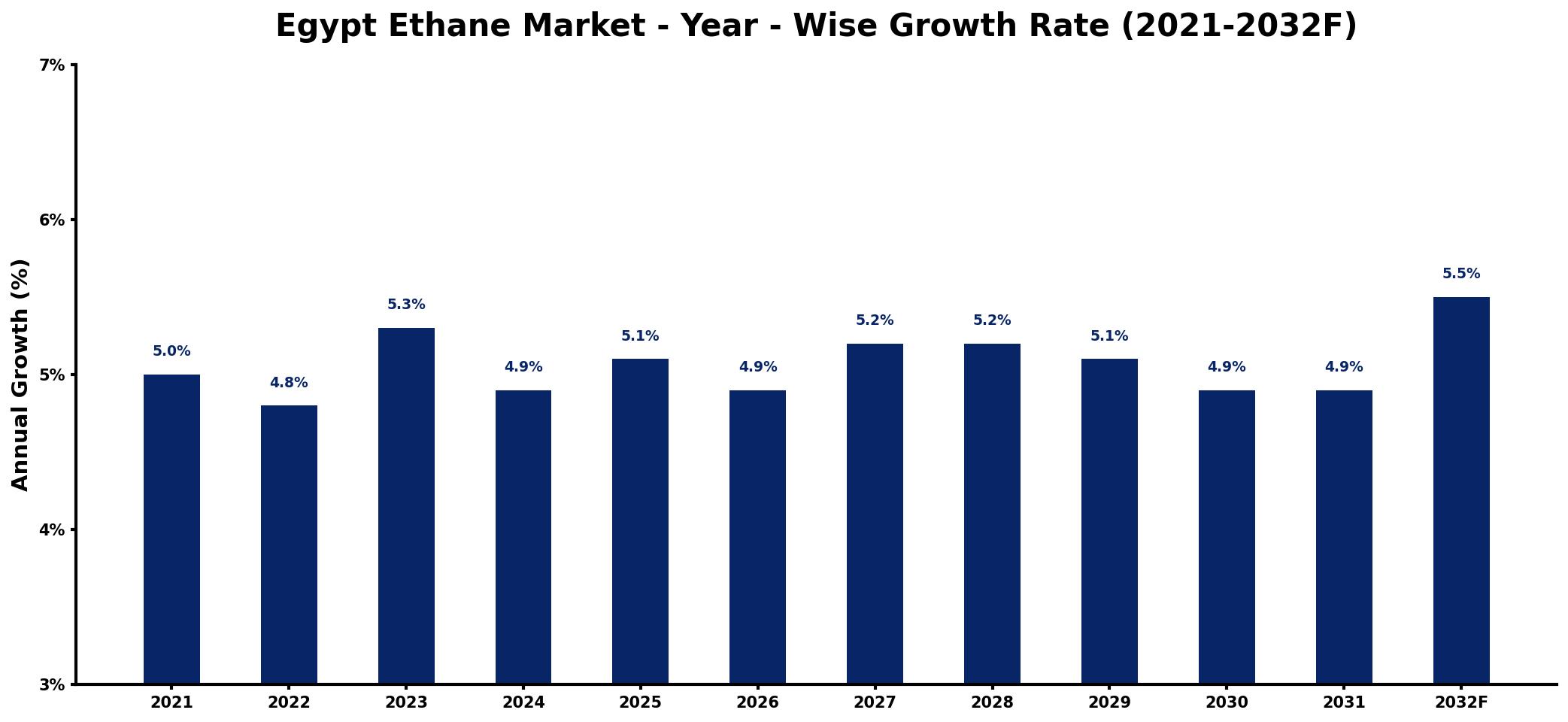
The table below presents the year‑wise growth rates along with the key drivers influencing the market
| Year | Growth Rate | Major Drivers |
| 2021 | 5.0% | Rising demand from petrochemical sector |
| 2022 | 4.8% | Increased investment in infrastructure |
| 2023 | 5.3% | Growth in energy production capacity |
| 2024 | 4.9% | Expansion of industrial applications |
| 2025 | 5.1% | Higher consumption in manufacturing |
| 2026 | 4.9% | Strengthened export market opportunities |
| 2027 | 5.2% | Technological advancements in production |
| 2028 | 5.2% | Boost in domestic energy requirements |
| 2029 | 5.1% | Emerging markets driving demand |
| 2030 | 4.9% | Sustainability initiatives promoting usage |
| 2031 | 4.9% | Regulatory support for industry growth |
| 2032 | 5.5% | Innovations enhancing production efficiency |
Note: Market size estimations and growth projections presented in this report are based on 6Wresearch's proprietary forecasting methodology, utilizing the latest available industry data, government publications, and primary research inputs.
Egypt Ethane Market Synopsis
The demand for ethane in Egypt is primarily driven by the petrochemical sector, which has seen significant growth in recent years. This sector's expansion is further amplified by the rising need for ethylene, a critical component in the production of a wide array of plastic materials.
Moreover, Egypts abundant natural gas reserves provide a solid foundation for the ethane market, ensuring a reliable supply. The government's concerted efforts to attract foreign investment and enhance local production capabilities are further solidifying the country's standing as a prominent player in the ethane landscape.
Egypt Ethane Market Key Takeaways
- The growth of the Egypt Ethane Market is primarily driven by the increasing demand from the petrochemical industry.
- Government initiatives are promoting investment in ethane production and infrastructure development.
- Domestic consumption is expected to rise alongside export opportunities, bolstered by significant natural gas reserves.
- Infrastructure constraints and regulatory challenges continue to pose risks to market expansion.
- Investment opportunities in production facilities and downstream industries present avenues for stakeholders.
Evaluation of Restraints in Egypt Ethane Market
Despite its promising outlook, the Egypt Ethane Market faces considerable challenges. Fluctuating global oil prices create volatility in production costs, impacting pricing strategies. Additionally, Egypt's reliance on limited domestic ethane reserves means that any disruption in supply could significantly affect the market. Infrastructure limitations, particularly in transportation and storage, also hinder seamless distribution and contribute to inefficiencies in the supply chain. Coupled with regulatory uncertainties, these factors create a complex environment that stakeholders must navigate to ensure market sustainability.
Egypt Ethane Market Trends
Current trends in the Egypt Ethane Market highlight an increasing shift toward cleaner energy sources. The government's focus on ethane as a viable alternative to traditional fossil fuels is becoming more pronounced, given its lower emissions profile. Additionally, there is a notable rise in investments directed toward enhancing ethane production facilities and optimizing existing infrastructure to better serve the growing demand.
Emerging technologies and innovations in the petrochemical sector are also shaping the landscape, with companies exploring advanced processes for ethylene production. This not only increases efficiency but also opens new pathways for product diversification, further driving demand for ethane.
Egypt Ethane Market Opportunities
The Egypt Ethane Market is ripe with investment opportunities, particularly in ethane production and related infrastructures. Given the recent discoveries of significant ethane reserves, there is a clear pathway for enhancing domestic production and meeting both local and international demand. Investors can capitalize on the need for modernized production facilities and the development of transportation networks. Furthermore, the growth of downstream industries—particularly in petrochemicals and plastics manufacturing—presents lucrative avenues for stakeholders looking to enter or expand within the market.
Government Initiatives in the Egypt Ethane Market
The Egyptian government plays a crucial role in shaping the ethane market through a variety of supportive policies and initiatives. By offering incentives for companies involved in ethane production and export, the government aims to attract significant foreign investment. Regulatory frameworks are also being established to ensure sustainable extraction practices while focusing on environmental conservation. These initiatives are designed to promote growth within the ethane sector and to enhance Egypt's energy security by diversifying its energy portfolio.
Future Insights of the Egypt Ethane Market
Looking ahead, the Egypt Ethane Market is set for significant growth between 2026 and 2032. This is attributable to a combination of expanding industrial demand, ongoing investments in infrastructure, and an increase in ethane's use as a cleaner energy source. However, stakeholders must remain vigilant regarding global economic uncertainties and the potential impact of fluctuating oil prices on market dynamics. Overall, the outlook is positive, with ample opportunities for entities willing to innovate and adapt in this evolving landscape.
Egypt Ethane Market Latest Developments (2025 - 2026)
Recent developments in the Egypt Ethane Market have highlighted a push towards enhancing production capabilities and improving infrastructure for storage and transportation. As companies continue to invest in expanding their operational capacities, there is a marked interest in adopting more advanced technologies aimed at increasing efficiency and reducing emissions. Furthermore, collaborative efforts between the government and private sector are fostering an environment conducive to growth, aiming to strengthen Egypt's position as a key player in the regional ethane market.
Egypt Ethane Market - Key Attractiveness of the Report
- 10 Years of Market Numbers
- Historical Data Starting from 2022 to 2025
- Base Year: 2025
- Forecast Data until 2032
- Key Performance Indicators Impacting the Market
- Major Upcoming Developments and Projects
Key Highlights of the Report:
- Egypt Ethane Market Outlook
- Market Size of Egypt Ethane Market, 2025
- Forecast of Egypt Ethane Market, 2032
- Historical Data and Forecast of Egypt Ethane Revenues & Volume for the Period 2022-2032F
- Egypt Ethane Market Trend Evolution
- Egypt Ethane Market Drivers and Challenges
- Egypt Ethane Price Trends
- Egypt Ethane Porter's Five Forces
- Egypt Ethane Industry Life Cycle
- Historical Data and Forecast of Egypt Ethane Market Revenues & Volume By Application for the Period 2022-2032F
- Historical Data and Forecast of Egypt Ethane Market Revenues & Volume By Ethylene Synthesis for the Period 2022-2032F
- Historical Data and Forecast of Egypt Ethane Market Revenues & Volume By Acetic Acid Synthesis for the Period 2022-2032F
- Historical Data and Forecast of Egypt Ethane Market Revenues & Volume By Refrigerant for the Period 2022-2032F
- Historical Data and Forecast of Egypt Ethane Market Revenues & Volume By End-Use Industry for the Period 2022-2032F
- Historical Data and Forecast of Egypt Ethane Market Revenues & Volume By Packaging for the Period 2022-2032F
- Historical Data and Forecast of Egypt Ethane Market Revenues & Volume By Automotive & Transportation for the Period 2022-2032F
- Historical Data and Forecast of Egypt Ethane Market Revenues & Volume By Construction for the Period 2022-2032F
- Historical Data and Forecast of Egypt Ethane Market Revenues & Volume By Electricals & Electronics for the Period 2022-2032F
- Historical Data and Forecast of Egypt Ethane Market Revenues & Volume By Healthcare for the Period 2022-2032F
- Egypt Ethane Import Export Trade Statistics
- Market Opportunity Assessment By Application
- Market Opportunity Assessment By End-Use Industry
- Egypt Ethane Top Companies Market Share
- Egypt Ethane Competitive Benchmarking By Technical and Operational Parameters
- Egypt Ethane Company Profiles
- Egypt Ethane Key Strategic Recommendations






































