Egypt Facial Recognition Market Size & Growth Rate (2026-2032)
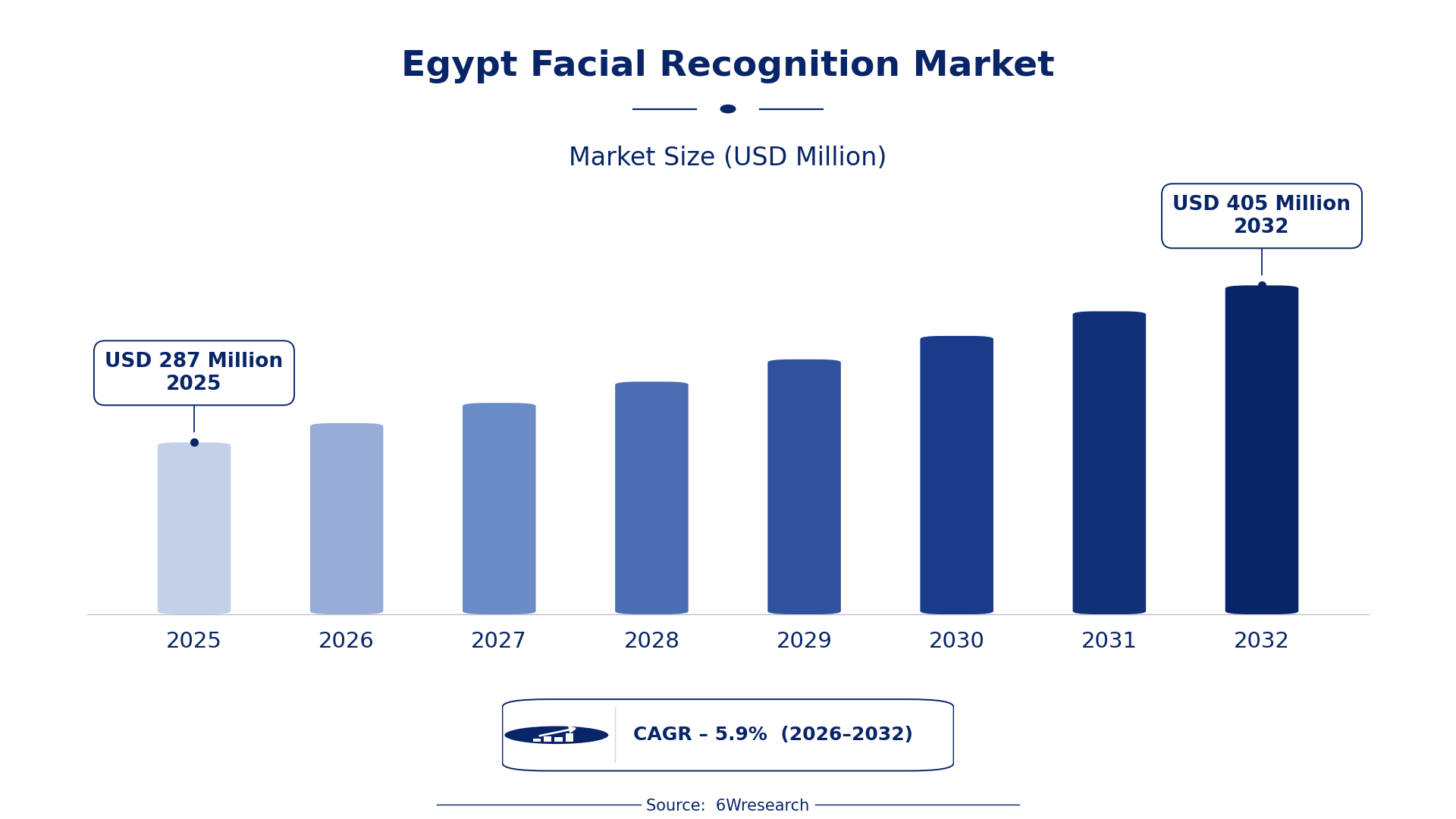
The Egypt Facial Recognition Market was estimated at USD 287 Million in 2025 and is projected to reach USD 405 Million by 2032, growing at a CAGR of 5.9% from 2026 to 2032.
Egypt Facial Recognition Market Synopsis
The Egypt Facial Recognition Market is on an upward trajectory, fueled by increasing demand for security solutions across various sectors. Government initiatives, particularly in security and surveillance, are driving the adoption of advanced facial recognition systems, making this technology integral to national and public safety efforts.
As businesses in banking, retail, and healthcare recognize the value of personalized customer experiences, the market for facial recognition technology is expanding. Companies are investing in innovative solutions that offer real-time identification and high accuracy, positioning themselves to capitalize on this growing trend.
Egypt Facial Recognition Market Year-wise Growth Rate and Key Drivers
This graph illustrates the annual growth rates of the Egypt Facial Recognition Market from 2021 to 2032, highlighting a steady upward trajectory and projected expansion over the forecast period.
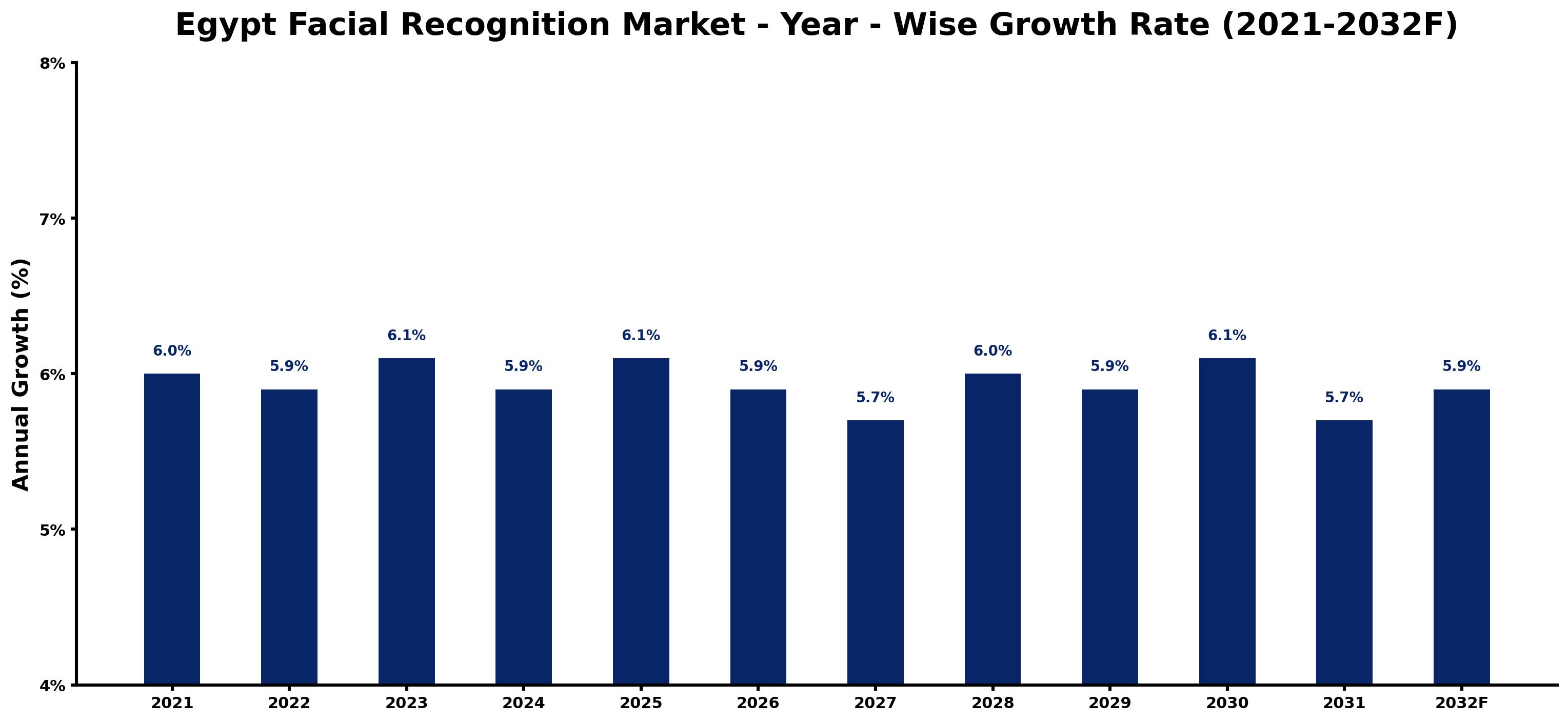
The table below presents the year‑wise growth rates along with the key drivers influencing the market
| Year | Growth Rate | Major Drivers |
| 2021 | 6.0% | Implementation of National Digital Identity Programme by Egypt. |
| 2022 | 5.9% | Launch of biometric surveillance systems for public safety. |
| 2023 | 6.1% | Growing investment in security technologies by local governments. |
| 2024 | 5.9% | Increased adoption of facial recognition in banking services. |
| 2025 | 6.1% | Regulatory support for biometric data protection frameworks. |
| 2026 | 5.9% | Rising security concerns driving demand for biometric solutions. |
| 2027 | 5.7% | Government initiatives for modernizing law enforcement technology. |
| 2028 | 6.0% | Partnerships between tech firms and Egyptian universities. |
| 2029 | 5.9% | Development of urban public transport systems utilizing biometrics. |
| 2030 | 6.1% | National security measures integrating AI-driven facial recognition. |
| 2031 | 5.7% | Growing popularity of smart home devices with biometric features. |
| 2032 | 5.9% | Increased funding for national cybersecurity and ID verification. |
Note: Market size estimations and growth projections presented in this report are based on 6Wresearch's proprietary forecasting methodology, utilizing the latest available industry data, government publications, and primary research inputs.
Egypt Facial Recognition Market Key Takeaways
Below are some of the specific key takeaways from the market, including:
- The Egyptian government is actively enhancing security measures, particularly in public areas and airports.
- Technological advancements in AI and machine learning are propelling the development of facial recognition systems.
- There is a marked increase in demand for contactless authentication methods, particularly post-pandemic.
- Regulatory frameworks are evolving, emphasizing the need for data privacy and security compliance.
- Investment in R&D for improving facial recognition technology is growing, with a focus on accuracy and reliability.
Evaluation of Restraints in Egypt Facial Recognition Market
While the market is expanding, several factors hold it back. Privacy and data security concerns are at the forefront, as the sensitivity of facial recognition technology raises alarm among consumers and advocacy groups. Cultural considerations also play a role; public acceptance is not guaranteed, and skepticism may hinder widespread adoption.
Technical limitations, such as the varying performance of systems in poor lighting or crowded environments, pose additional challenges. on top of that, regulatory uncertainties regarding the implementation of facial recognition further complicate the market, creating an environment where companies must tread cautiously.
Egypt Facial Recognition Market Trends
A notable trend is the growing integration of facial recognition technology within smart city initiatives. As urban areas adopt more advanced surveillance systems, the need for efficient and reliable facial recognition solutions becomes paramount. Additionally, the proliferation of mobile devices has accelerated the demand for contactless authentication methods, which are increasingly being integrated into consumer-facing applications.
on top of that, collaborations between technology providers and regulatory bodies are becoming common, as companies seek to develop solutions that address privacy concerns while meeting market demands. The focus on ethical AI and responsible data usage is shaping the future direction of the industry.
Egypt Facial Recognition Market Opportunities
Genuine growth opportunities are emerging in sectors such as healthcare and banking, where tailored facial recognition solutions can enhance customer experiences and security measures. The rising trend of personalized services offers a lucrative avenue for companies willing to innovate.
on top of that, the expansion of applications beyond traditional security—like in access control for events and venues—presents an attractive prospect for investment. Companies that prioritize research and development, particularly in improving accuracy and integrating with existing systems, will likely be well-positioned to capture market share.
Government Initiatives in the Egypt Facial Recognition Market
Government policy is increasingly influential in shaping the Egypt Facial Recognition Market. The Egyptian authorities are focusing on balancing security needs with privacy rights, leading to the introduction of regulations that govern the deployment of facial recognition technology. Such frameworks are vital for ensuring that the technology is used responsibly and ethically, fostering public trust while enhancing security.
- A regulatory framework was established in 2019 requiring approval from the National Telecommunications Regulatory Authority for any facial recognition system implementation.
- The government is currently conducting a comprehensive review of data privacy laws to align with international standards, expected to influence market operations.
- A national security initiative focused on enhancing surveillance at key public locations is ongoing, with facial recognition technology at its core.
- Upcoming public-private partnerships are planned to develop smart city projects that incorporate advanced facial recognition systems for urban safety.
- Recent training programs have been launched for law enforcement agencies on the ethical use of facial recognition technology.
Future Insights of the Egypt Facial Recognition Market
Looking ahead, the Egypt Facial Recognition Market is set for robust growth driven by technological advancements and increasing awareness of security needs. The integration of artificial intelligence will continue to enhance the functionality and reliability of facial recognition systems, making them indispensable in various sectors.
As regulatory frameworks solidify, companies that adapt to compliance requirements while innovating will thrive. The next few years will see a push towards more ethical applications of this technology, addressing privacy concerns while delivering enhanced security solutions.
Egypt Facial Recognition Market Latest Developments
In the past year, the Egypt Facial Recognition Market has witnessed a surge in activity, with several key developments aimed at enhancing technology capabilities and addressing regulatory challenges. Companies are actively pursuing partnerships and investing in innovation to stay ahead of emerging trends.
- A major technology vendor launched a new facial recognition platform in early 2025, designed for seamless integration with existing security systems.
- Ongoing pilot projects are assessing the effectiveness of facial recognition technology in public transportation systems, initiated in Q2 2025.
- By mid-2026, a planned rollout of an upgraded facial recognition system in major urban centers is expected to enhance public safety measures.
- Recent collaborations between tech firms and government agencies have focused on developing standards for data privacy related to facial recognition usage, which began in late 2025.
- Current discussions are underway for a public awareness campaign aimed at educating citizens about the benefits and privacy measures associated with facial recognition technology.
Egypt Facial Recognition Market - Key Attractiveness of the Report
- 10 Years of Market Numbers
- Historical Data Starting from 2022 to 2025
- Base Year: 2025
- Forecast Data until 2032
- Key Performance Indicators Impacting the Market
- Major Upcoming Developments and Projects
Key Highlights of the Report:
- Egypt Facial Recognition Market Outlook
- Market Size of Egypt Facial Recognition Market, 2025
- Forecast of Egypt Facial Recognition Market, 2032
- Historical Data and Forecast of Egypt Facial Recognition Revenues & Volume for the Period 2022-2032F
- Egypt Facial Recognition Market Trend Evolution
- Egypt Facial Recognition Market Drivers and Challenges
- Egypt Facial Recognition Price Trends
- Egypt Facial Recognition Porter's Five Forces
- Egypt Facial Recognition Industry Life Cycle
- Historical Data and Forecast of Egypt Facial Recognition Market Revenues & Volume By Component for the Period 2022-2032F
- Historical Data and Forecast of Egypt Facial Recognition Market Revenues & Volume By Software for the Period 2022-2032F
- Historical Data and Forecast of Egypt Facial Recognition Market Revenues & Volume By Services for the Period 2022-2032F
- Historical Data and Forecast of Egypt Facial Recognition Market Revenues & Volume By Application for the Period 2022-2032F
- Historical Data and Forecast of Egypt Facial Recognition Market Revenues & Volume By Access Control for the Period 2022-2032F
- Historical Data and Forecast of Egypt Facial Recognition Market Revenues & Volume By Attendance Tracking & Monitoring for the Period 2022-2032F
- Historical Data and Forecast of Egypt Facial Recognition Market Revenues & Volume By Emotion Recognition for the Period 2022-2032F
- Historical Data and Forecast of Egypt Facial Recognition Market Revenues & Volume By Security & Surveillance for the Period 2022-2032F
- Historical Data and Forecast of Egypt Facial Recognition Market Revenues & Volume By Others for the Period 2022-2032F
- Historical Data and Forecast of Egypt Facial Recognition Market Revenues & Volume By Vertical for the Period 2022-2032F
- Historical Data and Forecast of Egypt Facial Recognition Market Revenues & Volume By Retail & E-Commerce for the Period 2022-2032F
- Historical Data and Forecast of Egypt Facial Recognition Market Revenues & Volume By Media & Entertainment for the Period 2022-2032F
- Historical Data and Forecast of Egypt Facial Recognition Market Revenues & Volume By BFSI for the Period 2022-2032F
- Historical Data and Forecast of Egypt Facial Recognition Market Revenues & Volume By Automobile & Transportation for the Period 2022-2032F
- Historical Data and Forecast of Egypt Facial Recognition Market Revenues & Volume By Telecom & IT for the Period 2022-2032F
- Historical Data and Forecast of Egypt Facial Recognition Market Revenues & Volume By Government for the Period 2022-2032F
- Historical Data and Forecast of Egypt Facial Recognition Market Revenues & Volume By Healthcare for the Period 2022-2032F
- Historical Data and Forecast of Egypt Facial Recognition Market Revenues & Volume By Others for the Period 2022-2032F
- Historical Data and Forecast of Egypt Facial Recognition Market Revenues & Volume By Technology for the Period 2022-2032F
- Historical Data and Forecast of Egypt Facial Recognition Market Revenues & Volume By 2D for the Period 2022-2032F
- Historical Data and Forecast of Egypt Facial Recognition Market Revenues & Volume By 3D for the Period 2022-2032F
- Historical Data and Forecast of Egypt Facial Recognition Market Revenues & Volume By Facial Analytics for the Period 2022-2032F
- Egypt Facial Recognition Import Export Trade Statistics
- Market Opportunity Assessment By Component
- Market Opportunity Assessment By Application
- Market Opportunity Assessment By Vertical
- Market Opportunity Assessment By Technology
- Egypt Facial Recognition Top Companies Market Share
- Egypt Facial Recognition Competitive Benchmarking By Technical and Operational Parameters
- Egypt Facial Recognition Company Profiles
- Egypt Facial Recognition Key Strategic Recommendations






































