Egypt Food Processing & Handling Equipment Market Summary
The egypt food processing & handling equipment market was estimated at USD 204 Million in 2025 and is projected to reach USD 288 Million by 2032, growing at a CAGR of 6.2% from 2026 to 2032.
Egypt Food Processing & Handling Equipment Market Year-wise Growth Rate and Key Drivers
This graph highlights how the Egypt Food Processing & Handling Equipment Market has steadily grown over the past five years, supported by major growth factors.
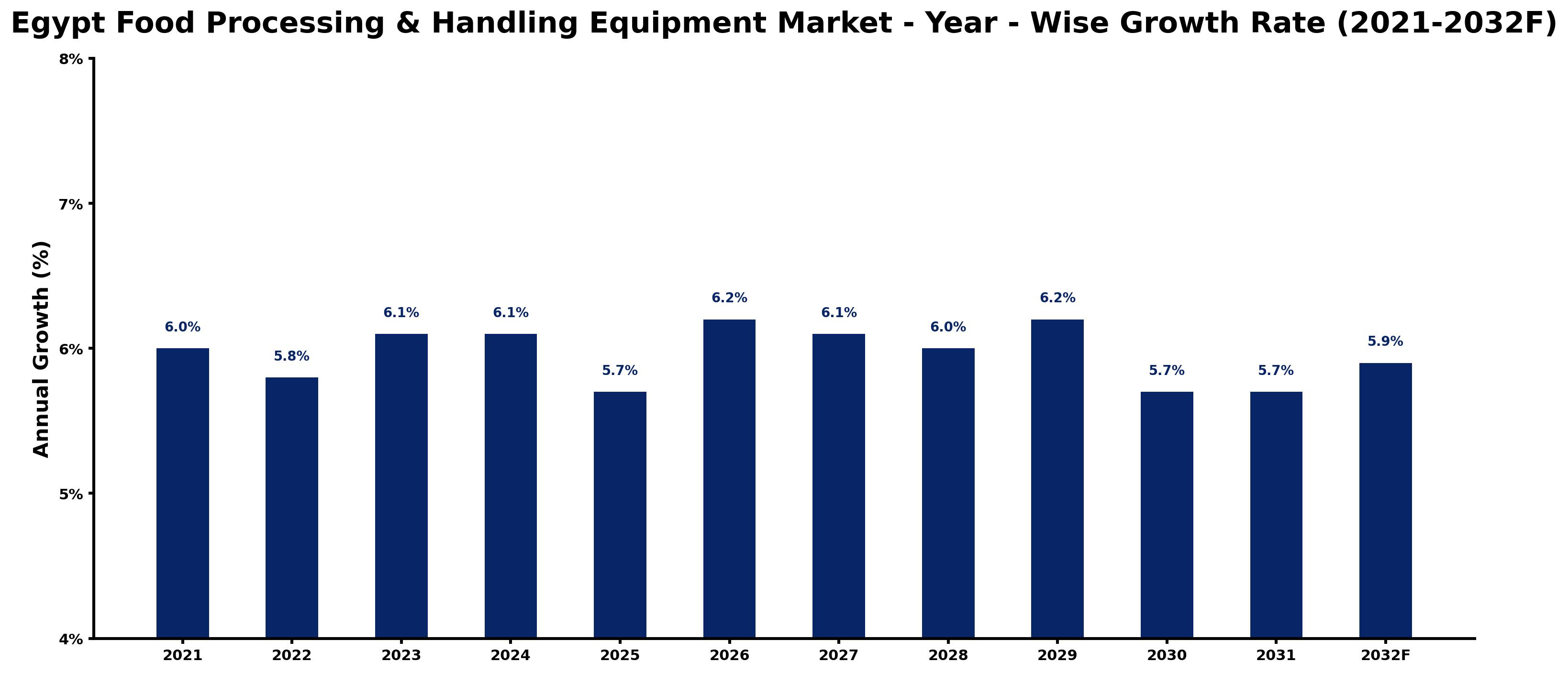
The table below presents the year wise growth rates along with the key drivers influencing the market
| Year | Growth Rate | Major Drivers |
| 2021 | 6.0% | Post-lockdown retail projects highlighted the necessity for upgraded food handling systems. |
| 2022 | 5.8% | Increased urbanization led to a spike in demand for efficient food processing equipment. |
| 2023 | 6.1% | Local manufacturers began investing in advanced technologies to enhance operational efficiencies. |
| 2024 | 6.1% | Consumer preference for packaged foods required significant improvements in production capabilities. |
| 2025 | 5.7% | Rising health awareness prompted companies to adopt stricter hygiene practices in food processing. |
| 2026 | 6.2% | The tourism sector's recovery encouraged hotels to upgrade their food service infrastructure. |
| 2027 | 6.1% | E-commerce growth pushed food processors to enhance logistics and inventory management systems. |
| 2028 | 6.0% | Adoption of innovative preservation techniques became essential for extending product shelf life. |
| 2029 | 6.2% | Collaborations between local firms and international suppliers fostered technology transfer opportunities. |
| 2030 | 5.7% | Increased export ambitions necessitated compliance with international food safety standards. |
| 2031 | 5.7% | Investment in renewable energy sources began influencing food processing equipment design choices. |
| 2032 | 5.9% | Automation trends prompted manufacturers to prioritize smart machinery for operational resilience. |
Note - Market size estimations and growth projections presented in this report are based on 6Wresearch's advanced forecasting approach, validated with industry datasets as of June 2026.
Egypt Food Processing & Handling Equipment Market Synopsis
The Egypt Food Processing Handling Equipment Market is projected to reach 6.2% and witness significant growth during the forecast period (2026-2032). This market is positioned at the intersection of technological advancement and the increasing consumer demand for processed food products. As Egypt's population continues to grow, so too does the need for efficient food processing solutions that align with modern standards of hygiene and quality. Factors such as rising disposable incomes have contributed to an increased preference for processed food, further driving the market's expansion.
Egypt Food Processing & Handling Equipment Market Growth Drivers
The growth of the Egypt Food Processing & Handling Equipment Market can be attributed to several key drivers:
- Increasing consumer demand for processed food is a primary catalyst. With a busy lifestyle, consumers are seeking convenient meal options, leading to an upsurge in food processing activities.
- Technological advancements play a crucial role. Modern equipment is designed to enhance processing efficiency, reduce waste, and improve product quality, allowing food manufacturers to optimize their operations.
- Government initiatives aimed at promoting food security have established a supportive framework for the food processing sector. Policies encouraging local production and quality standards are paving the way for growth.
- Rising disposable incomes contribute to changing consumer preferences, with increased willingness to spend on packaged and processed food items, thereby enhancing market potential.
- The growing focus on sustainability is pushing manufacturers towards adopting eco-friendly equipment and practices, which are not only better for the environment but also appeal to a more conscious consumer base.
Egypt Food Processing & Handling Equipment Market Trends and Opportunities
The Egypt Food Processing & Handling Equipment Market is showing distinct trends that highlight its evolution and identify future opportunities:
- The shift towards automation and digitalization is profound. Advanced technologies such as robotics and IoT are increasingly being implemented to improve operational efficiency in food processing facilities.
- There is a rising demand for modular and customizable equipment that caters to the specific needs of food processing companies, reflecting a move towards tailored solutions that enhance productivity.
- Investments in energy-efficient machinery are becoming more prevalent as the industry seeks to address rising energy costs and align with the global sustainability agenda.
- The trend towards heightened food safety awareness is influencing manufacturers to adopt stringent quality controls and invest in equipment that prioritizes safety standards.
- The e-commerce boom is reshaping food distribution channels, fostering opportunities for equipment manufacturers to develop solutions that facilitate online transactions and home delivery.
Egypt Food Processing & Handling Equipment Market Challenges and Restraints
Despite the positive outlook, several challenges could impede the growth of the Egypt Food Processing & Handling Equipment Market:
- High import tariffs on equipment can inflate costs, making it challenging for local manufacturers to compete effectively against cheaper alternatives from abroad.
- Fluctuating raw material prices introduce unpredictability, putting pressure on profit margins and complicating long-term financial planning for businesses.
- Access to advanced technology remains limited for some local manufacturers, which can hinder their ability to innovate and keep pace with larger, international competitors.
- An inconsistent quality of raw materials can negatively affect the output quality of processed foods, leading to potential compliance issues with safety regulations.
- A fragmented distribution network can challenge the efficiency of market operations, making it harder for manufacturers to reach their target customers effectively.
Egypt Food Processing & Handling Equipment Market Investment Opportunities
The Egypt Food Processing & Handling Equipment Market offers numerous investment opportunities due to the sector's growth potential:
- Modernizing production facilities is a key opportunity, where investors can support the upgrade of equipment to enhance overall operational efficiency and product quality.
- Investing in innovative technologies, such as automated systems and smart machinery, can help food processing companies reduce operational costs and improve productivity.
- Supporting initiatives focused on enhancing food safety standards can position investors favorably within the market, as safety has become a principal concern for consumers.
- Exploring sustainable equipment solutions presents another opportunity, as eco-friendly practices resonate more with an increasingly environmentally conscious consumer base.
- Engaging with local food processing firms to assist in navigating regulatory requirements can open pathways for investment in compliance-oriented solutions and systems.
Egypt Food Processing & Handling Equipment Market Government Investment and Initiatives
The Egyptian government has proactively implemented several policies to foster growth within the food processing and handling equipment market. Investment incentives, including tax breaks and subsidies, are designed to entice both local and foreign entities to establish and expand operations in this sector. Furthermore, significant public spending on infrastructure improvements, such as transportation networks and cold storage facilities, aims to enhance food processing efficiency. Regulatory measures focused on food safety standards ensure that companies comply with high-quality expectations, which, in turn, supports market stability and growth. These initiatives reflect a concerted effort to boost competitiveness, sustainability, and food security in Egypt's growing food industry.
Egypt Food Processing & Handling Equipment Market Latest Developments (May 2025 - June 2026)
Recent trends in the Egypt Food Processing & Handling Equipment Market reflect significant developments from May 2025 to June 2026. The continuous push towards automation has resulted in increased investments in cutting-edge technologies that improve processing efficiency and enhance product safety. Concurrently, regulatory bodies have intensified their focus on food quality and safety, leading to stricter compliance requirements for manufacturers. These changes have prompted many companies to reevaluate their operational protocols and invest in advanced equipment to meet new standards. The rise of convenience foods and e-commerce platforms has also had a marked influence, driving demand for innovative processing solutions tailored to changing consumer behaviors. Overall, these developments highlight the dynamic nature of the market as it adapts to emerging trends and regulatory landscapes.
Egypt Food Processing & Handling Equipment Market - Key Attractiveness of the Report
- 10 Years of Market Numbers
- Historical Data Starting from 2022 to 2025
- Base Year: 2025
- Forecast Data until 2032
- Key Performance Indicators Impacting the Market
- Major Upcoming Developments and Projects
Key Highlights of the Report:
- Egypt Food Processing & Handling Equipment Market Outlook
- Market Size of Egypt Food Processing & Handling Equipment Market, 2025
- Forecast of Egypt Food Processing & Handling Equipment Market, 2032F
- Historical Data and Forecast of Egypt Food Processing & Handling Equipment Revenues & Volume for the Period 2022-2032F
- Egypt Food Processing & Handling Equipment Market Trend Evolution
- Egypt Food Processing & Handling Equipment Market Drivers and Challenges
- Egypt Food Processing & Handling Equipment Price Trends
- Egypt Food Processing & Handling Equipment Porter's Five Forces
- Egypt Food Processing & Handling Equipment Industry Life Cycle
- Historical Data and Forecast of Egypt Food Processing & Handling Equipment Market Revenues & Volume By Equipment Type for the Period 2022-2032F
- Historical Data and Forecast of Egypt Food Processing & Handling Equipment Market Revenues & Volume By Food Processing equipment for the Period 2022-2032F
- Historical Data and Forecast of Egypt Food Processing & Handling Equipment Market Revenues & Volume By Foodservice equipment for the Period 2022-2032F
- Historical Data and Forecast of Egypt Food Processing & Handling Equipment Market Revenues & Volume By Food Packaging equipment for the Period 2022-2032F
- Historical Data and Forecast of Egypt Food Processing & Handling Equipment Market Revenues & Volume By Application for the Period 2022-2032F
- Historical Data and Forecast of Egypt Food Processing & Handling Equipment Market Revenues & Volume By Bakery & confectionery products for the Period 2022-2032F
- Historical Data and Forecast of Egypt Food Processing & Handling Equipment Market Revenues & Volume By Meat & poultry products for the Period 2022-2032F
- Historical Data and Forecast of Egypt Food Processing & Handling Equipment Market Revenues & Volume By Dairy products for the Period 2022-2032F
- Historical Data and Forecast of Egypt Food Processing & Handling Equipment Market Revenues & Volume By Alcoholic beverages for the Period 2022-2032F
- Historical Data and Forecast of Egypt Food Processing & Handling Equipment Market Revenues & Volume By Non-alcoholic beverages for the Period 2022-2032F
- Historical Data and Forecast of Egypt Food Processing & Handling Equipment Market Revenues & Volume By Fish & seafood products for the Period 2022-2032F
- Historical Data and Forecast of Egypt Food Processing & Handling Equipment Market Revenues & Volume By Others? for the Period 2022-2032F
- Historical Data and Forecast of Egypt Food Processing & Handling Equipment Market Revenues & Volume By Form for the Period 2022-2032F
- Historical Data and Forecast of Egypt Food Processing & Handling Equipment Market Revenues & Volume By Solid for the Period 2022-2032F
- Historical Data and Forecast of Egypt Food Processing & Handling Equipment Market Revenues & Volume By Liquid for the Period 2022-2032F
- Historical Data and Forecast of Egypt Food Processing & Handling Equipment Market Revenues & Volume By Semi-solid for the Period 2022-2032F
- Egypt Food Processing & Handling Equipment Import Export Trade Statistics
- Market Opportunity Assessment By Equipment Type
- Market Opportunity Assessment By Application
- Market Opportunity Assessment By Form
- Egypt Food Processing & Handling Equipment Top Companies Market Share
- Egypt Food Processing & Handling Equipment Competitive Benchmarking By Technical and Operational Parameters
- Egypt Food Processing & Handling Equipment Company Profiles
- Egypt Food Processing & Handling Equipment Key Strategic Recommendations






































