Egypt Leather Market Summary
The egypt leather market was estimated at USD 953 Million in 2025 and is projected to reach USD 1368 Million by 2032, growing at a CAGR of 5.9% from 2026 to 2032.
Egypt Leather Market Year-wise Growth Rate and Key Drivers
This graph highlights how the Egypt Leather Market has steadily grown over the past five years, supported by major growth factors.
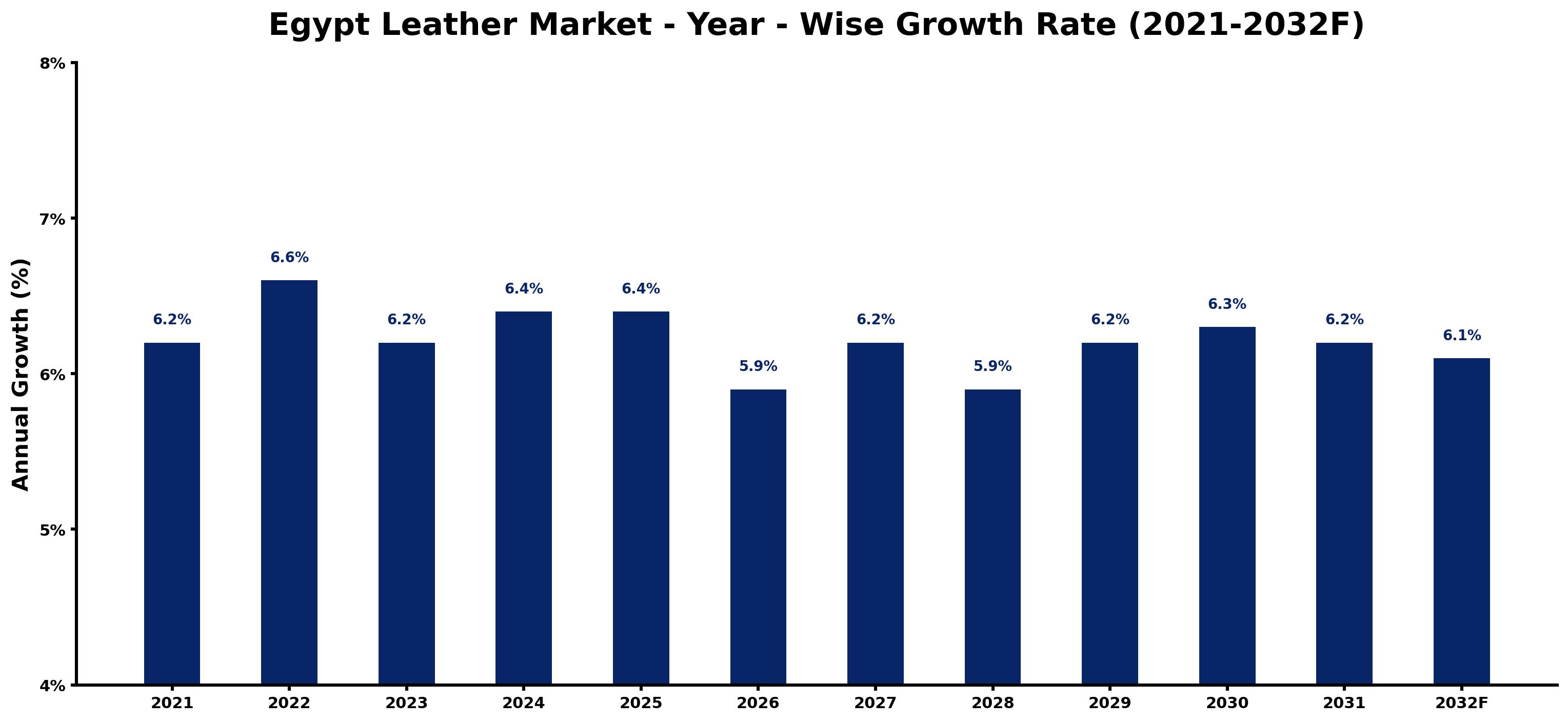
The table below presents the year wise growth rates along with the key drivers influencing the market
| Year | Growth Rate | Major Drivers |
| 2021 | 6.2% | Post-pandemic consumer preferences shifted towards sustainable and ethically sourced leather products. |
| 2022 | 6.6% | International brands increasingly collaborate with local artisans, enhancing product authenticity and appeal. |
| 2023 | 6.2% | E-commerce platforms gained traction, allowing smaller brands to reach broader audiences effortlessly. |
| 2024 | 6.4% | A growing middle class in Egypt influences premium leather goods consumption patterns significantly. |
| 2025 | 6.4% | Investment in local tanneries improves production efficiency and quality of leather materials. |
| 2026 | 5.9% | Fashion trends favoring vintage and handcrafted items boost demand for artisanal leather goods. |
| 2027 | 6.2% | Export opportunities to GCC countries expand, driven by Egypt's competitive pricing and craftsmanship. |
| 2028 | 5.9% | Innovations in tanning processes reduce environmental impact, attracting eco-conscious consumers effectively. |
| 2029 | 6.2% | Luxury brands expanding into Egypt elevate market standards and consumer expectations significantly. |
| 2030 | 6.3% | Increased tourism stimulates demand for locally made leather accessories and souvenirs. |
| 2031 | 6.2% | Urbanization trends lead to higher disposable income, encouraging leather goods purchases across demographics. |
| 2032 | 6.1% | Technological developments in manufacturing streamline production, enhancing scalability and reducing costs. |
Note - Market size estimations and growth projections presented in this report are based on 6Wresearch's advanced forecasting approach, validated with industry datasets as of June 2026.
Egypt Leather Market Synopsis
The Egypt Leather Market is projected to reach 5.9% and witness significant growth during the forecast period (2026-2032). This robust expansion is driven primarily by the increasing population and the heightened demand for leather products across various sectors. The rise in disposable income among Egyptian consumers is expected to further elevate the demand for luxury leather goods, positioning the market for remarkable growth. Additionally, supportive government policies, advancements in technology, and improved trade agreements are integral factors contributing to the positive outlook for the Egypt Leather Market.
Egypt Leather Market Growth Drivers
Several key drivers are propelling the growth of the Egypt Leather Market. Firstly, the demographic trends in Egypt reveal a young and growing population, which directly boosts consumption of leather goods. Secondly, the rising disposable income among consumers facilitates the acquisition of high-quality leather products, including apparel, accessories, and furnishings. Thirdly, government endorsement through various initiatives promotes investment in the leather sector, encouraging local manufacturers to innovate and expand their offerings.
Moreover, technological advancements in leather processing have improved product quality and efficiency, reducing production costs. This positions manufacturers to offer more competitive pricing without compromising quality. Finally, Egypt's advantageous labor costs compared to other regions attract foreign direct investment in the tanning industry, further bolstering the market.
Egypt Leather Market Challenges and Restraints
While the Egypt Leather Market shows promising growth potential, it also faces certain challenges that could restrain its progress. Environmental regulations, particularly those concerning waste management and chemical usage in tanning processes, require compliance, which can increase operational costs for manufacturers. Additionally, fluctuations in raw material prices, particularly animal hides, can create volatility in production costs and pricing strategies.
Another challenge is the competition from synthetic leather alternatives that are gaining popularity due to their cost-effectiveness and perceived environmental benefits. Furthermore, the global economic landscape's impact on demand for luxury goods can lead to unpredictability in sales. Lastly, the ongoing need for modernized infrastructure in the leather supply chain can pose significant hurdles to manufacturers aiming for expansion.
Egypt Leather Market Investment Opportunities
The landscape of the Egypt Leather Market is ripe with investment opportunities that investors and entrepreneurs can capitalize on. The growing trend towards sustainable and eco-friendly practices offers an avenue for investments into greener tanning processes and materials. Innovations in technology, such as automation in production lines and digital marketing strategies, can significantly enhance the efficiency and reach of local manufacturers.
Additionally, collaborations between local companies and international brands to establish joint ventures can facilitate knowledge transfer and access to advanced manufacturing techniques. As the demand for bespoke and luxury leather items increases, brands focusing on craftsmanship and unique designs stand to benefit from consumer trends. Furthermore, expanding into emerging markets within the region can provide lucrative avenues for growth for established players in the Egypt Leather Market.
Egypt Leather Market Government Investment and Initiatives
The Egyptian government has recognized the potential of the leather industry and is actively investing in development initiatives aimed at enhancing the market's competitiveness. Government policies are increasingly focused on promoting the leather sector through financial incentives, training programs for skilled labor, and infrastructure development. Initiatives that foster research and development in innovative leather processing techniques are being prioritized, thereby improving product quality and sustainability.
Moreover, trade agreements that facilitate smoother export processes and reduce tariffs on leather products are encouraging local manufacturers to expand their international presence. The establishment of free-trade zones and support for participation in international trade fairs are additional strategies being employed to elevate Egypt's position in the global leather market.
Egypt Leather Market Latest Developments (May 2025 - June 2026)
In the period between May 2025 and June 2026, the Egypt Leather Market experienced several notable developments. The implementation of new technological innovations in tanning processes has led to improved efficiency and reduced environmental impact, aligning with global sustainability trends. Local manufacturers are increasingly adopting practices that emphasize eco-friendly materials and methods, responding to rising consumer demand for sustainable products.
Additionally, there has been a noticeable increase in public and private sector collaborations aimed at enhancing the leather industry's infrastructure. Training programs for artisans and workers have been introduced, focusing on traditional craft skills alongside modern production techniques, increasing the skill level within the workforce. These initiatives have stimulated local artisans' capabilities and contributed to a burgeoning market for artisanal leather goods.
Egypt Leather Market - Key Attractiveness of the Report
- 10 Years of Market Numbers
- Historical Data Starting from 2022 to 2025
- Base Year: 2025
- Forecast Data until 2032
- Key Performance Indicators Impacting the Market
- Major Upcoming Developments and Projects
Key Highlights of the Report:
- Egypt Leather Market Outlook
- Market Size of Egypt Leather Market, 2025
- Forecast of Egypt Leather Market, 2032F
- Historical Data and Forecast of Egypt Leather Revenues & Volume for the Period 2022-2032F
- Egypt Leather Market Trend Evolution
- Egypt Leather Market Drivers and Challenges
- Egypt Leather Price Trends
- Egypt Leather Porter's Five Forces
- Egypt Leather Industry Life Cycle
- Historical Data and Forecast of Egypt Leather Market Revenues & Volume By Type for the Period 2022-2032F
- Historical Data and Forecast of Egypt Leather Market Revenues & Volume By Luggage for the Period 2022-2032F
- Historical Data and Forecast of Egypt Leather Market Revenues & Volume By Footwear for the Period 2022-2032F
- Historical Data and Forecast of Egypt Leather Market Revenues & Volume By Accessories for the Period 2022-2032F
- Historical Data and Forecast of Egypt Leather Market Revenues & Volume By Distribution Channel for the Period 2022-2032F
- Historical Data and Forecast of Egypt Leather Market Revenues & Volume By Online for the Period 2022-2032F
- Historical Data and Forecast of Egypt Leather Market Revenues & Volume By Offline for the Period 2022-2032F
- Egypt Leather Import Export Trade Statistics
- Market Opportunity Assessment By Type
- Market Opportunity Assessment By Distribution Channel
- Egypt Leather Top Companies Market Share
- Egypt Leather Competitive Benchmarking By Technical and Operational Parameters
- Egypt Leather Company Profiles
- Egypt Leather Key Strategic Recommendations






































