Egypt Mass Spectrometry Market Size, Share & Growth Rate
The Egypt Mass Spectrometry Market was estimated at USD 155 Million in 2025 and is projected to reach USD 206 Million by 2032, growing at a CAGR of 4.1% from 2026 to 2032. This growth trajectory is primarily driven by the increasing investments in research and development across various sectors, particularly pharmaceuticals and biotechnology. Furthermore, heightened awareness surrounding food safety and environmental testing is propelling the adoption of mass spectrometry technologies, ensuring precise analytical capabilities.
Egypt Mass Spectrometry Market Year-wise Growth Rate and Key Drivers
This graph highlights how the Egypt Mass Spectrometry Market has steadily grown over the years, supported by major growth factors.
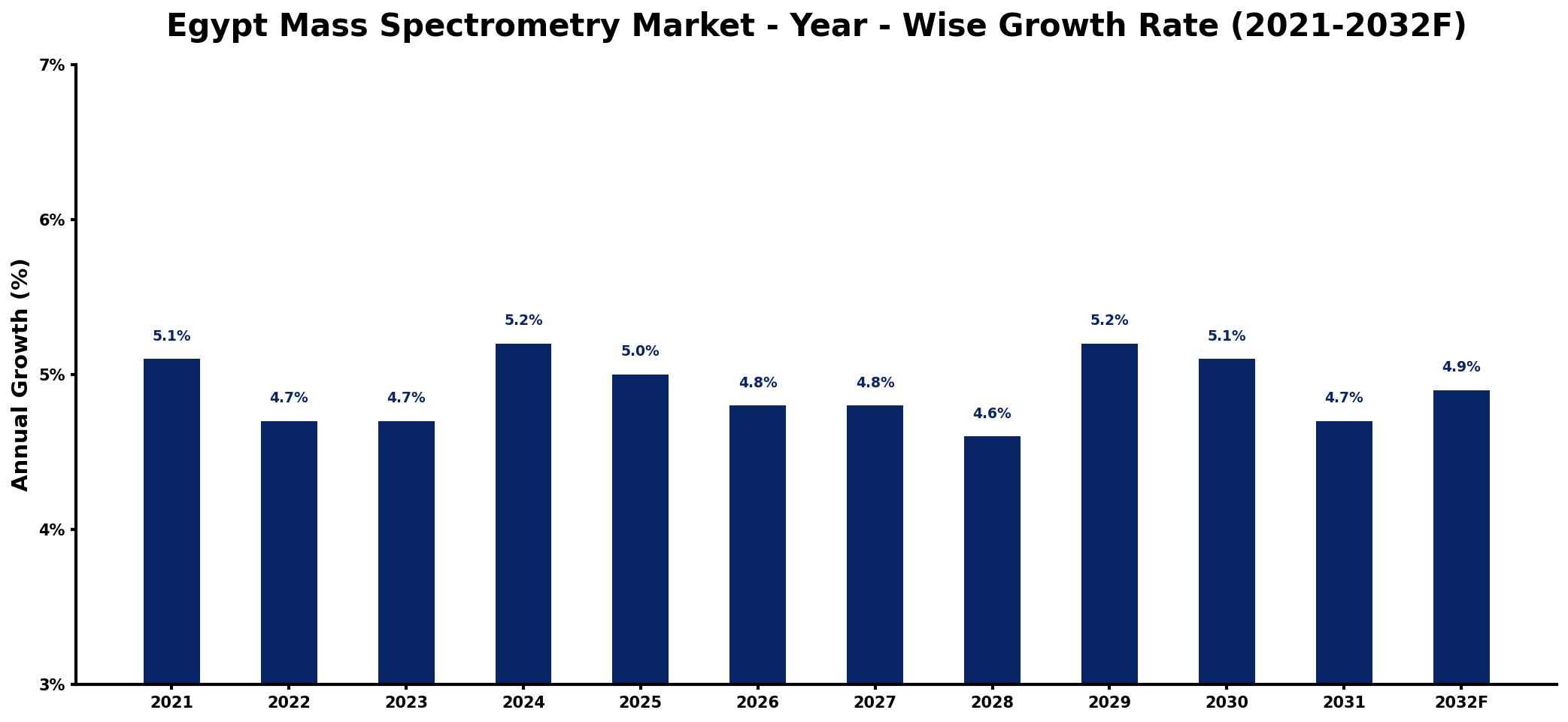
The table below presents the year‑wise growth rates along with the key drivers influencing the market
| Year | Growth Rate | Major Drivers |
| 2021 | 5.1% | Rising demand in pharmaceuticals sector |
| 2022 | 4.7% | Increased investment in research facilities |
| 2023 | 4.7% | Growing applications in environmental monitoring |
| 2024 | 5.2% | Expansion of biotechnology research initiatives |
| 2025 | 5.0% | growing downstream application demand |
| 2026 | 4.8% | Higher adoption in clinical diagnostics |
| 2027 | 4.8% | Investment growth in academic research |
| 2028 | 4.6% | Emergence of new analytical technologies |
| 2029 | 5.2% | Strengthening regulatory compliance standards |
| 2030 | 5.1% | enhanced product quality standards |
| 2031 | 4.7% | Increased usage in industrial applications |
| 2032 | 4.9% | improved processing technologies adoption |
Note: Market size estimations and growth projections presented in this report are based on 6Wresearch's proprietary forecasting methodology, utilizing the latest available industry data, government publications, and primary research inputs.
Egypt Mass Spectrometry Market Synopsis
The Egypt Mass Spectrometry Market is witnessing a remarkable shift as industries recognize the importance of advanced analytical techniques. With a growing demand for accurate compound detection and quantification, mass spectrometry is becoming an essential tool in various sectors including healthcare, agriculture, and environmental monitoring.
Current governmental initiatives aimed at enhancing scientific research and healthcare infrastructure are further catalyzing the market's growth. As Egypt focuses on modernizing its analytical capabilities, collaboration between academic institutions and the private sector is fostering a robust ecosystem that encourages innovation and development.
Egypt Mass Spectrometry Market Key Takeaways
- Significant growth driven by R&D investments in pharmaceuticals and biotechnology.
- Rising demand for mass spectrometry in food safety and environmental testing sectors.
- Technological advancements enhancing instrument capabilities are a market catalyst.
- Strategic partnerships among stakeholders are fostering innovation.
- Government policies are supportive of research and development initiatives.
Evaluation of Restraints in Egypt Mass Spectrometry Market
Despite the promising growth potential, the Egypt Mass Spectrometry Market faces notable challenges. One of the primary constraints is the high initial investment required for advanced mass spectrometry equipment, which can deter smaller entities from entering the market. Furthermore, there exists a significant skills gap, with a lack of qualified professionals proficient in mass spectrometry technology. This shortfall impedes the ability of organizations to fully leverage the benefits of these analytical tools. Lastly, infrastructure limitations and inadequate laboratory facilities can hinder the accessibility and implementation of mass spectrometry solutions across Egypt.
Egypt Mass Spectrometry Market Trends
Several trends are currently shaping the Egypt Mass Spectrometry Market. The continuous evolution of high-resolution mass spectrometry instruments is enhancing sensitivity and accuracy, making them more appealing to end-users. Additionally, the growing emphasis on clinical diagnostics and proteomics research is expanding the applicability of mass spectrometry techniques. Collaborative efforts between academic institutions and private organizations are leading to innovative breakthroughs that improve instrument functionality and application breadth. These trends are indicative of a market that is not only growing but evolving rapidly to meet industry demands.
Egypt Mass Spectrometry Market Opportunities
The Egypt Mass Spectrometry Market presents substantial investment opportunities. With an increasing focus on food safety and environmental protection, there is a rising demand for advanced analytical techniques. Investors can explore opportunities in providing cutting-edge mass spectrometry equipment, as well as offering essential maintenance and training services. Collaborations with local universities and research institutions can also facilitate growth, enhancing both technology transfer and innovation. Furthermore, establishing a local distribution network could significantly benefit stakeholders looking to capture a share of this expanding market.
Government Initiatives in the Egypt Mass Spectrometry Market
The Egyptian government is actively promoting policies aimed at bolstering innovation and R&D within the analytical sciences. Initiatives include funding programs, tax incentives, and strategic partnerships between private enterprises and academic institutions. Such measures are designed to enhance the capabilities of local mass spectrometry companies, ensuring they remain competitive in a rapidly evolving market landscape. Additionally, regulatory frameworks are being established to ensure the quality and safety of mass spectrometry services and equipment, contributing to a more reliable market environment.
Future Insights of the Egypt Mass Spectrometry Market
Looking ahead to 2026-2032, the Egypt Mass Spectrometry Market is anticipated to maintain its upward trajectory. The continued demand for precise and reliable analytical tools across various industries will propel market expansion. Government initiatives aimed at modernizing healthcare infrastructure, coupled with rising investments in R&D, are set to drive the adoption of mass spectrometry technologies. However, addressing challenges such as high initial costs and the need for skilled professionals will be critical in ensuring sustained growth and innovation in this sector.
Egypt Mass Spectrometry Market Latest Developments (2025 - 2026)
In recent months, the Egypt Mass Spectrometry Market has seen significant developments. New partnerships have emerged between academic institutions and industry stakeholders, aimed at enhancing research capabilities and expanding the application of mass spectrometry in clinical diagnostics. Additionally, technological advancements are leading to the introduction of more compact and efficient mass spectrometry instruments, which are increasingly tailored for specific applications in pharmaceuticals and environmental testing. These innovations reflect a dynamic market adapting to the evolving needs of various sectors.
Egypt Mass Spectrometry Market - Key Attractiveness of the Report
- 10 Years of Market Numbers
- Historical Data Starting from 2022 to 2025
- Base Year: 2025
- Forecast Data until 2032
- Key Performance Indicators Impacting the Market
- Major Upcoming Developments and Projects
Key Highlights of the Report:
- Egypt Mass Spectrometry Market Outlook
- Market Size of Egypt Mass Spectrometry Market, 2025
- Forecast of Egypt Mass Spectrometry Market, 2032
- Historical Data and Forecast of Egypt Mass Spectrometry Revenues & Volume for the Period 2022-2032F
- Egypt Mass Spectrometry Market Trend Evolution
- Egypt Mass Spectrometry Market Drivers and Challenges
- Egypt Mass Spectrometry Price Trends
- Egypt Mass Spectrometry Porter's Five Forces
- Egypt Mass Spectrometry Industry Life Cycle
- Historical Data and Forecast of Egypt Mass Spectrometry Market Revenues & Volume By Technology for the Period 2022-2032F
- Historical Data and Forecast of Egypt Mass Spectrometry Market Revenues & Volume By Hybrid Mass Spectrometry for the Period 2022-2032F
- Historical Data and Forecast of Egypt Mass Spectrometry Market Revenues & Volume By Single Mass Spectrometry for the Period 2022-2032F
- Historical Data and Forecast of Egypt Mass Spectrometry Market Revenues & Volume By Application for the Period 2022-2032F
- Historical Data and Forecast of Egypt Mass Spectrometry Market Revenues & Volume By Pharmaceutical for the Period 2022-2032F
- Historical Data and Forecast of Egypt Mass Spectrometry Market Revenues & Volume By Biotechnology for the Period 2022-2032F
- Historical Data and Forecast of Egypt Mass Spectrometry Market Revenues & Volume By Security for the Period 2022-2032F
- Historical Data and Forecast of Egypt Mass Spectrometry Market Revenues & Volume By Industrial chemistry for the Period 2022-2032F
- Historical Data and Forecast of Egypt Mass Spectrometry Market Revenues & Volume By Environmental testing for the Period 2022-2032F
- Historical Data and Forecast of Egypt Mass Spectrometry Market Revenues & Volume By Food & beverage testing for the Period 2022-2032F
- Historical Data and Forecast of Egypt Mass Spectrometry Market Revenues & Volume By Forensic for the Period 2022-2032F
- Historical Data and Forecast of Egypt Mass Spectrometry Market Revenues & Volume By Clinical for the Period 2022-2032F
- Egypt Mass Spectrometry Import Export Trade Statistics
- Market Opportunity Assessment By Technology
- Market Opportunity Assessment By Application
- Egypt Mass Spectrometry Top Companies Market Share
- Egypt Mass Spectrometry Competitive Benchmarking By Technical and Operational Parameters
- Egypt Mass Spectrometry Company Profiles
- Egypt Mass Spectrometry Key Strategic Recommendations






































