Egypt Natural Extracts Market Size, Share & Growth Rate
The Egypt Natural Extracts Market was estimated at USD 937 Million in 2025 and is projected to reach USD 1362 Million by 2032, growing at a CAGR of 5.5% from 2026 to 2032. This growth trajectory is primarily fueled by increasing consumer awareness regarding the health benefits of natural ingredients across multiple sectors. In particular, the rising demand for organic and sustainable products is reshaping consumer preferences, thereby driving innovation and investment in this vibrant market.
Egypt Natural Extracts Market Year-wise Growth Rate and Key Drivers
This graph highlights how the Egypt Natural Extracts Market has steadily grown over the years, supported by major growth factors.
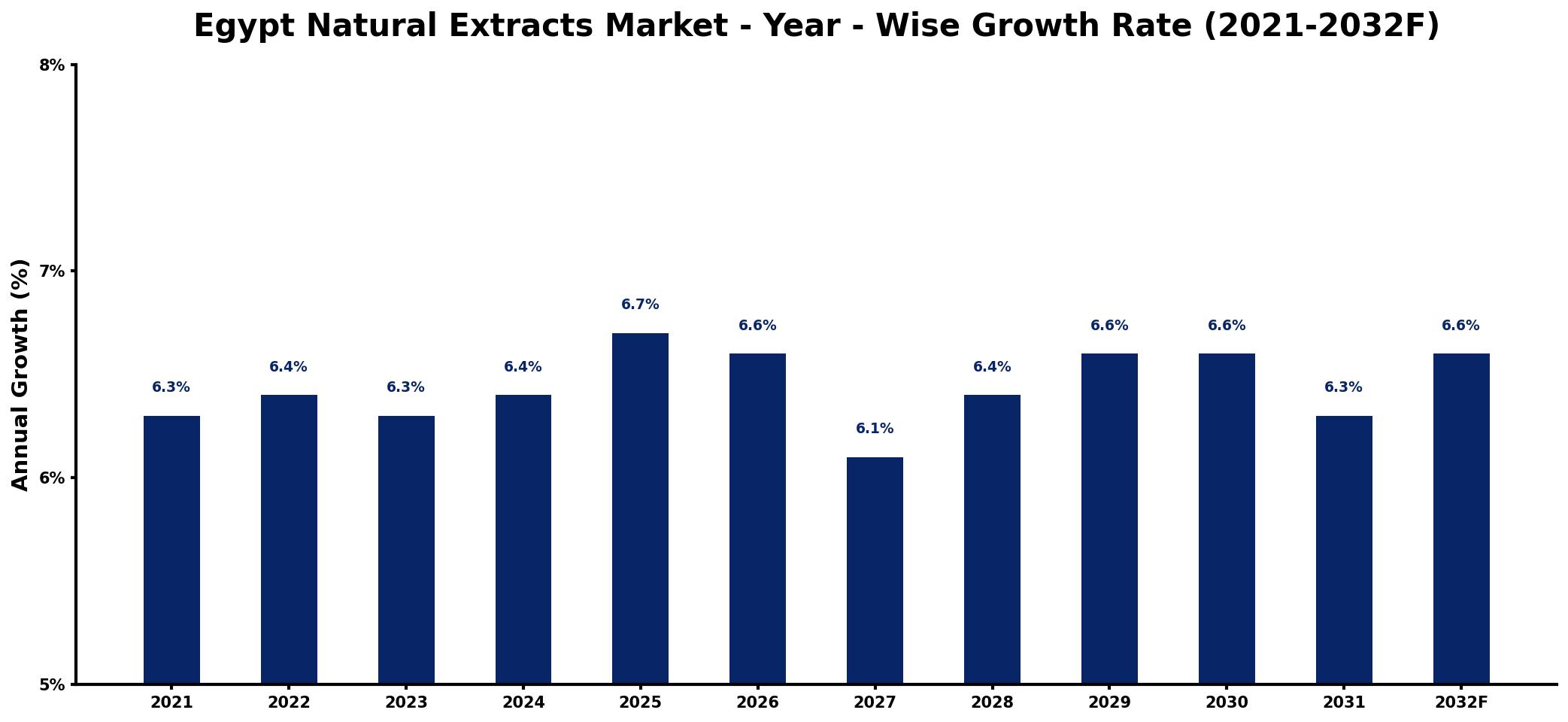
The table below presents the year‑wise growth rates along with the key drivers influencing the market
| Year | Growth Rate | Major Drivers |
| 2021 | 6.3% | Rising consumer health consciousness |
| 2022 | 6.4% | Increased investment in sustainability |
| 2023 | 6.3% | Growing demand for organic products |
| 2024 | 6.4% | Expansion of online retail platforms |
| 2025 | 6.7% | Emerging trends in wellness tourism |
| 2026 | 6.6% | Diversification of product offerings |
| 2027 | 6.1% | stronger distribution network expansion |
| 2028 | 6.4% | Heightened interest in herbal remedies |
| 2029 | 6.6% | Collaboration with local farmers |
| 2030 | 6.6% | Advancements in extraction technology |
| 2031 | 6.3% | Surge in beauty care applications |
| 2032 | 6.6% | Enhanced regulatory support initiatives |
Note: Market size estimations and growth projections presented in this report are based on 6Wresearch's proprietary forecasting methodology, utilizing the latest available industry data, government publications, and primary research inputs.
Egypt Natural Extracts Market Synopsis
The Egypt Natural Extracts Market has experienced significant momentum in recent years, underpinned by a burgeoning interest in natural and herbal remedies. As consumers become more health-conscious, the demand for plant-based ingredients continues to surge, leading to enhanced market dynamics.
Looking ahead, the market is poised for further expansion, influenced by evolving trends in clean labeling and sustainable sourcing. The increasing incorporation of traditional Egyptian ingredients, such as hibiscus and moringa, reflects the rich biodiversity of the region and resonates with both local and international consumers seeking authenticity.
Egypt Natural Extracts Market Key Takeaways
- The market is growing in response to heightened consumer interest in natural and organic products.
- Investment in product innovation and sustainable practices is on the rise among market players.
- Consumer preference is shifting towards traditional Egyptian ingredients, enhancing the markets uniqueness.
- Strategic partnerships are increasingly being formed to address supply chain challenges and expand market reach.
- Government policies are supporting the natural extracts sector through incentives and sustainable practices.
Evaluation of Restraints in Egypt Natural Extracts Market
Despite its promising growth, the Egypt Natural Extracts Market faces several restraints. Regulatory hurdles impose strict compliance requirements that can hinder operational agility. Additionally, the availability of raw materials is often limited due to seasonal factors and environmental challenges. These constraints are exacerbated by price volatility and inconsistent supply chain management, making it essential for market participants to invest in robust quality control systems and optimize their logistics. Establishing consumer trust in product authenticity and efficacy remains a critical challenge that must be addressed to unlock the market's full potential.
Egypt Natural Extracts Market Trends
Current trends indicate a marked shift towards organic and sustainable products across various industries, including cosmetics, food and beverage, and pharmaceuticals. The growing preference for plant-based extracts is largely driven by their perceived health benefits and minimal environmental impact. Furthermore, the popularity of traditional Egyptian ingredients is rising, with products featuring hibiscus, moringa, and black seed oil gaining traction both locally and in international markets. This shift highlights an ongoing consumer fascination with natural alternatives, further driving the demand for innovative extraction methods and formulations.
Egypt Natural Extracts Market Opportunities
The Egypt Natural Extracts Market is rich with investment opportunities, particularly in sectors such as essential oils, herbal extracts, and plant-based ingredients. Investors can leverage the countrys rich biodiversity by forging partnerships with local producers and investing in research and development to create cutting-edge products. The strategic geographic positioning of Egypt also provides a competitive edge for exporting to markets across the Middle East and Europe, enhancing the appeal for stakeholders seeking to capitalize on the global demand for natural ingredients.
Government Initiatives in the Egypt Natural Extracts Market
The Egyptian government is actively supporting the natural extracts market through a variety of initiatives aimed at promoting economic growth and sustainability. These initiatives include financial incentives for research and development in the sector, as well as tax breaks for companies engaged in the production of natural extracts. Additionally, regulations have been established to ensure sustainable harvesting practices, thereby protecting the environment while enhancing biodiversity. The government is also focused on elevating Egypt's profile in the global market for natural extracts through trade agreements and participation in international industry events.
Future Insights of the Egypt Natural Extracts Market
As we look toward 2026-2032, the Egypt Natural Extracts Market is set to experience robust growth driven by evolving consumer preferences for health and wellness. The increasing demand for clean-label products, combined with a strong focus on sustainability and innovative sourcing practices, will continue to propel market expansion. Egypts rich heritage of herbal medicine positions the nation to play a significant role in the global natural extracts landscape, further supporting both local and international suppliers in tapping into this lucrative market.
Egypt Natural Extracts Market Latest Developments (2025 - 2026)
Recent developments in the Egypt Natural Extracts Market indicate a surge in companies focusing on product innovation and quality certification. There is an ongoing trend of local producers exploring partnerships with international distributors to widen their market reach. Additionally, participation in global trade fairs has increased, showcasing Egypt's unique natural extracts to a broader audience and attracting foreign investment. These movements reflect the market's responsiveness to changing consumer demands and the global inclination towards sustainable products.
Egypt Natural Extracts Market - Key Attractiveness of the Report
- 10 Years of Market Numbers
- Historical Data Starting from 2022 to 2025
- Base Year: 2025
- Forecast Data until 2032
- Key Performance Indicators Impacting the Market
- Major Upcoming Developments and Projects
Key Highlights of the Report:
- Egypt Natural Extracts Market Outlook
- Market Size of Egypt Natural Extracts Market, 2025
- Forecast of Egypt Natural Extracts Market, 2032
- Historical Data and Forecast of Egypt Natural Extracts Revenues & Volume for the Period 2022-2032F
- Egypt Natural Extracts Market Trend Evolution
- Egypt Natural Extracts Market Drivers and Challenges
- Egypt Natural Extracts Price Trends
- Egypt Natural Extracts Porter's Five Forces
- Egypt Natural Extracts Industry Life Cycle
- Historical Data and Forecast of Egypt Natural Extracts Market Revenues & Volume By Product for the Period 2022-2032F
- Historical Data and Forecast of Egypt Natural Extracts Market Revenues & Volume By Essential Oils for the Period 2022-2032F
- Historical Data and Forecast of Egypt Natural Extracts Market Revenues & Volume By Oleoresins for the Period 2022-2032F
- Historical Data and Forecast of Egypt Natural Extracts Market Revenues & Volume By Herbal Extracts for the Period 2022-2032F
- Historical Data and Forecast of Egypt Natural Extracts Market Revenues & Volume By Natural Colors for the Period 2022-2032F
- Historical Data and Forecast of Egypt Natural Extracts Market Revenues & Volume By Dried Crops for the Period 2022-2032F
- Historical Data and Forecast of Egypt Natural Extracts Market Revenues & Volume By Application for the Period 2022-2032F
- Historical Data and Forecast of Egypt Natural Extracts Market Revenues & Volume By Personal Care & Cosmetics for the Period 2022-2032F
- Historical Data and Forecast of Egypt Natural Extracts Market Revenues & Volume By Food & Beverage for the Period 2022-2032F
- Historical Data and Forecast of Egypt Natural Extracts Market Revenues & Volume By Animal Feed for the Period 2022-2032F
- Historical Data and Forecast of Egypt Natural Extracts Market Revenues & Volume By Pharmaceuticals for the Period 2022-2032F
- Historical Data and Forecast of Egypt Natural Extracts Market Revenues & Volume By Nutraceuticals for the Period 2022-2032F
- Historical Data and Forecast of Egypt Natural Extracts Market Revenues & Volume By Others for the Period 2022-2032F
- Egypt Natural Extracts Import Export Trade Statistics
- Market Opportunity Assessment By Product
- Market Opportunity Assessment By Application
- Egypt Natural Extracts Top Companies Market Share
- Egypt Natural Extracts Competitive Benchmarking By Technical and Operational Parameters
- Egypt Natural Extracts Company Profiles
- Egypt Natural Extracts Key Strategic Recommendations






































