Egypt Non-ferrous Metal Market Summary
The egypt non-ferrous metal market was estimated at USD 221 Million in 2025 and is projected to reach USD 242 Million by 2032, growing at a CAGR of 0.7% from 2026 to 2032.
Egypt Non-ferrous Metal Market Year-wise Growth Rate and Key Drivers
This graph highlights how the Egypt Non-ferrous Metal Market has steadily grown over the past five years, supported by major growth factors.
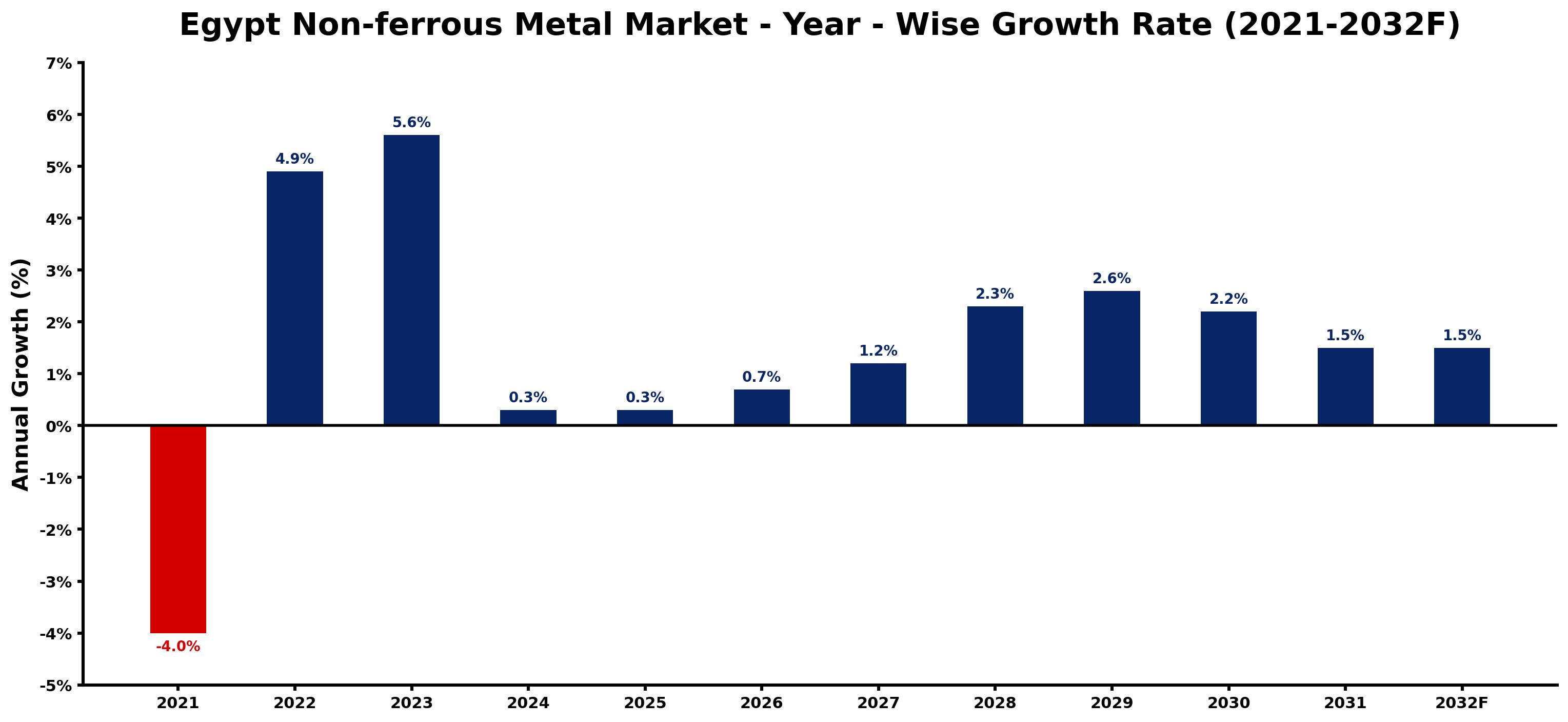
The table below presents the year wise growth rates along with the key drivers influencing the market
| Year | Growth Rate | Major Drivers |
| 2021 | -4.0% | Political instability led to decreased foreign investment, hampering growth in the nonferrous metal sector. |
| 2022 | 4.9% | Renewable energy investment highlights the critical need for aluminum and copper components. |
| 2023 | 5.6% | Emerging infrastructure projects necessitate increased copper use for wiring and connections. |
| 2024 | 0.3% | Local industries explore recycling initiatives, boosting demand for secondary non-ferrous metals. |
| 2025 | 0.3% | Increased automotive manufacturing drives demand for lightweight non-ferrous materials in vehicles. |
| 2026 | 0.7% | Technological advancements in electronics require higher-quality metals for efficient production. |
| 2027 | 1.2% | Egypt's economic diversification strategy emphasizes non-ferrous metals' role in manufacturing. |
| 2028 | 2.3% | Frequent power outages prompt investment in resilient aluminum power grid solutions. |
| 2029 | 2.6% | Regional trade agreements facilitate easier access to non-ferrous metal imports and exports. |
| 2030 | 2.2% | Urbanization trends lead to higher demand for construction-grade non-ferrous metals. |
| 2031 | 1.5% | Sustainability drives innovation in the non-ferrous metal recycling sector across Egypt. |
| 2032 | 1.5% | New automotive regulations prioritize lightweight materials, enhancing non-ferrous metal utilization. |
Note - Market size estimations and growth projections presented in this report are based on 6Wresearch's advanced forecasting approach, validated with industry datasets as of June 2026.
Egypt Non-ferrous Metal Market Synopsis
The Egypt Non-ferrous Metal Market is projected to reach 0.7% and witness significant growth during the forecast period (2026-2032). This growth trajectory can be attributed to a myriad of factors, including increased investments in infrastructure development, advancements in technology, and escalating demand from the automotive sector. Furthermore, the ongoing industrialization processes within the region, combined with government initiatives aimed at promoting renewable energy, are contributing positively to the market's expansion over the forecast period. Notably, aluminum continues to dominate the non-ferrous metal landscape in Egypt, primarily due to its extensive application in construction materials such as window frames and door panels. Projections indicate that demand for aluminum will remain robust, fueled by public investment in housing projects across multiple Egyptian cities by 2030. Copper, recognized for its ability to maintain high durability in electrical power transmission networks while offering low maintenance costs, is also expected to see increased consumption from 2026 to 2032. These dynamics collectively drive the growth of the Egypt non-ferrous metal market.
Egypt Non-ferrous Metal Market Growth Drivers
Significant growth drivers position the Egypt non-ferrous metal market for sustained expansion through 2032. One of the primary catalysts is the substantial uptick in infrastructure projects across the nation. The Egyptian government has launched several major initiatives aimed at improving transportation networks and urban infrastructure, which invariably boosts demand for non-ferrous metals.
- Increasing urbanization is leading to higher requirements for construction materials, notably aluminum, which is seeing heightened demand due to its lightweight and versatile properties.
- The automotive industry is experiencing a steady evolution, with a shift towards lightweight materials for improved fuel efficiency, thereby enhancing demand for copper and aluminum.
- Technological advancements in metal production processes have led to improved efficiencies and cost-effectiveness, further driving consumption rates.
- Government initiatives promoting sustainable practices and renewable energy are fostering a favorable environment for metals like aluminum, which are integral in solar panel installations and other green technologies.
- Growing consumer awareness regarding the benefits of non-ferrous metals in various applications is stimulating market growth, as industries seek to adopt materials that enhance efficiency and reduce environmental impact.
Egypt Non-ferrous Metal Market Government Investment and Initiatives
The Egyptian government has been proactive in fostering growth within the non-ferrous metal sector through various investments and initiatives. These efforts are crucial for enhancing infrastructure and supporting sustainable industrial development. The government's focus on infrastructure development is evident in its comprehensive plans to upgrade transportation and urban facilities while promoting investments in renewable energy projects.
- The public sector is channeling funds into large-scale construction and infrastructure projects, directly increasing demand for non-ferrous metals.
- Incentives for local manufacturing are being introduced to reduce reliance on imports, encouraging domestic production of non-ferrous metals.
- Strategic partnerships with international firms are being fostered to enhance technological capabilities within the non-ferrous metal industry.
- The government's commitment to industrialization is reflected in various policies that aim to streamline regulatory processes and encourage foreign investments.
- Public awareness campaigns are being launched to emphasize the benefits of using non-ferrous metals in various applications, highlighting their environmental and economic advantages.
Egypt Non-ferrous Metal Market Trends and Opportunities
As the Egypt non-ferrous metal market evolves, several trends and opportunities present themselves, indicating areas for potential growth and development. The increasing focus on sustainability is not just a trend; it's becoming a fundamental aspect of industry practices.
- Adoption of circular economy principles is growing, with initiatives aimed at recycling non-ferrous metals gaining traction—this is significant for both environmental stewardship and resource management.
- The integration of smart technologies in production processes is enhancing operational efficiencies and reducing costs, offering new opportunities for producers within the market.
- Sector diversification is occurring, with industries such as electronics and renewable energy expanding their requirements for non-ferrous metals, thus opening new avenues for market players.
- The rise in electric vehicles (EVs) is creating an urgent need for lightweight materials, particularly aluminum, catalyzing demand across the automotive supply chain.
- Collaborations between governmental bodies and private enterprises are fostering innovation, which will be pivotal in adapting to emerging market needs and environmental regulations.
Egypt Non-ferrous Metal Market Latest Developments (May 2025 - June 2026)
Recent developments in the Egypt non-ferrous metal market reflect significant progress toward achieving growth targets. Innovations in production techniques have been instrumental in enhancing efficiency and reducing environmental impact, paving the way for increased competitiveness. The period has also seen a surge in public sector investment aimed at bolstering infrastructure, consequently increasing demand for non-ferrous metals, particularly in construction and energy sectors. Furthermore, government initiatives focused on renewable energy have led to a sustained growth in aluminum usage within solar and wind energy projects, reflecting a broader commitment to sustainability.
Egypt Non-ferrous Metal Market - Key Attractiveness of the Report
- 10 Years of Market Numbers
- Historical Data Starting from 2022 to 2025
- Base Year: 2025
- Forecast Data until 2032
- Key Performance Indicators Impacting the Market
- Major Upcoming Developments and Projects
Key Highlights of the Report:
- Egypt Non-ferrous Metal Market Outlook
- Market Size of Egypt Non-ferrous Metal Market, 2025
- Forecast of Egypt Non-ferrous Metal Market, 2032F
- Historical Data and Forecast of Egypt Non-ferrous Metal Revenues & Volume for the Period 2022-2032F
- Egypt Non-ferrous Metal Market Trend Evolution
- Egypt Non-ferrous Metal Market Drivers and Challenges
- Egypt Non-ferrous Metal Price Trends
- Egypt Non-ferrous Metal Porter's Five Forces
- Egypt Non-ferrous Metal Industry Life Cycle
- Historical Data and Forecast of Egypt Non-ferrous Metal Market Revenues & Volume By Types for the Period 2022-2032F
- Historical Data and Forecast of Egypt Non-ferrous Metal Market Revenues & Volume By Aluminum for the Period 2022-2032F
- Historical Data and Forecast of Egypt Non-ferrous Metal Market Revenues & Volume By Copper for the Period 2022-2032F
- Historical Data and Forecast of Egypt Non-ferrous Metal Market Revenues & Volume By Lead for the Period 2022-2032F
- Historical Data and Forecast of Egypt Non-ferrous Metal Market Revenues & Volume By Tin for the Period 2022-2032F
- Historical Data and Forecast of Egypt Non-ferrous Metal Market Revenues & Volume By Nickel for the Period 2022-2032F
- Historical Data and Forecast of Egypt Non-ferrous Metal Market Revenues & Volume By Titanium for the Period 2022-2032F
- Historical Data and Forecast of Egypt Non-ferrous Metal Market Revenues & Volume By Zinc for the Period 2022-2032F
- Historical Data and Forecast of Egypt Non-ferrous Metal Market Revenues & Volume By Applications for the Period 2022-2032F
- Historical Data and Forecast of Egypt Non-ferrous Metal Market Revenues & Volume By Automobile Industry for the Period 2022-2032F
- Historical Data and Forecast of Egypt Non-ferrous Metal Market Revenues & Volume By Electronic Power Industry for the Period 2022-2032F
- Historical Data and Forecast of Egypt Non-ferrous Metal Market Revenues & Volume By Construction Industry for the Period 2022-2032F
- Historical Data and Forecast of Egypt Non-ferrous Metal Market Revenues & Volume By Other for the Period 2022-2032F
- Egypt Non-ferrous Metal Import Export Trade Statistics
- Market Opportunity Assessment By Types
- Market Opportunity Assessment By Applications
- Egypt Non-ferrous Metal Top Companies Market Share
- Egypt Non-ferrous Metal Competitive Benchmarking By Technical and Operational Parameters
- Egypt Non-ferrous Metal Company Profiles
- Egypt Non-ferrous Metal Key Strategic Recommendations






































