Egypt Polyester Fabric Market Summary
The egypt polyester fabric market was estimated at USD 301 Million in 2025 and is projected to reach USD 420 Million by 2032, growing at a CAGR of 5.6% from 2026 to 2032.
Egypt Polyester Fabric Market Year-wise Growth Rate and Key Drivers
This graph highlights how the Egypt Polyester Fabric Market has steadily grown over the past five years, supported by major growth factors.
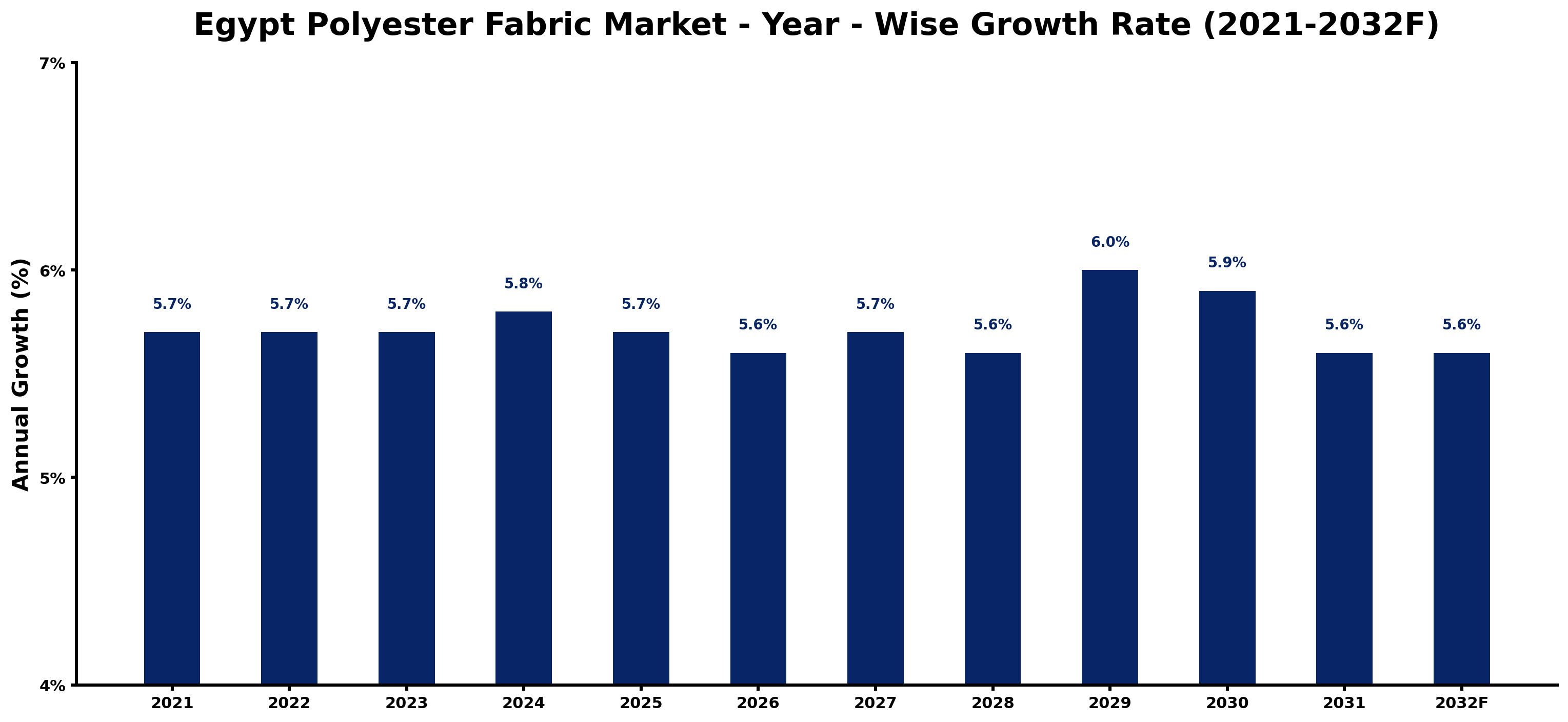
The table below presents the year wise growth rates along with the key drivers influencing the market
| Year | Growth Rate | Major Drivers |
| 2021 | 5.7% | Post-lockdown retail projects began emphasizing sustainable fabric sourcing across Egypt. |
| 2022 | 5.7% | Local manufacturers explored innovative techniques to enhance polyester fabric durability significantly. |
| 2023 | 5.7% | Consumer preferences shifted toward eco-friendly materials, impacting retail fabric selections noticeably. |
| 2024 | 5.8% | Expansion of fashion brands into the Egyptian market increased polyester fabric demand substantially. |
| 2025 | 5.7% | Construction projects accelerated, highlighting polyester's utility in affordable housing solutions. |
| 2026 | 5.6% | Technological advancements in fabric production improved cost-efficiency for local manufacturers. |
| 2027 | 5.7% | E-commerce platforms introduced new polyester textile lines catering to diverse consumer preferences. |
| 2028 | 5.6% | Egypt's tourism recovery necessitated textiles for various hospitality and retail sectors. |
| 2029 | 6.0% | Emerging lifestyle trends emphasized athleisure, positively influencing polyester fabric usage. |
| 2030 | 5.9% | Regional trade agreements facilitated the import of specialized polyester blends for local designers. |
| 2031 | 5.6% | Sustainability awareness prompts brands to invest in recycled polyester fabric innovations. |
| 2032 | 5.6% | Urbanization trends fueled demand for functional textiles in urban residential developments. |
Note - Market size estimations and growth projections presented in this report are based on 6Wresearch's advanced forecasting approach, validated with industry datasets as of June 2026.
Egypt Polyester Fabric Market Synopsis
The Egypt Polyester Fabric Market is projected to reach 5.6% and witness significant growth during the forecast period (2026-2032). This anticipated growth is driven by a confluence of factors, including heightened consumer spending on apparel, increasing per capita income levels, and rising disposable incomes among the Egyptian population. The shift towards more comfortable and durable fabrics, facilitated by technological advancements in polyester production, has further stimulated demand. Additionally, the burgeoning popularity of e-commerce platforms has allowed manufacturers to broaden their customer base across various regions, contributing to higher sales volumes for polyester fabrics. The overarching demand from key end-user industries, such as home furnishings, automotive interiors, and industrial applications, is expected to sustain momentum throughout the forecast period.
Egypt Polyester Fabric Market Growth Drivers
Several key factors are propelling the growth of the Egypt Polyester Fabric Market. Firstly, the increase in consumer disposable income has led to greater spending on textiles, promoting the demand for high-quality apparel made from polyester fabrics. Secondly, advancements in fabric technology have resulted in the production of polyester materials that are not only durable but also offer enhanced comfort compared to traditional fibers.
- The growing middle class in Egypt has significantly impacted the demand for apparel, leading to increased consumption of polyester fabrics.
- Technological innovations have enabled the introduction of eco-friendly production processes, aligning with global sustainability trends and appealing to environmentally-conscious consumers.
- The versatility of polyester fabrics—suitable for a wide range of applications from fashion to industrial uses—has expanded the market's potential.
- The rise of e-commerce has made polyester fabric products more accessible to a broader audience, facilitating an increase in online sales.
- Strong growth in the home furnishings and automotive sectors in Egypt has also fueled demand for polyester fabrics tailored for upholstery and interior applications.
Egypt Polyester Fabric Market Trends and Opportunities
The Egypt Polyester Fabric Market is witnessing several emerging trends and opportunities. As consumer preferences evolve, there is an increasing inclination towards fabrics that offer both functionality and style. The demand for versatile materials that can be used in both casual wear and professional attire is growing.
- There is a notable trend towards sustainable and recycled polyester fabrics, driven by consumer awareness and demand for environmentally-friendly options.
- The expansion of online retail has created new opportunities for brands to innovate in marketing and distribution, allowing for customized products to cater to diverse consumer needs.
- Investments in research and development are on the rise, focusing on creating high-performance polyester fabrics suitable for technical applications, including sportswear and protective clothing.
- Collaborations between textile manufacturers and fashion designers are leading to unique offerings that blend aesthetics with functionality, enhancing market appeal.
- Government initiatives to promote local manufacturing can lead to reduced import reliance and stimulate domestic production of polyester fabrics.
Egypt Polyester Fabric Market Challenges and Restraints
Despite the positive outlook, the Egypt Polyester Fabric Market faces challenges that could impede growth. Fluctuations in raw material prices, particularly petroleum-based inputs essential for polyester production, may pose significant challenges to manufacturers. Additionally, competition from alternative fibers, such as cotton and sustainable materials, continues to grow.
- Environmental concerns surrounding the production and disposal of synthetic fabrics may deter some consumers, leading to a potential shift towards natural fibers.
- The market is also affected by global economic uncertainties that could influence consumer spending patterns and industrial investments.
- Manufacturers may struggle with compliance regarding environmental regulations as the global market moves towards stricter sustainability norms.
- Supply chain disruptions, exacerbated by geopolitical tensions or global pandemics, can affect the availability of raw materials and impact production timelines.
- Skilled labor shortages in the textile industry may limit operational efficiency and output capacity, creating obstacles for growth.
Egypt Polyester Fabric Market Government Investment and Initiatives
The Egyptian government has implemented several initiatives aimed at boosting the polyester fabric sector. Public spending on infrastructure improvements relevant to textile manufacturing, together with incentives for local production, aims to create a more conducive environment for market growth. Investments in technology and training programs to enhance workforce skills in the textile industry are also a priority, fostering innovation and productivity in polyester fabric manufacturing.
- Government policies encouraging foreign investment in textile production have started to create a more competitive environment for local businesses.
- There have been efforts to facilitate access to financing for small and medium-sized enterprises (SMEs) involved in polyester fabric production, promoting entrepreneurship within the sector.
- Public initiatives targeting improvement in export capabilities are designed to capitalize on global demand for Egyptian textiles, enhancing the nation's competitiveness.
- Support for research and development in sustainable textiles reflects a commitment to aligning with international environmental standards, thus potentially attracting eco-conscious investment.
- Collaboration with industry associations to provide better market intelligence and resources for manufacturers has been encouraged to bolster the polyester fabric market.
Egypt Polyester Fabric Market Latest Developments (May 2025 - June 2026)
The period from May 2025 to June 2026 has seen significant developments within the Egypt Polyester Fabric Market. Innovations in production technologies have gained momentum, focusing on enhancing the properties of polyester fabrics to meet evolving consumer needs. Manufacturers are increasingly investing in eco-friendly production methods in response to growing sustainability trends.
- Research institutions and universities have engaged in collaborative projects aimed at developing new polyester blends that offer superior performance characteristics.
- The rise of online platforms has transformed how polyester fabric is marketed, with digital strategies becoming integral to reaching broader demographics.
- Trade fairs and exhibitions have begun to showcase advancements in polyester technology, promoting networking between manufacturers and suppliers.
- Partnerships with international firms are increasingly common, focusing on sharing best practices in manufacturing and distribution.
- Consumer awareness campaigns regarding the benefits of polyester fabrics have intensified, positively influencing market perceptions.
Egypt Polyester Fabric Market - Key Attractiveness of the Report
- 10 Years of Market Numbers
- Historical Data Starting from 2022 to 2025
- Base Year: 2025
- Forecast Data until 2032
- Key Performance Indicators Impacting the Market
- Major Upcoming Developments and Projects
Key Highlights of the Report:
- Egypt Polyester Fabric Market Outlook
- Market Size of Egypt Polyester Fabric Market, 2025
- Forecast of Egypt Polyester Fabric Market, 2032F
- Historical Data and Forecast of Egypt Polyester Fabric Revenues & Volume for the Period 2022-2032F
- Egypt Polyester Fabric Market Trend Evolution
- Egypt Polyester Fabric Market Drivers and Challenges
- Egypt Polyester Fabric Price Trends
- Egypt Polyester Fabric Porter's Five Forces
- Egypt Polyester Fabric Industry Life Cycle
- Historical Data and Forecast of Egypt Polyester Fabric Market Revenues & Volume By Type for the Period 2022-2032F
- Historical Data and Forecast of Egypt Polyester Fabric Market Revenues & Volume By PET for the Period 2022-2032F
- Historical Data and Forecast of Egypt Polyester Fabric Market Revenues & Volume By PCDT for the Period 2022-2032F
- Historical Data and Forecast of Egypt Polyester Fabric Market Revenues & Volume By Applications for the Period 2022-2032F
- Historical Data and Forecast of Egypt Polyester Fabric Market Revenues & Volume By Carpets & Rugs for the Period 2022-2032F
- Historical Data and Forecast of Egypt Polyester Fabric Market Revenues & Volume By Non-Woven Fabrics Fiberfill for the Period 2022-2032F
- Historical Data and Forecast of Egypt Polyester Fabric Market Revenues & Volume By Apparels for the Period 2022-2032F
- Historical Data and Forecast of Egypt Polyester Fabric Market Revenues & Volume By Home Textiles for the Period 2022-2032F
- Historical Data and Forecast of Egypt Polyester Fabric Market Revenues & Volume By Others? for the Period 2022-2032F
- Egypt Polyester Fabric Import Export Trade Statistics
- Market Opportunity Assessment By Type
- Market Opportunity Assessment By Applications
- Egypt Polyester Fabric Top Companies Market Share
- Egypt Polyester Fabric Competitive Benchmarking By Technical and Operational Parameters
- Egypt Polyester Fabric Company Profiles
- Egypt Polyester Fabric Key Strategic Recommendations






































