Egypt Small Mammal and Reptile Food Market Size, Share & Growth Rate
The Egypt Small Mammal and Reptile Food Market was estimated at USD 217 Million in 2025 and is projected to reach USD 282 Million by 2032, growing at a CAGR of 3.8% from 2026 to 2032. This growth trajectory is largely driven by the increasing pet ownership trends among Egyptian households, coupled with a heightened focus on the nutritional needs of small mammals and reptiles. As consumers become more discerning about their pets' diets, the demand for specialized food products is set to rise, creating ample opportunities for innovation and market expansion.
Egypt Small Mammal and Reptile Food Market Year-wise Growth Rate and Key Drivers
This graph highlights how the Egypt Small Mammal and Reptile Food Market has steadily grown over the years, supported by major growth factors.
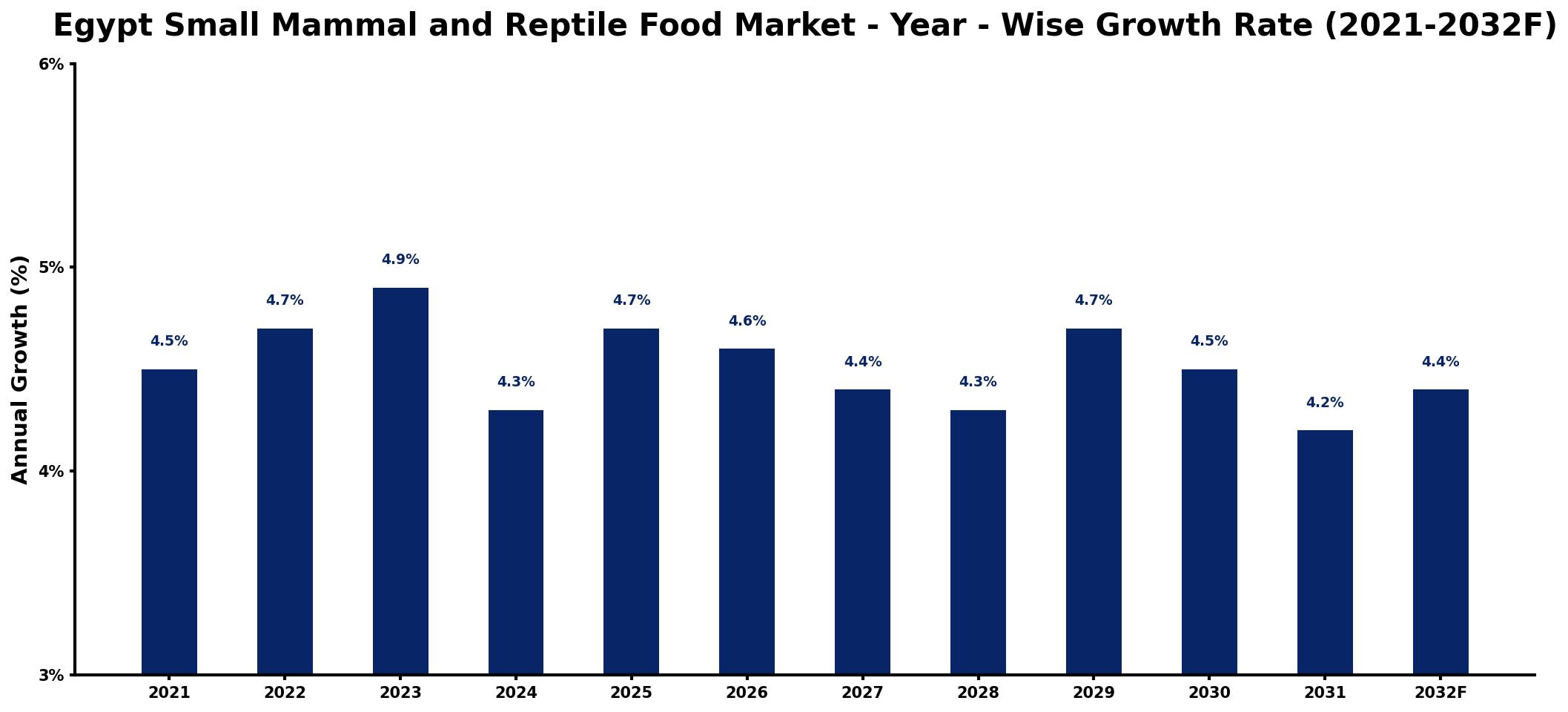
The table below presents the year‑wise growth rates along with the key drivers influencing the market
| Year | Growth Rate | Major Drivers |
| 2021 | 4.5% | Increased pet ownership rates |
| 2022 | 4.7% | Growing awareness of nutrition |
| 2023 | 4.9% | Rise in specialty pet shops |
| 2024 | 4.3% | Expanding online retail platforms |
| 2025 | 4.7% | Higher disposable income levels |
| 2026 | 4.6% | Increased demand for premium products |
| 2027 | 4.4% | Emergence of new brands |
| 2028 | 4.3% | Strengthened supply chain networks |
| 2029 | 4.7% | Interest in sustainable sourcing |
| 2030 | 4.5% | Expansion of pet care services |
| 2031 | 4.2% | Increase in educational resources |
| 2032 | 4.4% | Growth in urban pet ownership |
Note: Market size estimations and growth projections presented in this report are based on 6Wresearch's proprietary forecasting methodology, utilizing the latest available industry data, government publications, and primary research inputs.
Egypt Small Mammal and Reptile Food Market Synopsis
A pivotal force shaping the Egypt Small Mammal and Reptile Food Market is the surge in pet ownership, particularly among younger demographics. This demographic shift has fostered an environment where pet parents are increasingly aware of the essential nutritional requirements for their furry and scaly companions, leading to a greater demand for specialized dietary solutions.
Moreover, the rising trend of humanization of pets has changed consumer purchasing behaviors. Pet owners are now treating their small mammals and reptiles as integral family members, willing to invest more in high-quality and tailored food products to enhance their pets' health and well-being.
Egypt Small Mammal and Reptile Food Market Key Takeaways
- The market is witnessing a growing preference for natural and organic food options among consumers.
- Pet ownership trends are shifting, particularly towards small mammals and reptiles, stimulating market growth.
- There is increasing awareness among pet owners regarding the specific dietary needs of these animals.
- Limited availability of specialized products poses challenges to the market but opens avenues for growth.
- Investors are eyeing opportunities in innovative and premium food offerings tailored to exotic pets.
Evaluation of Restraints in Egypt Small Mammal and Reptile Food Market
Despite its potential, the Egypt Small Mammal and Reptile Food Market faces notable restraints. One major limitation is the restricted availability of specialized food products, as many pet stores primarily stock items targeted at more popular pets like dogs and cats. This lack of variety often leaves small mammal and reptile owners with few suitable options, potentially compromising their pets' health. Moreover, many consumers remain unaware of the particular dietary requirements for these animals, which can further hinder market growth and create gaps in consumer education. Addressing these challenges will be essential for driving the market forward.
Egypt Small Mammal and Reptile Food Market Trends
Current trends in the Egypt Small Mammal and Reptile Food Market reflect a strong consumer shift towards natural, organic, and health-focused food options. Pet owners are increasingly searching for products that do not contain artificial additives and are rich in essential nutrients. Furthermore, the demand for personalized diets tailored to specific pet species and health conditions is gaining traction. This trend is further supported by the growth of specialty pet food stores and online platforms offering an expansive range of premium products.
Egypt Small Mammal and Reptile Food Market Opportunities
The Egypt Small Mammal and Reptile Food Market is ripe with investment opportunities, especially given the rising consumer interest in small and exotic pets. Entrepreneurs and established players alike can benefit from investing in the manufacturing and distribution of high-quality, nutritionally balanced food options that cater specifically to these niche markets. Additionally, focusing on organic and natural products can differentiate brands and enhance market appeal. Marketing strategies that educate consumers about the unique dietary needs of small mammals and reptiles will also play a crucial role in capturing a larger share of this emerging market.
Government Initiatives in the Egypt Small Mammal and Reptile Food Market
Government policies surrounding the Egypt Small Mammal and Reptile Food Market are increasingly focused on ensuring product safety and quality. Regulations require businesses in this sector to adhere to strict guidelines concerning the sourcing, processing, and labeling of food products for small mammals and reptiles. Additionally, efforts to monitor the use of additives and preservatives are in place to safeguard animal health. These initiatives aim to bolster consumer confidence in pet food products, ultimately supporting market growth.
Future Insights of the Egypt Small Mammal and Reptile Food Market
Looking ahead to the period from 2026 to 2032, the Egypt Small Mammal and Reptile Food Market is projected to experience steady expansion. Driven by a continual increase in pet ownership and a growing emphasis on specialized nutrition, the market is poised for significant advancements. Innovations in product offerings, sustainable sourcing, and heightened consumer education will likely shape the landscape of the market. Overall, these factors are expected to create promising growth opportunities for both established and new entrants in this niche sector.
Egypt Small Mammal and Reptile Food Market Latest Developments (2025 - 2026)
Recent developments in the Egypt Small Mammal and Reptile Food Market indicate a shift towards enhanced product offerings and marketing strategies. Notably, there is a growing number of retail outlets focusing specifically on small mammals and reptiles, aiming to provide a wider range of options for pet owners. Additionally, online retailers are gaining traction, offering convenience and a broader selection of premium products. The rise of social media platforms is also facilitating better consumer education regarding the nutritional needs of these pets.
Egypt Small Mammal and Reptile Food Market - Key Attractiveness of the Report
- 10 Years of Market Numbers
- Historical Data Starting from 2022 to 2025
- Base Year: 2025
- Forecast Data until 2032
- Key Performance Indicators Impacting the Market
- Major Upcoming Developments and Projects
Key Highlights of the Report:
- Egypt Small Mammal and Reptile Food Market Outlook
- Market Size of Egypt Small Mammal and Reptile Food Market, 2025
- Forecast of Egypt Small Mammal and Reptile Food Market, 2032
- Historical Data and Forecast of Egypt Small Mammal and Reptile Food Revenues & Volume for the Period 2022-2032F
- Egypt Small Mammal and Reptile Food Market Trend Evolution
- Egypt Small Mammal and Reptile Food Market Drivers and Challenges
- Egypt Small Mammal and Reptile Food Price Trends
- Egypt Small Mammal and Reptile Food Porter's Five Forces
- Egypt Small Mammal and Reptile Food Industry Life Cycle
- Historical Data and Forecast of Egypt Small Mammal and Reptile Food Market Revenues & Volume By Type for the Period 2022-2032F
- Historical Data and Forecast of Egypt Small Mammal and Reptile Food Market Revenues & Volume By Rabbits Food for the Period 2022-2032F
- Historical Data and Forecast of Egypt Small Mammal and Reptile Food Market Revenues & Volume By Rodents Food for the Period 2022-2032F
- Historical Data and Forecast of Egypt Small Mammal and Reptile Food Market Revenues & Volume By Small Reptiles Food for the Period 2022-2032F
- Historical Data and Forecast of Egypt Small Mammal and Reptile Food Market Revenues & Volume By Other for the Period 2022-2032F
- Historical Data and Forecast of Egypt Small Mammal and Reptile Food Market Revenues & Volume By Application for the Period 2022-2032F
- Historical Data and Forecast of Egypt Small Mammal and Reptile Food Market Revenues & Volume By Pet-Speciality Stores for the Period 2022-2032F
- Historical Data and Forecast of Egypt Small Mammal and Reptile Food Market Revenues & Volume By Supermarkets and Hypermarkets for the Period 2022-2032F
- Historical Data and Forecast of Egypt Small Mammal and Reptile Food Market Revenues & Volume By Convenience Stores for the Period 2022-2032F
- Historical Data and Forecast of Egypt Small Mammal and Reptile Food Market Revenues & Volume By Other for the Period 2022-2032F
- Egypt Small Mammal and Reptile Food Import Export Trade Statistics
- Market Opportunity Assessment By Type
- Market Opportunity Assessment By Application
- Egypt Small Mammal and Reptile Food Top Companies Market Share
- Egypt Small Mammal and Reptile Food Competitive Benchmarking By Technical and Operational Parameters
- Egypt Small Mammal and Reptile Food Company Profiles
- Egypt Small Mammal and Reptile Food Key Strategic Recommendations






































