Egypt Trolley Market Size, Share & Growth Rate
The Egypt Trolley Market was estimated at USD 278 Million in 2025 and is projected to reach USD 376 Million by 2032, growing at a CAGR of 4.4% from 2026 to 2032. This growth trajectory is primarily fueled by the burgeoning retail sector, especially as large shopping malls proliferate and e-commerce expands. Furthermore, increasing urbanization and the evolving logistics landscape are intensifying the demand for effective and durable trolley solutions in various sectors.
Egypt Trolley Market Year-wise Growth Rate and Key Drivers
This graph highlights how the Egypt Trolley Market has steadily grown over the years, supported by major growth factors.
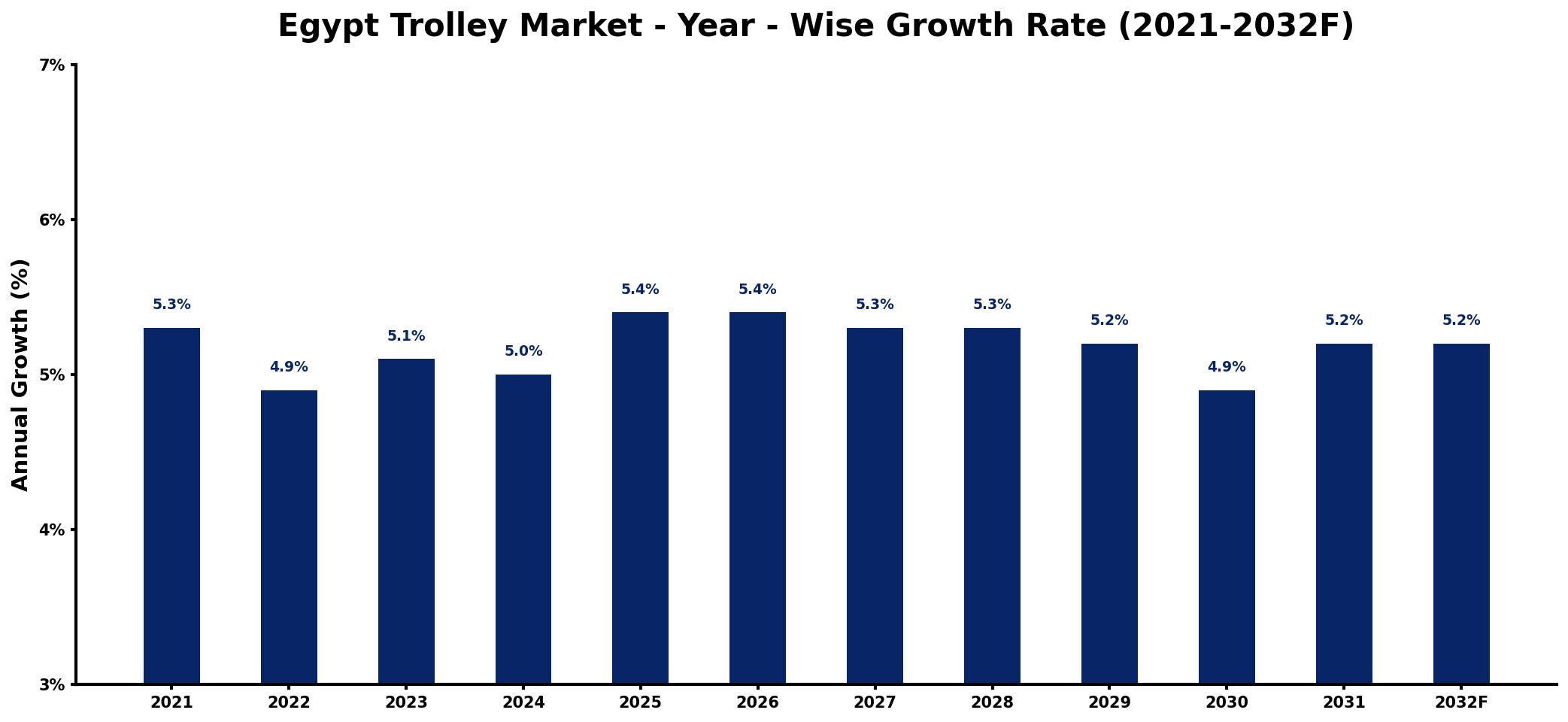
The table below presents the year‑wise growth rates along with the key drivers influencing the market
| Year | Growth Rate | Major Drivers |
| 2021 | 5.3% | Rising consumer purchasing power |
| 2022 | 4.9% | Increased urbanization trends observed |
| 2023 | 5.1% | Growing e-commerce logistics requirements |
| 2024 | 5.0% | Surge in retail sector investments |
| 2025 | 5.4% | Expansion of distribution networks |
| 2026 | 5.4% | Higher demand for convenience solutions |
| 2027 | 5.3% | Increased focus on sustainability initiatives |
| 2028 | 5.3% | Growth in hospitality sector needs |
| 2029 | 5.2% | Boost in online shopping activities |
| 2030 | 4.9% | Emergence of smart technology applications |
| 2031 | 5.2% | Rising demand for home delivery |
| 2032 | 5.2% | growing automotive sector requirements |
Note: Market size estimations and growth projections presented in this report are based on 6Wresearch's proprietary forecasting methodology, utilizing the latest available industry data, government publications, and primary research inputs.
Egypt Trolley Market Synopsis
The Egypt trolley market is currently experiencing a dynamic shift, driven by a surge in consumer demand for efficient shopping solutions and enhanced logistical operations. Retailers are increasingly recognizing the utility of high-quality trolleys, paving the way for sustained growth in the coming years.
Looking ahead, the market is poised for substantial growth as awareness regarding the functionality of trolleys improves among both businesses and consumers. Innovations in trolley design and materials, alongside government initiatives to bolster local manufacturing, are expected to further drive market momentum.
Egypt Trolley Market Key Takeaways
- The market is expanding, driven by urbanization and growth in retail and logistics sectors.
- Consumer demand is being shaped by increased awareness of trolley benefits, particularly in e-commerce.
- Government support for infrastructure development enhances the trolley market landscape.
- Price sensitivity remains a concern, impacting accessibility for some consumers.
- Opportunities for sustainable trolley production are emerging as environmental awareness grows.
Evaluation of Restraints in Egypt Trolley Market
Despite positive market indicators, the Egypt trolley market faces significant restraints. One major limitation is the prevailing low consumer demand, largely due to traditional transportation methods overshadowing the utility of trolleys. Additionally, price sensitivity can deter potential buyers, as high manufacturing costs often inflate prices, placing quality trolleys out of reach for many. Moreover, the presence of counterfeit products can undermine consumer confidence, further stifling growth in this sector.
Egypt Trolley Market Trends
Current trends highlight a shift towards eco-friendly materials and designs, as businesses and consumers alike prioritize sustainability. Innovations in trolley technology, including smart features that enhance user convenience and tracking capabilities, are beginning to emerge. Furthermore, the alignment of trolley manufacturing with local sourcing initiatives is gaining traction, further supporting economic growth and operational efficiency in Egypt.
Egypt Trolley Market Opportunities
The market presents several genuine opportunities for growth and investment. With the ongoing expansion of e-commerce and logistics, there is a pressing need for advanced trolley systems designed specifically for warehousing and distribution centers. Additionally, as awareness surrounding the utility of trolleys among tourists and travelers increases, there lies significant potential for niche market segments to develop. Investing in high-quality, durable, and sustainable products could also enhance market competitiveness.
Government Initiatives in the Egypt Trolley Market
The Egyptian government has been proactive in promoting infrastructure development, which indirectly supports the trolley market's growth. Initiatives aimed at enhancing public transportation and urban development create a conducive environment for trolley adoption across various sectors. Moreover, policies encouraging local manufacturing and sustainability initiatives are paving the way for businesses to produce eco-friendly trolley solutions, addressing both domestic needs and export potential.
Future Insights of the Egypt Trolley Market
Between 2026 and 2032, the Egypt trolley market is expected to evolve significantly. The combination of increasing urbanization, a growing retail sector, and improved logistics infrastructure will likely drive sustained demand. With a focus on innovation and sustainability, manufacturers who adapt to market needs and consumer preferences will be well-positioned to capitalize on upcoming growth opportunities.
Egypt Trolley Market Latest Developments (2025 - 2026)
Recent developments in the Egypt trolley market indicate a heightened focus on quality and innovation. Manufacturers are investing in advanced materials and designs to meet the changing demands of both retail and logistics sectors. Additionally, there is a noticeable increase in collaborations aimed at enhancing distribution efficiencies. The growing trend towards sustainability is prompting businesses to explore eco-friendly production methods and materials, reflecting broader global shifts.
Egypt Trolley Market - Key Attractiveness of the Report
- 10 Years of Market Numbers
- Historical Data Starting from 2022 to 2025
- Base Year: 2025
- Forecast Data until 2032
- Key Performance Indicators Impacting the Market
- Major Upcoming Developments and Projects
Key Highlights of the Report:
- Egypt Trolley Market Outlook
- Market Size of Egypt Trolley Market, 2025
- Forecast of Egypt Trolley Market, 2032
- Historical Data and Forecast of Egypt Trolley Revenues & Volume for the Period 2022-2032F
- Egypt Trolley Market Trend Evolution
- Egypt Trolley Market Drivers and Challenges
- Egypt Trolley Price Trends
- Egypt Trolley Porter's Five Forces
- Egypt Trolley Industry Life Cycle
- Historical Data and Forecast of Egypt Trolley Market Revenues & Volume By Product for the Period 2022-2032F
- Historical Data and Forecast of Egypt Trolley Market Revenues & Volume By Manual for the Period 2022-2032F
- Historical Data and Forecast of Egypt Trolley Market Revenues & Volume By Electric for the Period 2022-2032F
- Historical Data and Forecast of Egypt Trolley Market Revenues & Volume By Application for the Period 2022-2032F
- Historical Data and Forecast of Egypt Trolley Market Revenues & Volume By Commercial for the Period 2022-2032F
- Historical Data and Forecast of Egypt Trolley Market Revenues & Volume By Non-commercial for the Period 2022-2032F
- Historical Data and Forecast of Egypt Trolley Market Revenues & Volume By Distribution for the Period 2022-2032F
- Historical Data and Forecast of Egypt Trolley Market Revenues & Volume By Offline for the Period 2022-2032F
- Historical Data and Forecast of Egypt Trolley Market Revenues & Volume By Online for the Period 2022-2032F
- Egypt Trolley Import Export Trade Statistics
- Market Opportunity Assessment By Product
- Market Opportunity Assessment By Application
- Market Opportunity Assessment By Distribution
- Egypt Trolley Top Companies Market Share
- Egypt Trolley Competitive Benchmarking By Technical and Operational Parameters
- Egypt Trolley Company Profiles
- Egypt Trolley Key Strategic Recommendations






































