Egypt Wine production Machinery Market Summary
The egypt wine production machinery market was estimated at USD 387 Million in 2025 and is projected to reach USD 526 Million by 2032, growing at a CAGR of 5.3% from 2026 to 2032.
Egypt Wine production Machinery Market Year-wise Growth Rate and Key Drivers
This graph highlights how the Egypt Wine production Machinery Market has steadily grown over the past five years, supported by major growth factors.
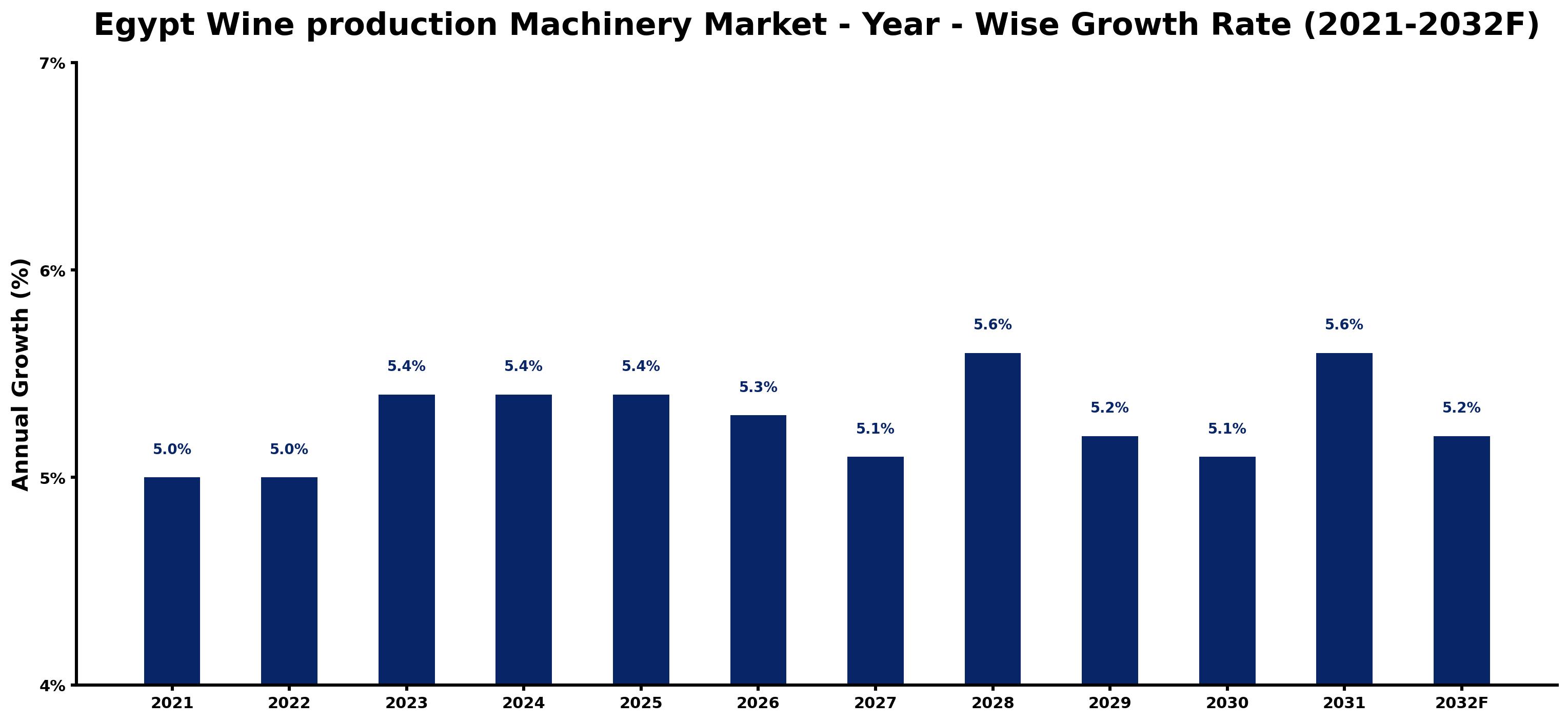
The table below presents the year wise growth rates along with the key drivers influencing the market
| Year | Growth Rate | Major Drivers |
| 2021 | 5.0% | Increased local consumption of wine encourages investment in production machinery and technologies. |
| 2022 | 5.0% | Regional wine tourism development highlights Egypt's potential as a significant wine producer. |
| 2023 | 5.4% | Partnerships between local vineyards and machinery suppliers create innovative production solutions. |
| 2024 | 5.4% | Emerging interest in organic and sustainable wines shifts machinery production trends. |
| 2025 | 5.4% | Accessibility to international markets pushes local wineries to upgrade their equipment. |
| 2026 | 5.3% | Technological innovations in fermentation processes attract attention from global investors. |
| 2027 | 5.1% | Local universities strengthen research programs focused on agricultural machinery for vineyards. |
| 2028 | 5.6% | Increased competition among producers leads to higher demand for efficient machinery. |
| 2029 | 5.2% | National focus on quality standards elevates the need for advanced production systems. |
| 2030 | 5.1% | Export opportunities to Europe encourage investment in state-of-the-art processing technology. |
| 2031 | 5.6% | Emergence of boutique wineries drives niche machinery requirements for smaller producers. |
| 2032 | 5.2% | Consumer trends favoring premium wines compel producers to refine production capabilities. |
Note - Market size estimations and growth projections presented in this report are based on 6Wresearch's advanced forecasting approach, validated with industry datasets as of June 2026.
Egypt Wine production Machinery Market Synopsis
The Egypt Wine production Machinery Market is projected to reach 5.3% and witness significant growth during the forecast period (2026-2032). This growth is largely fueled by rising consumer preferences for locally-produced wines and an increase in vineyard acreage across the country. Various types of machinery, such as grape crushers, destemmers, fermentation tanks, and bottling lines, are essential in addressing the requirements of wineries, whether they are large-scale operations or boutique establishments. Moreover, advancements in technology, notably automation and digitalization, are enhancing the efficiency and quality of the wine production process in Egypt.
Egypt Wine production Machinery Market Growth Drivers
The primary drivers of the Egypt Wine production Machinery Market include:
- Increasing demand for local wine varieties, driven by a growing middle-class population that values unique and culturally relevant products.
- Expansion of vineyard areas, encouraging the establishment of new wineries, further stimulating machinery demand.
- Technological advancements such as automation, which enhance production efficiency, reduce labor costs, and improve the quality of the final product.
- Government support initiatives aimed at modernizing the wine industry, creating a favorable environment for investment and growth.
- A shift towards sustainable practices, motivating wineries to invest in eco-friendly machinery that aligns with global trends towards sustainability.
Egypt Wine production Machinery Market Trends and Opportunities
Several key trends are shaping the Egypt Wine production Machinery Market:
- There is a noticeable shift towards automated equipment that simplifies numerous processes, from grape sorting to bottling, thereby enhancing productivity.
- Environmental considerations are encouraging wineries to adopt sustainable machinery, reflecting a commitment to reducing energy consumption and carbon emissions.
- Increased interest in compact and smaller-scale machinery that caters specifically to boutique wineries and urban winemaking ventures, allowing for greater flexibility and innovation.
- As consumer preferences evolve, there is a growing demand for equipment that can produce high-quality and diverse wine styles, driving innovation in design and functionality.
- The integration of smart technology within production machinery to facilitate better control, monitoring, and data analysis, which enhances decision-making processes for winery operators.
Egypt Wine production Machinery Market Challenges and Restraints
While the Egypt Wine production Machinery Market shows promise, it also faces numerous challenges:
- The limited domestic manufacturing capacity for high-quality wine production machinery leads to a reliance on imports, which can raise costs and create barriers to entry.
- Fluctuations in exchange rates can adversely affect the pricing of imported machinery, impacting the profitability of local wineries.
- Strict regulations surrounding alcohol production can complicate the licensing and importation processes for wine production machinery.
- The relatively modest size of the wine industry in Egypt compared to other countries may result in less attention and investment in specialized machinery development.
- Despite the increasing awareness of wine culture, societal attitudes towards alcohol production can create hurdles for the industry, limiting its growth potential.
Egypt Wine production Machinery Market Investment Opportunities
The investment landscape within the Egypt Wine production Machinery Market is attractive due to several factors:
- As the local demand for wine grows, there are opportunities for investors to capitalize on this trend by supplying advanced production machinery that enhances operational efficiency.
- Government efforts to support the wine industry through favorable policies and incentives present a conducive environment for new entrants and investors.
- Investing in innovative machinery that aligns with sustainability trends can create a competitive advantage for wineries looking to meet consumer preferences.
- The expansion of vineyard acreage is creating additional opportunities for machinery suppliers focused on enhancing production capabilities.
- Investors can explore partnerships with local wineries to facilitate the modernization of their production facilities, thereby accelerating industry growth.
Egypt Wine production Machinery Market Government Investment and Initiatives
The Egyptian government plays a significant role in shaping the wine production machinery market through various policies and initiatives:
- The government has introduced regulations that govern the production and sale of alcoholic beverages, including wine, which have a direct impact on the machinery market.
- Importation policies for wine production machinery necessitate compliance with stringent licensing and regulatory frameworks, ensuring the quality and standards of products.
- Tariffs and taxes on imported machinery are strategically used to promote local manufacturing capabilities, though they may also inflate costs for local wineries reliant on foreign technology.
- The government is engaged in promoting self-sufficiency within the wine industry, offering incentives for local companies to invest in the development of domestic machinery.
- Public funding initiatives aim to support the overall growth of the wine sector by encouraging sustainable practices and technological adoption across wineries.
Egypt Wine production Machinery Market Latest Developments (May 2025 - June 2026)
The recent period has witnessed significant developments in the Egypt Wine production Machinery Market, characterized by a focus on modernization and efficiency:
- A surge in investments aimed at upgrading older wine production facilities to meet international quality standards has been notable.
- Wineries are actively exploring partnerships with technology firms to integrate smart solutions into their production lines, enhancing operational efficiencies.
- Increased participation of local firms in developing grape processing technologies reflects a growing trend towards localized machinery production.
- Collaboration between governmental bodies and industry stakeholders has intensified, aimed at identifying and addressing barriers within the wine production sector.
- Consumer interest in gourmet and boutique wines has led to a spike in demand for specialized machinery that caters to small-scale producers.
Egypt Wine production Machinery Market - Key Attractiveness of the Report
- 10 Years of Market Numbers
- Historical Data Starting from 2022 to 2025
- Base Year: 2025
- Forecast Data until 2032
- Key Performance Indicators Impacting the Market
- Major Upcoming Developments and Projects
Key Highlights of the Report:
- Egypt Wine production Machinery Market Outlook
- Market Size of Egypt Wine production Machinery Market, 2025
- Forecast of Egypt Wine production Machinery Market, 2032F
- Historical Data and Forecast of Egypt Wine production Machinery Revenues & Volume for the Period 2022-2032F
- Egypt Wine production Machinery Market Trend Evolution
- Egypt Wine production Machinery Market Drivers and Challenges
- Egypt Wine production Machinery Price Trends
- Egypt Wine production Machinery Porter's Five Forces
- Egypt Wine production Machinery Industry Life Cycle
- Historical Data and Forecast of Egypt Wine production Machinery Market Revenues & Volume By Type for the Period 2022-2032F
- Historical Data and Forecast of Egypt Wine production Machinery Market Revenues & Volume By Tanks & fermenters for the Period 2022-2032F
- Historical Data and Forecast of Egypt Wine production Machinery Market Revenues & Volume By Crushing & Pressing Equipment for the Period 2022-2032F
- Historical Data and Forecast of Egypt Wine production Machinery Market Revenues & Volume By Temperature Control Equipment for the Period 2022-2032F
- Historical Data and Forecast of Egypt Wine production Machinery Market Revenues & Volume By Filtration Equipment for the Period 2022-2032F
- Historical Data and Forecast of Egypt Wine production Machinery Market Revenues & Volume By Others for the Period 2022-2032F
- Egypt Wine production Machinery Import Export Trade Statistics
- Market Opportunity Assessment By Type
- Egypt Wine production Machinery Top Companies Market Share
- Egypt Wine production Machinery Competitive Benchmarking By Technical and Operational Parameters
- Egypt Wine production Machinery Company Profiles
- Egypt Wine production Machinery Key Strategic Recommendations






































