Estonia Canned Tuna Market Top 5 Importing Countries and Market Competition (HHI) Analysis
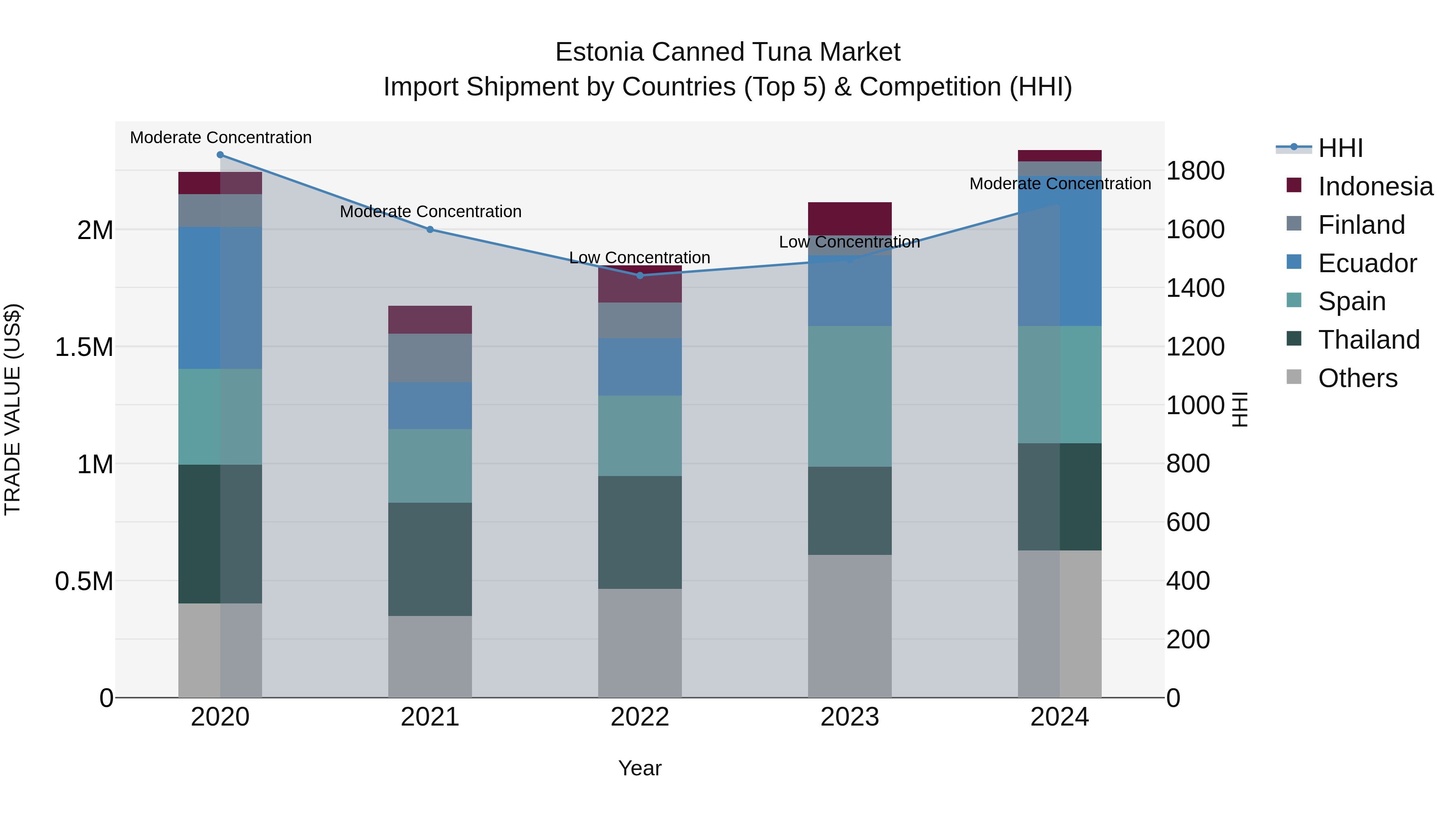
The canned tuna import market in Estonia experienced significant growth in 2024, with top exporting countries being Ecuador, Spain, Thailand, Germany, and Colombia. The market concentration, as measured by the HHI, shifted from low to moderate concentration, indicating a more competitive landscape. The compound annual growth rate (CAGR) from 2020 to 2024 was steady at 1.03, but there was a notable spike in growth from 2023 to 2024, with a growth rate of 10.47%. This suggests a rising demand for canned tuna in Estonia and potential opportunities for market expansion in the coming years.
Canned Tuna Market: Estonia vs Top 5 Major Economies in 2027 (Europe)
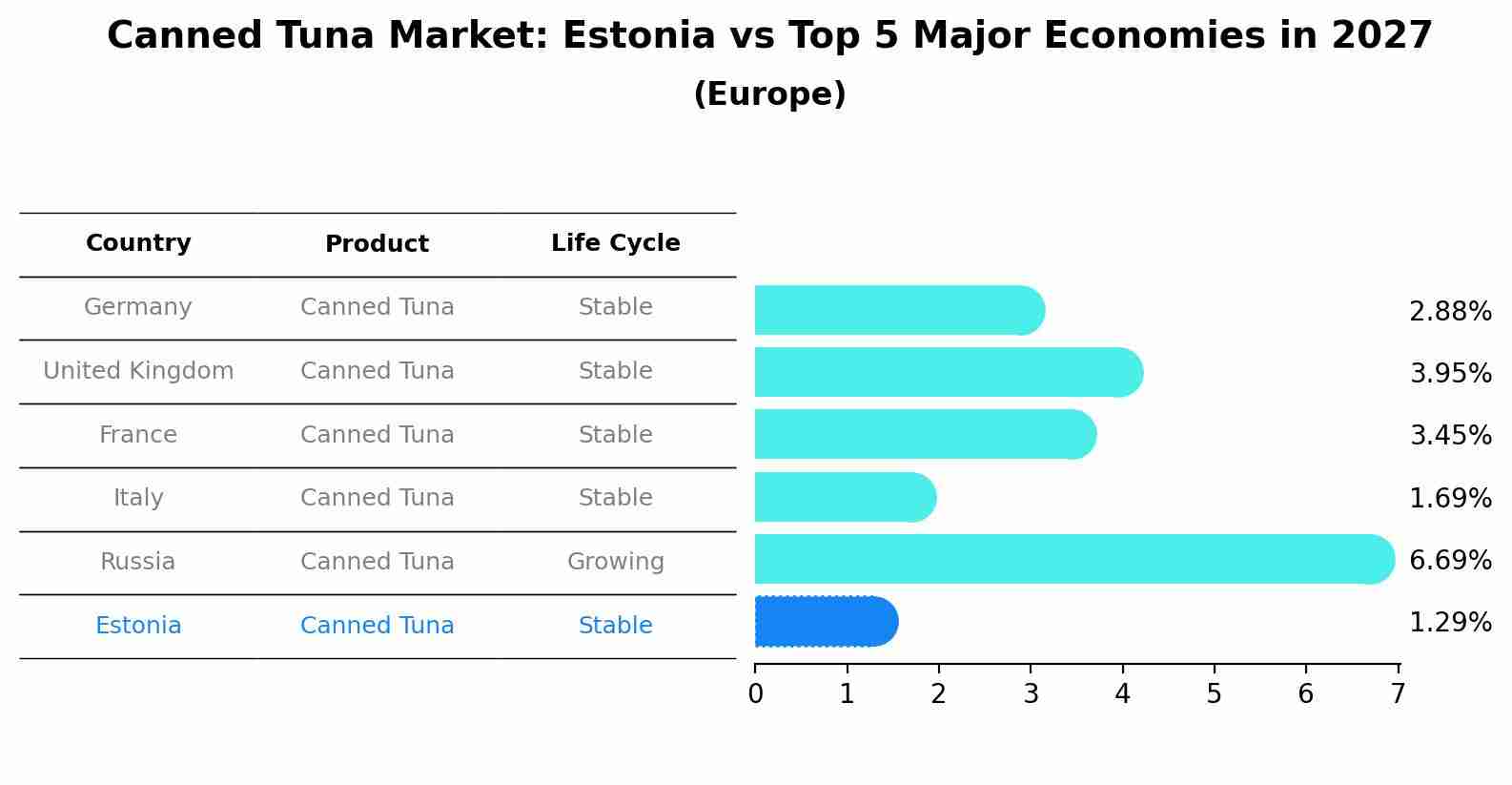
By 2027, Estonia's Canned Tuna market is forecasted to achieve a stable growth rate of 1.29%, with Germany leading the Europe region, followed by United Kingdom, France, Italy and Russia.
Estonia Canned Tuna Market Overview
The canned tuna market in Estonia, highlighting consumer preferences, health considerations, and the role of sustainable fishing practices.
Drivers of the market
The Canned Tuna market in Estonia is driven by the growing popularity of canned fish as an affordable, convenient, and healthy source of protein. Tuna is widely used in sandwiches, salads, and other quick meals, making it a go-to food for busy consumers. The rising awareness of the health benefits associated with omega-3 fatty acids and the increasing demand for eco-friendly and sustainable sourcing practices in seafood products also support the markets expansion.
Challenges of the market
In Estonia, the Canned Tuna Market faces challenges from increasing scrutiny over the environmental impact of tuna fishing practices, such as bycatch and overfishing. Rising consumer demand for sustainably sourced tuna pushes companies to adopt more expensive eco-friendly practices. Additionally, the market is impacted by fluctuations in raw material prices, which affects profitability.
Government Policy of the market
Estonian policies in the canned tuna market emphasize sustainable fishing practices in line with EU regulations. The government promotes eco-friendly production processes and supports businesses committed to sustainable sourcing and packaging. Financial incentives are available for companies working to reduce the environmental impact of canned tuna production.
Key Highlights of the Report:
- Estonia Canned Tuna Market Outlook
- Market Size of Estonia Canned Tuna Market, 2024
- Forecast of Estonia Canned Tuna Market, 2031
- Historical Data and Forecast of Estonia Canned Tuna Revenues & Volume for the Period 2021-2031
- Estonia Canned Tuna Market Trend Evolution
- Estonia Canned Tuna Market Drivers and Challenges
- Estonia Canned Tuna Price Trends
- Estonia Canned Tuna Porter`s Five Forces
- Estonia Canned Tuna Industry Life Cycle
- Historical Data and Forecast of Estonia Canned Tuna Market Revenues & Volume By Product for the Period 2021-2031
- Historical Data and Forecast of Estonia Canned Tuna Market Revenues & Volume By Skipjack for the Period 2021-2031
- Historical Data and Forecast of Estonia Canned Tuna Market Revenues & Volume By Yellowfin for the Period 2021-2031
- Historical Data and Forecast of Estonia Canned Tuna Market Revenues & Volume By Others for the Period 2021-2031
- Historical Data and Forecast of Estonia Canned Tuna Market Revenues & Volume By Distribution Channel for the Period 2021-2031
- Historical Data and Forecast of Estonia Canned Tuna Market Revenues & Volume By Hypermarket & Supermarket for the Period 2021-2031
- Historical Data and Forecast of Estonia Canned Tuna Market Revenues & Volume By Specialty Stores for the Period 2021-2031
- Historical Data and Forecast of Estonia Canned Tuna Market Revenues & Volume By Online for the Period 2021-2031
- Estonia Canned Tuna Import Export Trade Statistics
- Market Opportunity Assessment By Product
- Market Opportunity Assessment By Distribution Channel
- Estonia Canned Tuna Top Companies Market Share
- Estonia Canned Tuna Competitive Benchmarking By Technical and Operational Parameters
- Estonia Canned Tuna Company Profiles
- Estonia Canned Tuna Key Strategic Recommendations






































