Estonia Chlorine Market Top 5 Importing Countries and Market Competition (HHI) Analysis
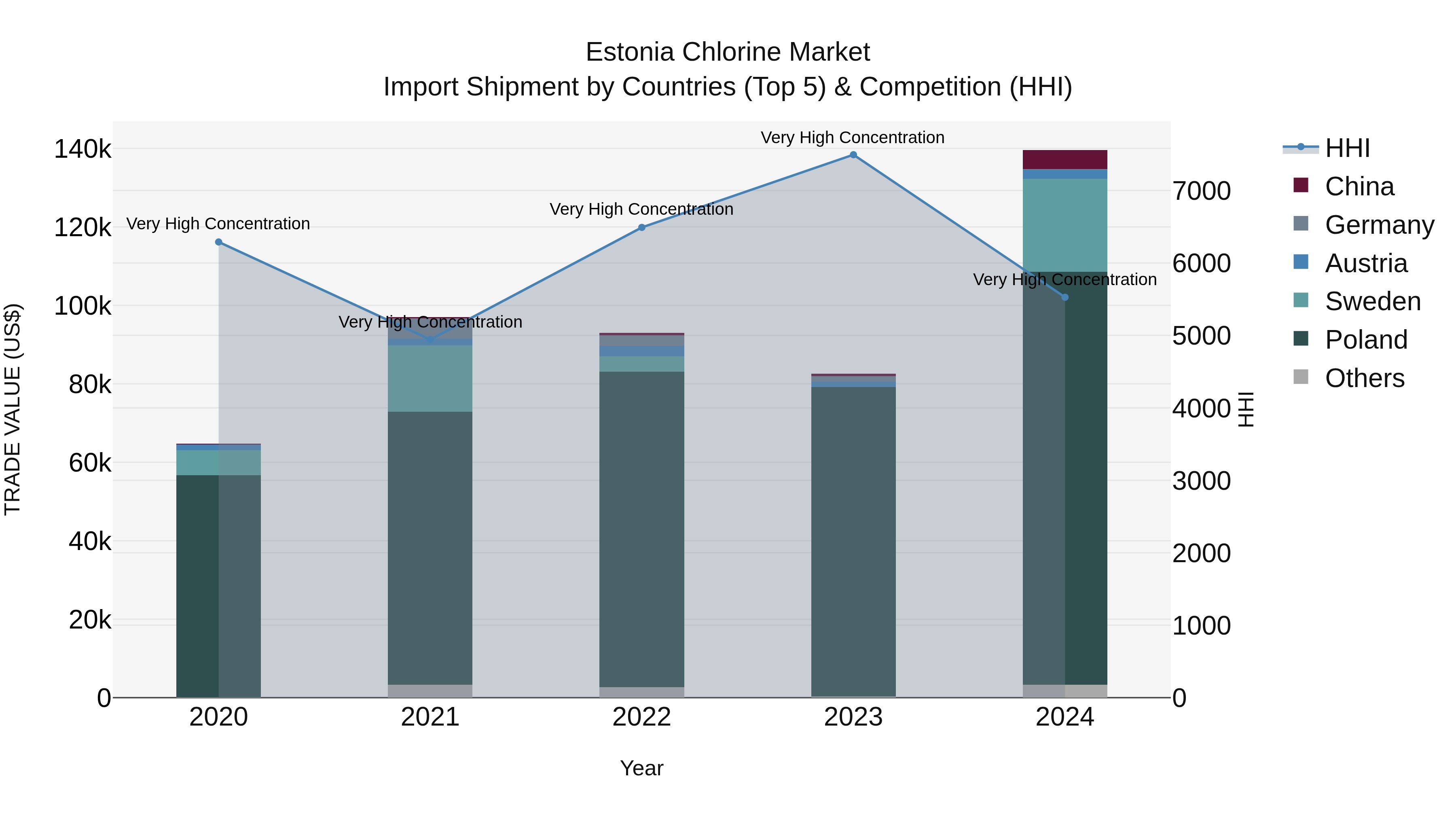
Estonia`s chlorine import market in 2024 continued to be dominated by key suppliers such as Poland, Sweden, China, Finland, and Austria. The high Herfindahl-Hirschman Index (HHI) indicates a concentrated market structure. The impressive Compound Annual Growth Rate (CAGR) of 21.15% from 2020 to 2024 highlights the increasing demand for chlorine in Estonia. The remarkable growth rate of 69.07% from 2023 to 2024 suggests a significant surge in import shipments during that period, reflecting a dynamic and evolving market landscape.
Estonia Chlorine Market Overview
Chlorine is essential in Estonia`s water treatment and chemical manufacturing sectors. The market benefits from growing environmental regulations, which boost demand for water treatment chemicals. Its applications in pharmaceuticals and manufacturing further support market growth.
Drivers of the market
The growth of the chlorine market in Estonia is primarily driven by its use in manufacturing plastics, pharmaceuticals, and disinfectants. The increasing importance of chlorine in water purification processes and the growing demand for chlorine-based compounds in various chemical industries further propel the market.
Challenges of the market
The chlorine market in Estonia faces challenges related to environmental concerns, production costs, and regulatory compliance. Chlorine is widely used in industries such as water treatment, plastics, and chemicals, but its production involves complex chemical processes that can have negative environmental impacts. As environmental regulations become stricter, producers are under pressure to adopt cleaner and more sustainable manufacturing methods. Additionally, the market is subject to fluctuations in chlorine demand based on industrial activity, making it challenging for suppliers to predict and stabilize pricing and availability.
Government Policy of the market
The government of Estonia regulates the chlorine market with a focus on safety, environmental protection, and sustainability. Policies are in place to ensure the safe production, storage, and transportation of chlorine, which is critical in various industries, including water treatment, chemicals, and pharmaceuticals. Estonia also encourages the use of chlorine in environmentally friendly applications and offers incentives for research into chlorine substitutes that have less harmful environmental impacts.
Key Highlights of the Report:
- Estonia Chlorine Market Outlook
- Market Size of Estonia Chlorine Market, 2024
- Forecast of Estonia Chlorine Market, 2031
- Historical Data and Forecast of Estonia Chlorine Revenues & Volume for the Period 2021-2031
- Estonia Chlorine Market Trend Evolution
- Estonia Chlorine Market Drivers and Challenges
- Estonia Chlorine Price Trends
- Estonia Chlorine Porter`s Five Forces
- Estonia Chlorine Industry Life Cycle
- Historical Data and Forecast of Estonia Chlorine Market Revenues & Volume By Application for the Period 2021-2031
- Historical Data and Forecast of Estonia Chlorine Market Revenues & Volume By EDC/PVC for the Period 2021-2031
- Historical Data and Forecast of Estonia Chlorine Market Revenues & Volume By Isocyanates and Oxygenates for the Period 2021-2031
- Historical Data and Forecast of Estonia Chlorine Market Revenues & Volume By Chloromethanes for the Period 2021-2031
- Historical Data and Forecast of Estonia Chlorine Market Revenues & Volume By Solvents and Epichlorohydrin for the Period 2021-2031
- Historical Data and Forecast of Estonia Chlorine Market Revenues & Volume By Inorganic Chemicals for the Period 2021-2031
- Historical Data and Forecast of Estonia Chlorine Market Revenues & Volume By Other Applications for the Period 2021-2031
- Historical Data and Forecast of Estonia Chlorine Market Revenues & Volume By End-user for the Period 2021-2031
- Historical Data and Forecast of Estonia Chlorine Market Revenues & Volume By Water Treatment for the Period 2021-2031
- Historical Data and Forecast of Estonia Chlorine Market Revenues & Volume By Pharmaceutical for the Period 2021-2031
- Historical Data and Forecast of Estonia Chlorine Market Revenues & Volume By Chemicals for the Period 2021-2031
- Historical Data and Forecast of Estonia Chlorine Market Revenues & Volume By Paper and Pulp for the Period 2021-2031
- Historical Data and Forecast of Estonia Chlorine Market Revenues & Volume By Plastic for the Period 2021-2031
- Historical Data and Forecast of Estonia Chlorine Market Revenues & Volume By Pesticides for the Period 2021-2031
- Historical Data and Forecast of Estonia Chlorine Market Revenues & Volume By Other for the Period 2021-2031
- Estonia Chlorine Import Export Trade Statistics
- Market Opportunity Assessment By Application
- Market Opportunity Assessment By End-user
- Estonia Chlorine Top Companies Market Share
- Estonia Chlorine Competitive Benchmarking By Technical and Operational Parameters
- Estonia Chlorine Company Profiles
- Estonia Chlorine Key Strategic Recommendations






































