Estonia Coal Tar Market Top 5 Importing Countries and Market Competition (HHI) Analysis
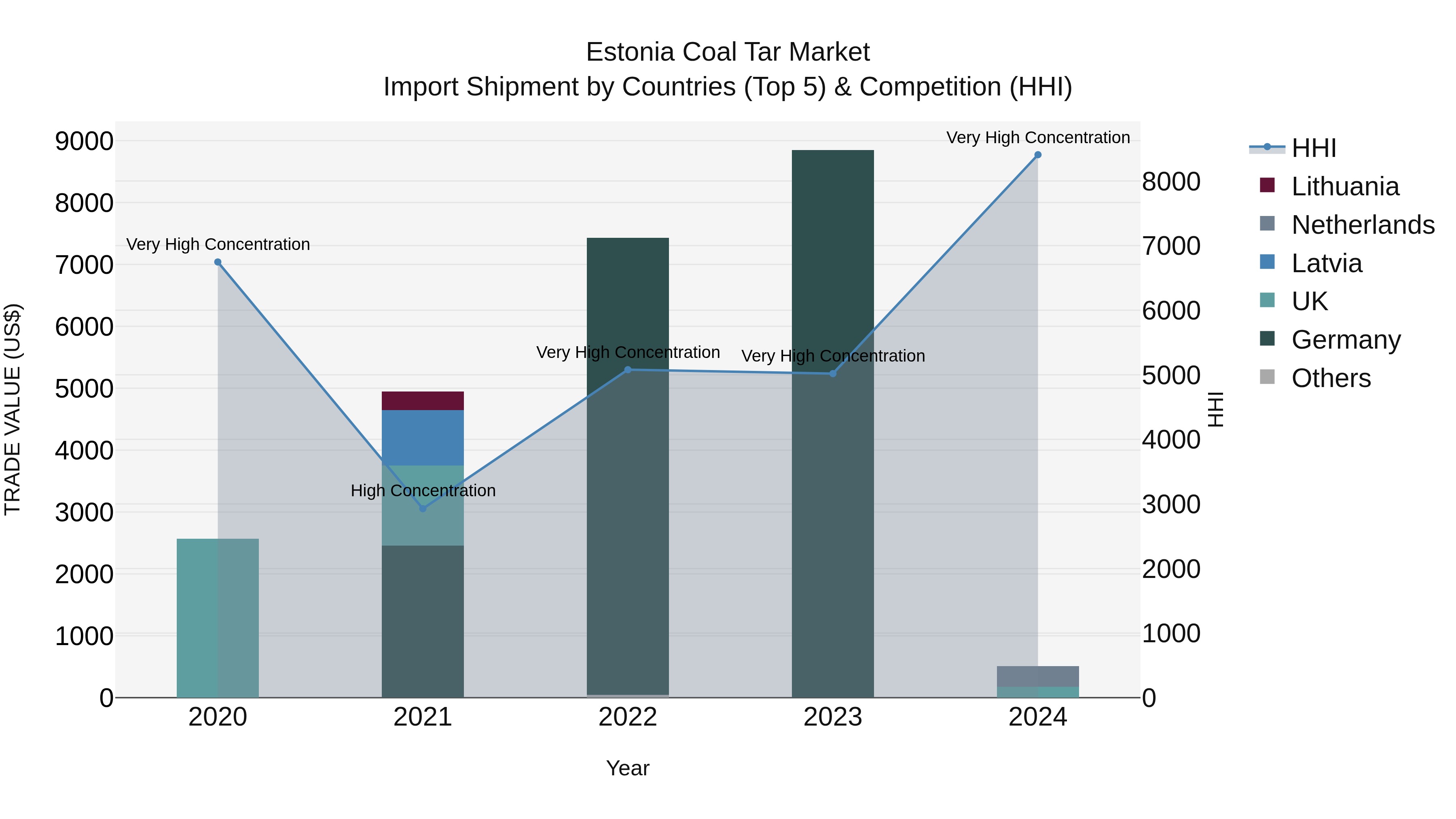
Estonia`s coal tar import shipments in 2024 continued to see a high concentration of supply from top exporters such as Netherlands, UK, Germany, Finland, and Lithuania. Despite a significant decline in the Compound Annual Growth Rate (CAGR) from 2020 to 2024 at -33.33%, the year-on-year growth rate in 2024 plummeted even further to -94.26%. The high Herfindahl-Hirschman Index (HHI) indicates a persistent market dominance by key exporting countries, posing challenges and opportunities for the Estonian coal tar import market in the coming years.
Coal Tar Market: Estonia vs Top 5 Major Economies in 2027 (Europe)
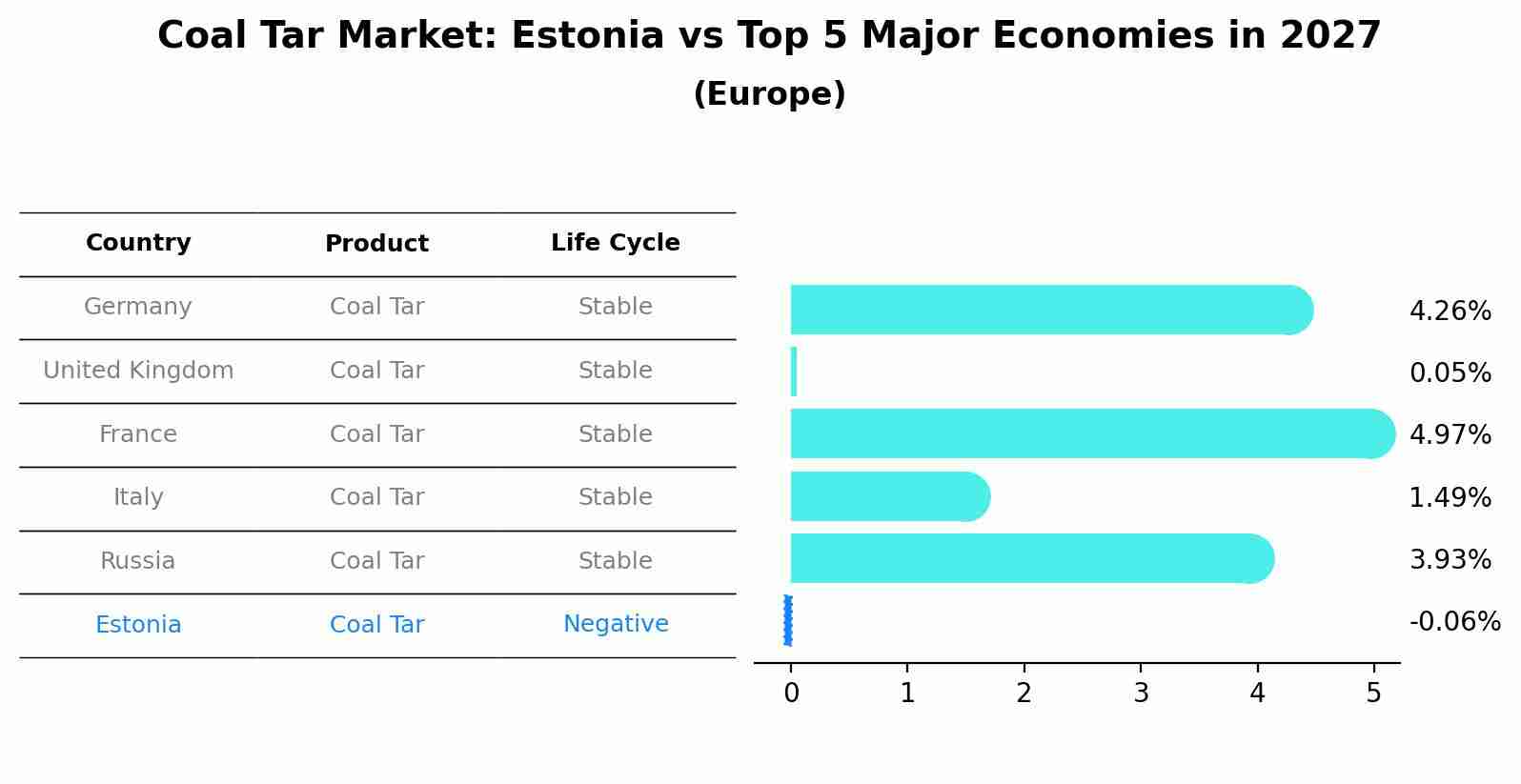
Estonia's Coal Tar market is anticipated to experience a negative growth rate of -0.06% by 2027, reflecting trends observed in the largest economy Germany, followed by United Kingdom, France, Italy and Russia.
Estonia Coal Tar Market Overview
Coal tar has applications in Estonias chemical and construction industries, particularly in waterproofing and coating. Demand remains steady, though the market is subject to environmental regulations and alternative materials.
Drivers of the market
The coal tar market in Estonia is growing due to its wide application in industries such as chemicals, construction, and steel. Coal tar is used in the production of various products, including dyes, plastics, and paving materials. The increasing demand for high-quality industrial products and the continued use of coal tar as a raw material in several manufacturing processes contribute to the market`s growth.
Challenges of the market
The Estonia Coal Tar Market faces challenges primarily related to environmental concerns and the push for greener alternatives. Coal tar is a byproduct of coal processing, and its use in various industries such as road construction and roofing is being scrutinized due to its environmental impact. The market is affected by rising regulations on the disposal and management of coal tar, especially given its potential to contaminate soil and water. The increasing focus on sustainability also drives demand for alternative materials that are less harmful to the environment, reducing the overall demand for coal tar.
Government Policy of the market
Estonias coal tar market is guided by environmental regulations aimed at reducing the harmful emissions and waste associated with coal tar production. The government enforces strict safety and pollution control standards for industries that process coal tar, such as those in the chemical and construction sectors. Policies also encourage the recycling and reuse of coal tar products, especially for use in the production of pitch and other materials. The government offers financial incentives for the development of more sustainable technologies in coal tar processing, including innovations that reduce emissions, improve efficiency, and minimize waste generation.
Key Highlights of the Report:
- Estonia Coal Tar Market Outlook
- Market Size of Estonia Coal Tar Market, 2024
- Forecast of Estonia Coal Tar Market, 2031
- Historical Data and Forecast of Estonia Coal Tar Revenues & Volume for the Period 2021-2031
- Estonia Coal Tar Market Trend Evolution
- Estonia Coal Tar Market Drivers and Challenges
- Estonia Coal Tar Price Trends
- Estonia Coal Tar Porter`s Five Forces
- Estonia Coal Tar Industry Life Cycle
- Historical Data and Forecast of Estonia Coal Tar Market Revenues & Volume By Type for the Period 2021-2031
- Historical Data and Forecast of Estonia Coal Tar Market Revenues & Volume By Low Temperature Coal Tar for the Period 2021-2031
- Historical Data and Forecast of Estonia Coal Tar Market Revenues & Volume By Medium Temperature Coal Tar for the Period 2021-2031
- Historical Data and Forecast of Estonia Coal Tar Market Revenues & Volume By High Temperature Coal Tar for the Period 2021-2031
- Historical Data and Forecast of Estonia Coal Tar Market Revenues & Volume By Application for the Period 2021-2031
- Historical Data and Forecast of Estonia Coal Tar Market Revenues & Volume By Coal Tar Pitch for the Period 2021-2031
- Historical Data and Forecast of Estonia Coal Tar Market Revenues & Volume By Carbon Black Oil for the Period 2021-2031
- Historical Data and Forecast of Estonia Coal Tar Market Revenues & Volume By Specialty Oils for the Period 2021-2031
- Historical Data and Forecast of Estonia Coal Tar Market Revenues & Volume By End-use for the Period 2021-2031
- Historical Data and Forecast of Estonia Coal Tar Market Revenues & Volume By Aluminum Industry for the Period 2021-2031
- Historical Data and Forecast of Estonia Coal Tar Market Revenues & Volume By Roofing for the Period 2021-2031
- Historical Data and Forecast of Estonia Coal Tar Market Revenues & Volume By Tire Industry for the Period 2021-2031
- Historical Data and Forecast of Estonia Coal Tar Market Revenues & Volume By Paint Industry for the Period 2021-2031
- Historical Data and Forecast of Estonia Coal Tar Market Revenues & Volume By Wood Preservation for the Period 2021-2031
- Historical Data and Forecast of Estonia Coal Tar Market Revenues & Volume By Others for the Period 2021-2031
- Historical Data and Forecast of Estonia Coal Tar Market Revenues & Volume By Marketing Channel for the Period 2021-2031
- Historical Data and Forecast of Estonia Coal Tar Market Revenues & Volume By Online for the Period 2021-2031
- Historical Data and Forecast of Estonia Coal Tar Market Revenues & Volume By Offline for the Period 2021-2031
- Estonia Coal Tar Import Export Trade Statistics
- Market Opportunity Assessment By Type
- Market Opportunity Assessment By Application
- Market Opportunity Assessment By End-use
- Market Opportunity Assessment By Marketing Channel
- Estonia Coal Tar Top Companies Market Share
- Estonia Coal Tar Competitive Benchmarking By Technical and Operational Parameters
- Estonia Coal Tar Company Profiles
- Estonia Coal Tar Key Strategic Recommendations






































